What causes IBS flare-ups? 20 triggers and how they work
One day everything hurts, and the next day nothing does. IBS flare-ups feel random, yet they follow known mechanisms and recognizable triggers.

What is an IBS flare-up, and what drives it?
A flare-up, sometimes called an IBS attack, is a temporary worsening of IBS symptoms. The mechanisms behind it are few, but the triggers that set them off are many. Recognizing your triggers is the best way to manage flare-ups over the long term. First, a short look at the three main mechanisms.
Visceral hypersensitivity
Gas or stool that stretches the gut may cause pain in a person with IBS, while a person without IBS feels little or nothing.1 Changes in the pain-signaling pathways of the nervous system are thought to be involved.
Gut spasticity
In gut spasticity, the smooth muscle of the digestive tract contracts in an abnormal way. This disturbs peristalsis, the rhythmic movement that carries food and stool along. Digestion and the passage of stool then become uneven.
Secretory dysfunction
The gut secretes fluid and electrolytes into the intestine. When this balance is off, there is too little fluid, which leads to constipation, or too much, which leads to diarrhea.
IBS flare-up symptoms
IBS is diagnosed from the pattern of symptoms. A doctor does a limited set of tests to rule out other causes, mostly when something looks unusual.2, 3 Living with IBS can feel like a guessing game, because the symptoms differ from person to person and from one flare-up to the next.
During a flare-up, people commonly have:
- abdominal pain or cramping
- bloating and gas
- diarrhea, constipation or both (see the three main IBS subtypes)
- urgency, or a feeling that the bowel is not fully empty
- mucus in the stool
- tiredness or nausea
How long does an IBS flare-up last?
There is no single agreed definition of a flare-up, so there is no exact figure either. In practice, a flare-up can last from a few hours to several days. In some people it lasts a few weeks.
The duration depends on the trigger and on how early you respond. Stress can keep a flare-up going for longer, because stress hormones act directly on gut motility and secretion.4 An early response often helps, and our guide on how to stop an IBS flare-up lists 12 steps. If symptoms last more than a few weeks or keep getting worse, see a doctor.
Causes of IBS flare-ups: 20 triggers in four groups
The main triggers of IBS flare-ups fall into four groups: immune, hormonal, dietary and environmental. Here are five from each group.

Immune triggers
Mast cells, dysbiosis, inflammatory reactions, autoimmune impact and medications.
Hormonal triggers
Cortisol, serotonin, female hormones, thyroid and MMC, and somatostatin.
Immune-related triggers
Do your symptoms get worse in allergy season? Mast cells may be the link. When an allergen activates them, they release histamine, which is a main player in allergic reactions. Activated mast cells close to gut nerves have also been linked with abdominal pain in IBS.5 Histamine can therefore make symptoms come and go with varying intensity.
The balance of the gut microbiota can tip after a course of antibiotics. Bacteria may then overgrow and produce gas and other by-products. These can irritate the gut lining and cause pain or discomfort.
Chronic stress can push the immune system to overreact, which may cause low-grade inflammation in the intestines.6 The gut can then become more sensitive to normal stimuli. This helps to explain why symptoms get worse in stressful periods.
Autoimmune disease adds another route. The immune system can damage the enteric nervous system, the gut's own network of nerves, and that disturbs the signals between gut and brain. Autoimmune disease may also make IBS more likely to develop.
Regular use of non-steroidal anti-inflammatory drugs (NSAIDs) can make IBS harder to manage. These common painkillers raise intestinal permeability, often called leaky gut.7 Substances that should stay in the gut can then reach the bloodstream and trigger an immune response. Talk to your doctor before you change any medicine.
Hormone-related triggers
Cortisol is best known for its role in the stress response. Stress hormones can change gut motility, which may worsen pain and discomfort even in people who follow a strict diet and lifestyle plan.4
Many women notice changes around their period. Hormone levels influence gut transit and pain perception, but the pattern differs from woman to woman.8 Keeping a symptom diary across the cycle can show your own pattern.
About 90% of the body's serotonin is made in the gut, and it helps to regulate bowel movements.9 Changes in serotonin signaling are linked to IBS. Some people notice more symptoms in winter, when there is less daylight. That link is still speculative.
The migrating motor complex (MMC) is a cyclic wave of electrical activity that sweeps through the gut between meals.10 Disrupted thyroid function can make it irregular. Transit times then change, and bacteria may overgrow, which can set off a flare-up.11 Thyroid hormone changes may also alter the gut-brain axis.
This hormone slows gut motility and secretion, and its drug versions are known to do so. Whether natural levels play a part in IBS flare-ups is not proven. For now it is a possible player and not an established trigger.
Diet-related triggers
FODMAPs are Fermentable Oligosaccharides, Disaccharides, Monosaccharides And Polyols. These carbohydrates occur in many foods. High FODMAP foods, such as a peach, draw water into the gut and ferment there. The result is gas and distension, and this can set off a flare-up.12 A low FODMAP diet often brings relief at first.13 Unless dysbiosis is addressed, the symptoms may come back.
Dairy products rich in lactose can make IBS worse in people with lactose intolerance or disaccharidase deficiency. Undigested lactose reaches the colon and ferments. The gas it produces leads to bloating and diarrhea.
Some people with IBS feel better without gluten. In one trial of people with self-reported non-celiac gluten sensitivity, symptoms did not follow gluten once FODMAPs were lowered.14 Fructans in wheat may be the real trigger in many cases. A different route has been described in celiac disease. There, bacteria such as Pseudomonas aeruginosa from the small intestine produce gluten fragments that provoke the immune system.15 Whether this applies to IBS without celiac disease is not established. See also Pseudomonas in stool.
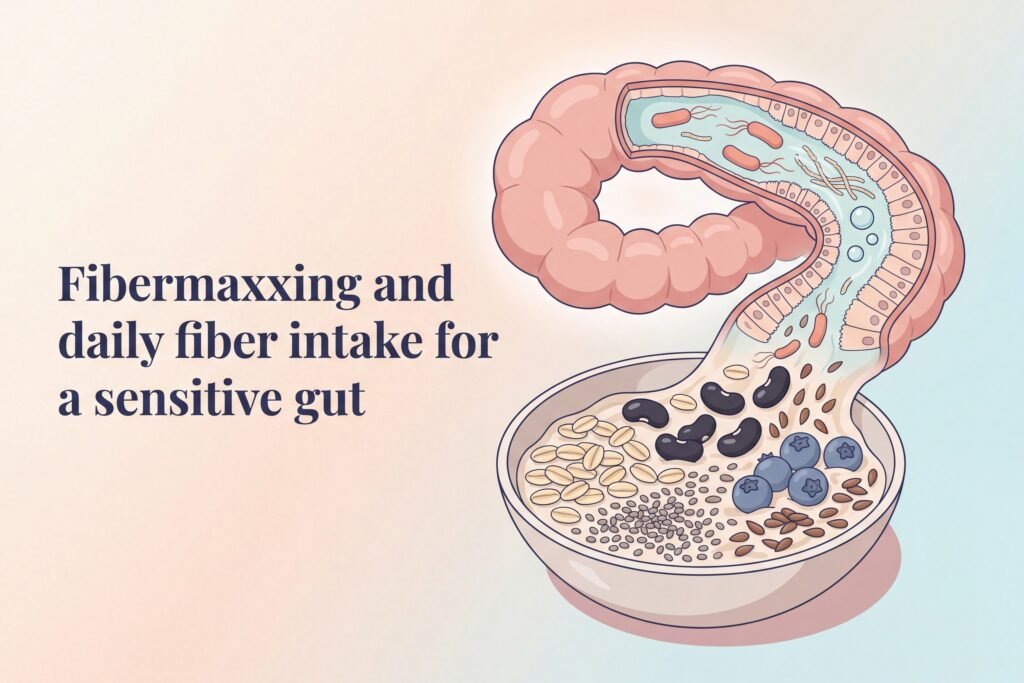
Too little fiber slows transit and leads to constipation. Too much raw, insoluble fiber can cause bloating. Soluble fiber is usually better tolerated than insoluble fiber in IBS.3 Balance is key.
Some people get diarrhea and cramping after spicy food. If this applies to you, a food diary can confirm it.
Environment-related triggers
The environment is easy to overlook, yet it is always present.
Loud, constant noise is a stressor. Stress changes gut motility, so noise may add to a flare-up in sensitive people. Direct evidence is limited.
Air pollution can cause inflammation in the body. It has been proposed to affect the gut lining as well. The evidence for IBS is limited.
Shift work disrupts sleep, and the gut follows a daily rhythm of its own. In a study of nurses, rotating shift work was linked with more IBS.16 Read more in night shift work and IBS.
Some people notice more symptoms in very hot or very cold weather. Why this happens is not clear.
Some people feel more bloating or indigestion when they fly or travel to altitude. Small studies suggest that the pressure in a plane cabin slows stomach emptying, especially after a meal rich in fiber.
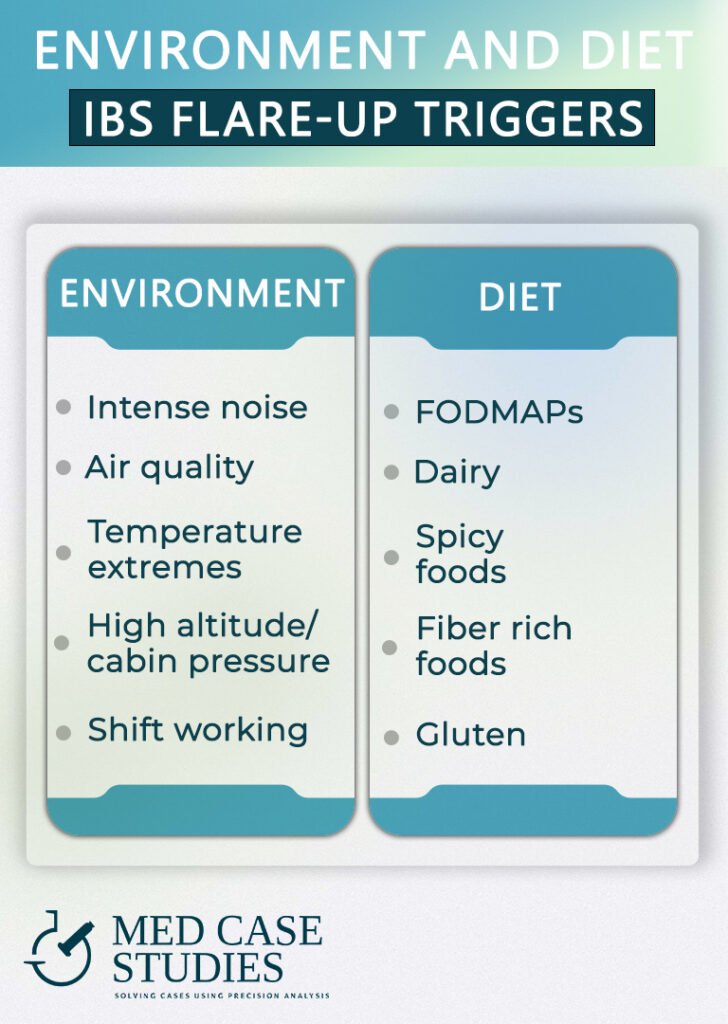
Environmental triggers
Intense noise, air quality, temperature extremes, high altitude and cabin pressure, and shift working.
Dietary triggers
FODMAPs, dairy, spicy foods, fiber rich foods and gluten.
Knowing your trigger helps to manage IBS
Knowing what sets off your flare-ups can change your daily life. It lets you plan ahead instead of reacting to each episode. A food and symptom diary helps, and so does a note about stress, sleep and your cycle. Over a few weeks, patterns usually appear.
Emmelia's case, a spring story
Emmelia is a pseudonym. The case is real, and the name was changed to protect the patient. She was seen in a clinic where I work as a scientific collaborator.
- Symptoms
She had recurring abdominal pain, bloating and unpredictable bowel habits, and they got worse in spring.
- Suspicion
Because of the seasonal pattern and her stronger reactions to some foods, mast cell activation was suspected as one possible trigger.
- Tests
Two tests were used to look for it: serum tryptase and urinary N-methylhistamine. Both are markers of mast cell activity. The results pointed to more reactive mast cells.
- Plan
Her plan then included a low-histamine, Mediterranean-style diet. It had plenty of fresh fruit and vegetables, lean protein and healthy fats, and it left out high-histamine foods such as fermented products, citrus fruit and processed food.
- Result
Six weeks later she reported less pain and discomfort.
One case cannot show that a plan works. It does show why the question "what sets off my flare-ups?" can have a different answer for each person.
Frequently asked questions
An IBS flare-up is a sudden increase in IBS symptoms. It can last from a few hours to several weeks. There is no single agreed definition, and the duration depends on the person and on the trigger.
Abdominal pain or cramping, bloating, gas, diarrhea, constipation or a mix of both. The symptoms vary in intensity and duration from person to person. Blood in the stool, unexplained weight loss, fever or symptoms that wake you at night need a medical check.
Triggers differ from person to person. Common ones are stress, certain foods and drinks, hormonal changes, and changes in routine or sleep. Identifying your personal triggers helps to manage and prevent flare-ups.
Keep a detailed food and symptom diary. Write down what you eat, your stress level, your sleep, your cycle if you have one, and any change in routine, together with your symptoms. After a few weeks, compare the entries. Patterns tend to show up.
Yes. Stress can make a flare-up more likely and longer. It is a hormonal signal of threat, and stress hormones such as epinephrine and cortisol act directly on gut motility and secretion.4
They depend on the person and on the symptoms. Common options are changes in diet, stress management, over-the-counter medicines and prescription medicines.3 For quick steps at the start of a flare-up, see how to stop an IBS flare-up.
References
16 studies
- Mertz H, Naliboff B, Munakata J, Niazi N, Mayer EA. Altered rectal perception is a biological marker of patients with irritable bowel syndrome. Gastroenterology. 1995.
- Mearin F, Lacy BE, Chang L, et al. Bowel disorders. Gastroenterology. 2016.
- Lacy BE, Pimentel M, Brenner DM, et al. ACG clinical guideline: management of irritable bowel syndrome. Am J Gastroenterol. 2021.
- Chang L. The role of stress on physiologic responses and clinical symptoms in irritable bowel syndrome. Gastroenterology. 2011.
- Barbara G, Stanghellini V, De Giorgio R, et al. Activated mast cells in proximity to colonic nerves correlate with abdominal pain in irritable bowel syndrome. Gastroenterology. 2004.
- Qin HY, Cheng CW, Tang XD, Bian ZX. Impact of psychological stress on irritable bowel syndrome. World J Gastroenterol. 2014.
- Bjarnason I, Hayllar J, MacPherson AJ, Russell AS. Side effects of nonsteroidal anti-inflammatory drugs on the small and large intestine in humans. Gastroenterology. 1993.
- Heitkemper MM, Chang L. Do fluctuations in ovarian hormones affect gastrointestinal symptoms in women with irritable bowel syndrome? Gend Med. 2009.
- Gershon MD, Tack J. The serotonin signaling system: from basic understanding to drug development for functional GI disorders. Gastroenterology. 2007.
- Deloose E, Janssen P, Depoortere I, Tack J. The migrating motor complex: control mechanisms and its role in health and disease. Nat Rev Gastroenterol Hepatol. 2012.
- Lauritano EC, Bilotta AL, Gabrielli M, et al. Association between hypothyroidism and small intestinal bacterial overgrowth. J Clin Endocrinol Metab. 2007.
- Murray K, Wilkinson-Smith V, Hoad C, et al. Differential effects of FODMAPs (fermentable oligo-, di-, mono-saccharides and polyols) on small and large intestinal contents in healthy subjects shown by MRI. Am J Gastroenterol. 2014.
- Halmos EP, Power VA, Shepherd SJ, Gibson PR, Muir JG. A diet low in FODMAPs reduces symptoms of irritable bowel syndrome as compared with a typical Australian diet. Gastroenterology. 2014.
- Biesiekierski JR, Peters SL, Newnham ED, et al. No effects of gluten in patients with self-reported non-celiac gluten sensitivity after dietary reduction of fermentable, poorly absorbed, short-chain carbohydrates. Gastroenterology. 2013.
- Caminero A, Galipeau HJ, McCarville JL, et al. Duodenal bacteria from patients with celiac disease and healthy subjects distinctly affect gluten breakdown and immunogenicity. Gastroenterology. 2016.
- Nojkov B, Rubenstein JH, Chey WD, Hoogerwerf WA. The impact of rotating shift work on the prevalence of irritable bowel syndrome in nurses. Am J Gastroenterol. 2010.
Found this useful? Share it with someone who needs it.
Cite this article
Prevedoros, T. (2023, June 3). What causes IBS flare-ups? 20 triggers and how they work. Gut Pathways. https://gutpathways.com/articles/causes-ibs-flare-up/