Why IBS can start after antibiotics and how long it lasts
After a stomach bug, antibiotics are one of the most common sparks, so IBS after antibiotics is a familiar story. Each drug leaves its own fingerprint on the microbiome, which is why generic "gut-healing" tips often fall flat.
How do antibiotics cause IBS?
Large studies link antibiotic use with a later diagnosis of IBS. In a nationwide Swedish study, people who had used antibiotics had more than twice the odds of IBS. The more courses, the higher the odds: 1 to 2 courses raised them by about two thirds, while 3 or more courses raised them more than threefold, whatever the class of antibiotic.1
As described in IBSyncrasy, each drug leaves its own "microbial fingerprint", so the fallout is not the same for everyone. Four mechanisms explain most of it.
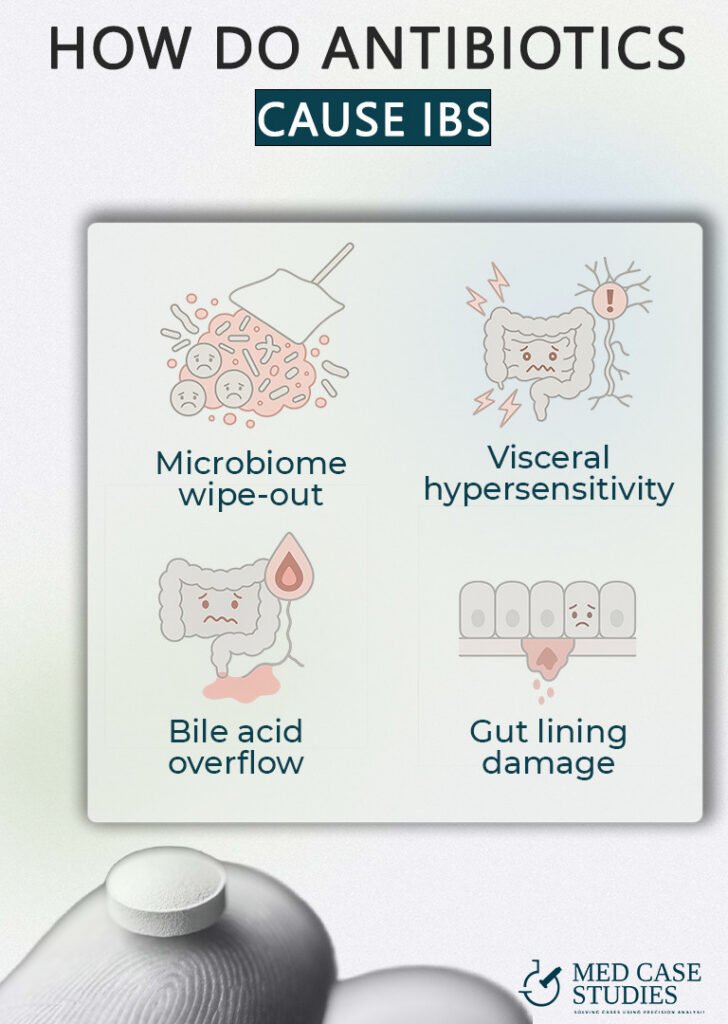
Microbiome wipe-out
Antibiotics can lead to IBS by wiping out the microbiome.
Visceral hypersensitivity
Antibiotics can lead to IBS through visceral hypersensitivity.
Bile acid overflow
Antibiotics can lead to IBS through bile acid overflow.
Gut lining damage
Antibiotics can lead to IBS through damage to the gut lining.
Microbiome wipe-out
Broad-spectrum antibiotics do not only hit the germ that made you sick. They also reduce the helpful microbes that keep gas producers and toxin makers in check. When the helpful strains thin out, fast-growing species move in and change the way food ferments. This sets the stage for bloating and irregular stools.
Visceral hypersensitivity
Gut nerves rely in part on short-chain fatty acids from helpful microbes. When those microbes disappear, the nerves may fire at weaker stimuli, so normal digestion can feel painful. In mice, an antibiotic alone lowered the pain threshold of the gut, and a single Lactobacillus strain brought it back towards normal.2
Bile acid overflow
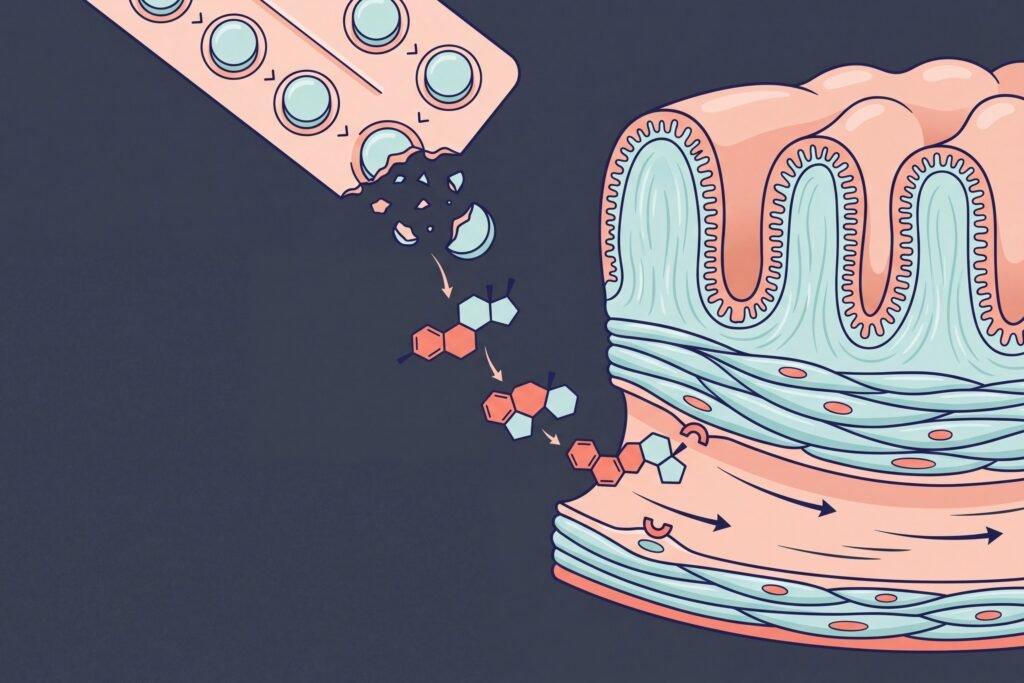
Some antibiotics remove the bacteria that turn primary bile acids into milder secondary forms. Extra primary bile acids then reach the colon, draw in water and speed up transit, which leads to the loose stools of IBS-D. Research on the gut microbiota and bile acid axis in IBS-D supports this route.3 The mechanism is similar to the one behind IBS after gallbladder removal.
Gut lining damage
Some cephalosporins, such as ceftriaxone, may thin the mucus layer and loosen the tight junctions between cells. In rats, a short course of ceftriaxone disrupted the intestinal barrier.4 A leaky barrier and low-grade inflammation can keep the bowel swinging between sluggish and urgent.
IBS symptoms after antibiotics
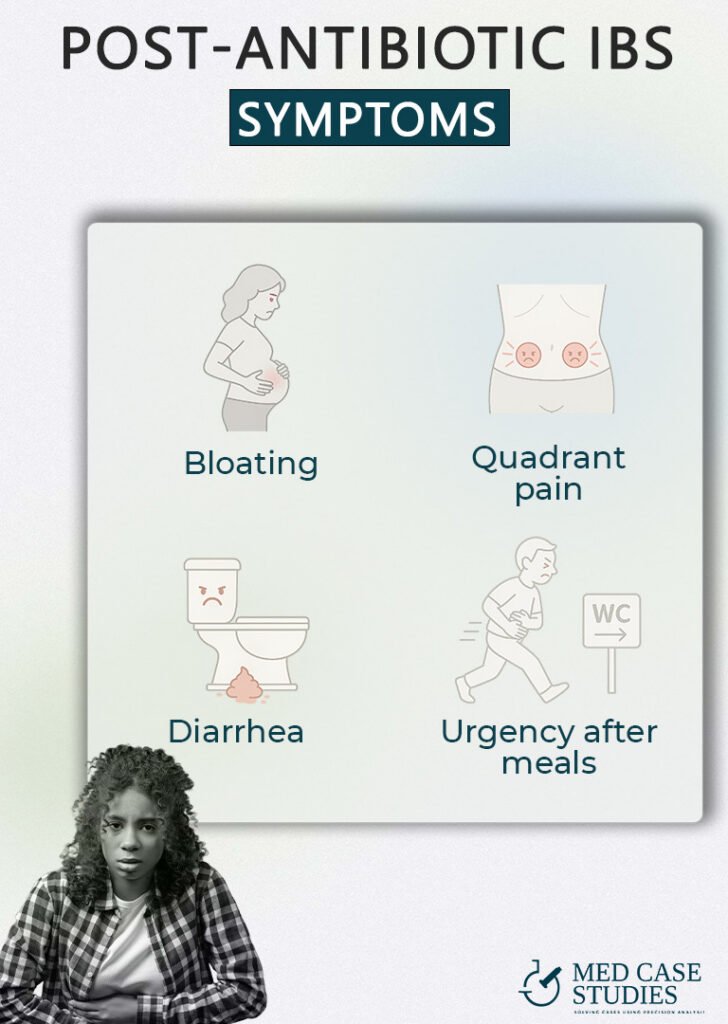
Bloating
Bloating is a typical symptom of IBS after antibiotics.
Quadrant pain
Quadrant pain is a typical symptom of IBS after antibiotics.
Diarrhea
Diarrhea is a typical symptom of IBS after antibiotics.
Urgency after meals
Urgency after meals is a typical symptom of IBS after antibiotics.
Bloating
When broad-spectrum drugs empty out the "old-growth" microbes, fast-growing fermenters take the leftover food. They produce extra hydrogen and methane, and the abdomen feels tight by late afternoon. Shifts in gut bacteria have been linked with bloating and distension.5
Pain under the left or right ribs
Gas can rise and stall at the two bends of the colon: the splenic flexure on the left and the hepatic flexure on the right. Pressure at these "bottlenecks" may cause sharp, local aches that often ease after a belch or a bowel movement. Splenic flexure syndrome, long seen as a relative of IBS, is the textbook example.
Diarrhea
When the bacteria that convert primary bile acids are lost, extra bile reaches the colon, draws in water and speeds up transit. The result is urgent, watery stools that can feel like a stomach bug. Bile acid diarrhoea is common in IBS-D and can follow an infection, which supports this route.6
Urgency after meals
Many people describe a "must go now" feeling within minutes of eating. This is the gastrocolic reflex, the normal signal that moves the colon after a meal. In IBS the reflex can be exaggerated, so normal waves of movement turn into a rush to the bathroom.7
How long does IBS after antibiotics last?
The timeline varies a lot. For some people the gut settles within a week, and for others the effects last for months or even a year. Changes in the gut microbiome can last for weeks or even months after the last pill,8 especially when the loss of diversity was large at the start.
Why some cases clear quickly and others drag on
Depth of the disruption
A short, narrow-spectrum course may remove a few species. A broad combination can empty whole microbial neighborhoods and leave the colon sensitive for much longer.
Who moves in next
Opportunists can take the free space. Klebsiella oxytoca can bloom after amoxicillin-clavulanate, and its toxin can cause hemorrhagic colitis.9 Citrobacter freundii is another opportunist that is sometimes found in people who stay bloated.
Host factors
Age, baseline stress and acid-suppressing drugs taken at the same time influence how fast the helpful bacteria take back their space and how stable the community stays afterward.
Three typical recovery arcs
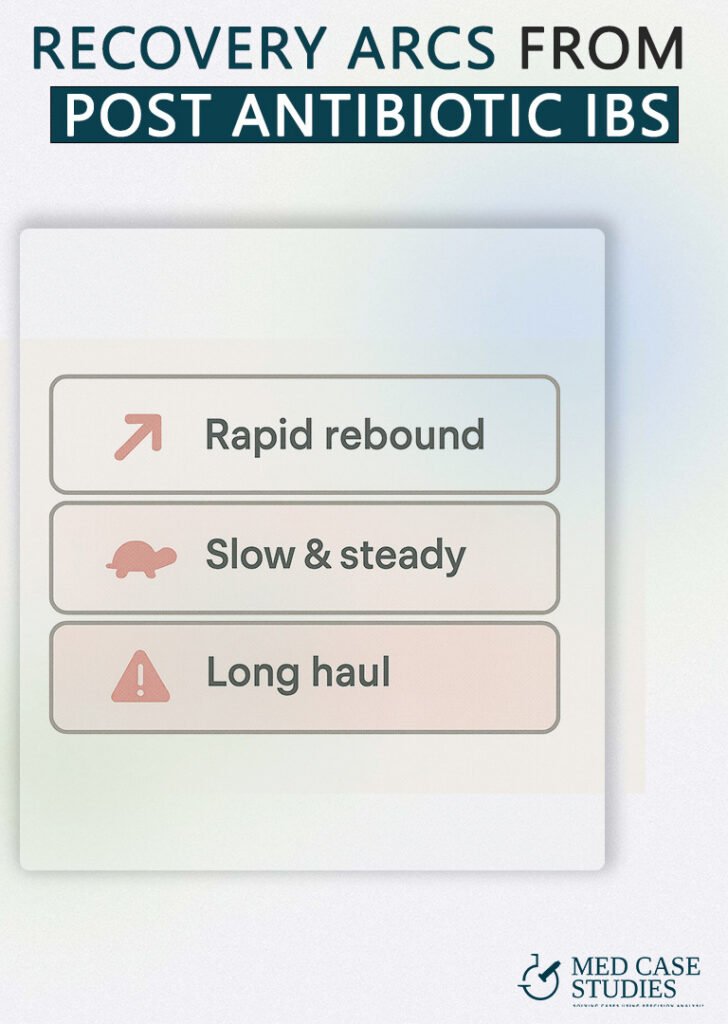
Rapid rebound
Rapid rebound is one recovery arc from post-antibiotic IBS.
Slow and steady
Slow and steady is one recovery arc from post-antibiotic IBS.
Long haul
Long haul is one recovery arc from post-antibiotic IBS.
- DaysRapid reboundmild imbalance, quick return of diversity, little sensitization of the nerves
- 6 to 12 weeksSlow and steadythe most common pattern. Pain eases and stools settle as the microbiome rebuilds
- 6+ monthsLong hauldeep disruption, lasting overgrowth of Klebsiella, Citrobacter or similar strains, and nerves that stay sensitive
So no clock fits everyone. The bigger the microbial shake-up, the longer digestion takes to feel normal again, and the more carefully it is worth watching which bacteria gain the upper hand.
How different antibiotics affect your microbiome
The effect of antibiotics on the gut microbiota is one reason people develop IBS, including the stubborn post-infectious IBS that appears weeks after the first bug is gone. Here is how four groups of antibiotics can set the stage for lasting symptoms.
Amoxicillin-clavulanate, ampicillin
What they hit: mostly the walls of Gram-positive bacteria, although broad combinations also reach Gram-negatives.
What it means for the gut: helpful Bacteroides and other bacteria can drop, while Klebsiella oxytoca can surge. This bacterium makes a toxin that inflames the colon and can cause bloody diarrhea and cramps within days of starting the antibiotic.9
How long it stays: the drug and its by-products remain in the stool for several days, which gives opportunists time to settle.
Azithromycin, erythromycin
What they hit: the 50S ribosome of bacteria. They also mimic the gut hormone motilin, so they speed up gut contractions.
What it means for the gut: diversity drops and Enterobacteriaceae can rise. In mice, azithromycin changed the gut microbiota.10 Bile acid recycling may stall as well, which can lead to loose stools and gas.
How long it stays: the drug concentrates in bile. Urgency often peaks a day or two after the last pill.
Ciprofloxacin, levofloxacin
What they hit: DNA gyrase in many Gram-negative and some Gram-positive bacteria.
What it means for the gut: in healthy volunteers, ciprofloxacin changed the abundance of a large share of gut bacteria. Most of the community recovered within weeks, but the recovery was incomplete, and repeated courses left lasting changes.11 Some reports describe a large drop in Bifidobacterium and a rise of the mucus-loving Akkermansia.
How long it stays: the drug can be found in the stool for several days, long enough to select resistant E. coli.
Clindamycin
What it hits: anaerobic Gram-positive bacteria, through the 50S ribosome. It removes much of the colon's protective Bacteroides layer.
What it means for the gut: after a 7-day course, changes in Bacteroides could still be found up to two years later.12 The gap it leaves favors Clostridioides difficile, or months of bloating and changing stool forms.
How long it stays: both the drug and the gap it leaves last. The risk of C. difficile stays raised for at least a month.
What recovery tends to look like
In the clinics where I work as a scientific collaborator, many people come convinced that a "quick" antibiotic course left them worse off than the first infection. Recovery is usually gradual. With a full plan of diet, chosen probiotics and, where a doctor finds it suitable, a short course of a non-absorbed antibiotic, the first small improvements often appear within the first weeks. Steady day-to-day comfort tends to come later, often around the sixth week.
What the studies show
Response can start early
In the rifaximin trials for IBS-D, more people responded than on placebo as early as one week after a 2-week course, and the difference lasted for at least five weeks.13
Adherence matters
In a real-life study of a probiotic in IBS, 60% took the full course. The main reasons for stopping were the price, mild side effects (mainly bloating) and the taste.14
New infections can set it back
After a norovirus outbreak in Italy carried by drinking water, 13% of the people who fell ill developed post-infectious IBS.15 Some people notice that their symptoms return in winter, when norovirus is common.
A long low FODMAP diet has a cost
A strict low FODMAP diet can ease gas within days, but it lowers bifidobacteria.16 Less fuel for short-chain fatty acids may keep the nerves excitable, so foods are best reintroduced once symptoms settle.
Deep wipe-outs last
In people who had a stem cell transplant, antibiotics changed the gut microbiome deeply, and some groups of bacteria were still missing months later.17
Repeat courses can work
When IBS-D symptoms returned after rifaximin, a repeat course was safe and effective in a large trial.18
When recovery drags past two months, stool tests often show one of two patterns: runaway Enterobacteriaceae after earlier broad-spectrum courses, or a microbiome still missing key species. In those cases, looking for hidden infections and reviewing earlier antibiotic choices is the next logical step.
Frequently asked questions
Antibiotic use is linked with a higher risk of IBS. In a large Swedish study, people who had used antibiotics had more than twice the odds of a later IBS diagnosis, and the odds rose with the number of courses.1
It varies. Some people recover within days, many within 6 to 12 weeks, and some need more than six months. Changes in the microbiome can last for weeks or months after the last pill.8
They may help some people, but the effect depends on the strain. In mice, one Lactobacillus strain reversed the gut pain caused by an antibiotic.2 In people, the choice of strain matters, so it is best discussed with a doctor.
References
18 studies
- Staller K, Olén O, Söderling J, et al. Antibiotic use as a risk factor for irritable bowel syndrome: results from a nationwide, case-control study. Aliment Pharmacol Ther. 2023.
- Verdú EF, Bercik P, Verma-Gandhu M, et al. Specific probiotic therapy attenuates antibiotic induced visceral hypersensitivity in mice. Gut. 2006.
- Zhan K, Wu H, Xu Y, et al. The function of the gut microbiota-bile acid-TGR5 axis in diarrhea-predominant irritable bowel syndrome. mSystems. 2024.
- Zou W, Liu Y, Zhang W, et al. Short-term use of ceftriaxone sodium leads to intestinal barrier disruption and ultrastructural changes of kidney in SD rats. Ren Fail. 2023.
- Crucillà S, Caldart F, Michelon M, et al. Functional abdominal bloating and gut microbiota: an update. Microorganisms. 2024.
- Farrugia A, Arasaradnam R. Bile acid diarrhoea: pathophysiology, diagnosis and management. Frontline Gastroenterol. 2021.
- Malone JC, Thavamani A. Physiology, gastrocolic reflex. StatPearls. 2023.
- Suvvari TK, Vallurupalli V, Koneru KS, et al. The lasting imprint of antibiotics on gut microbiota: exploring long-term consequences and therapeutic interventions. Cureus. 2025.
- Youn Y, Lee SW, Cho HH, et al. Antibiotics-associated hemorrhagic colitis caused by Klebsiella oxytoca: two case reports. Pediatr Gastroenterol Hepatol Nutr. 2018.
- Li R, Wang H, Shi Q, et al. Effects of oral florfenicol and azithromycin on gut microbiota and adipogenesis in mice. PLoS One. 2017.
- Dethlefsen L, Relman DA. Incomplete recovery and individualized responses of the human distal gut microbiota to repeated antibiotic perturbation. Proc Natl Acad Sci U S A. 2011.
- Jernberg C, Löfmark S, Edlund C, et al. Long-term ecological impacts of antibiotic administration on the human intestinal microbiota. ISME J. 2007.
- Lacy BE, Chang L, Rao SSC, et al. Rifaximin treatment for individual and multiple symptoms of irritable bowel syndrome with diarrhea: an analysis using new end points. Clin Ther. 2023.
- Laterza L, Napoli M, Petito V, et al. Evaluation of tolerability and major factors affecting the adherence to probiotic therapy in patients with irritable bowel syndrome: a prospective, observational, real-life study. Minerva Med. 2023.
- Zanini B, Ricci C, Bandera F, et al. Incidence of post-infectious irritable bowel syndrome and functional intestinal disorders following a water-borne viral gastroenteritis outbreak. Am J Gastroenterol. 2012.
- Staudacher HM, Lomer MCE, Farquharson FM, et al. A diet low in FODMAPs reduces symptoms in patients with irritable bowel syndrome and a probiotic restores Bifidobacterium species: a randomized controlled trial. Gastroenterology. 2017.
- Nakagaki M, Hajkowicz K, Roberts JA, et al. Cause and effect? A review of the impact of antibiotics on the gut microbiome in patients undergoing hematopoietic stem cell transplantation. Expert Rev Anti Infect Ther. 2025.
- Lembo A, Pimentel M, Rao SS, et al. Repeat treatment with rifaximin is safe and effective in patients with diarrhea-predominant irritable bowel syndrome. Gastroenterology. 2016.
Found this useful? Share it with someone who needs it.
Cite this article
Prevedoros, T. (2025, August 10). Why IBS can start after antibiotics and how long it lasts. Gut Pathways. https://gutpathways.com/articles/ibs-after-antibiotics/