GutPathways Take the quiz
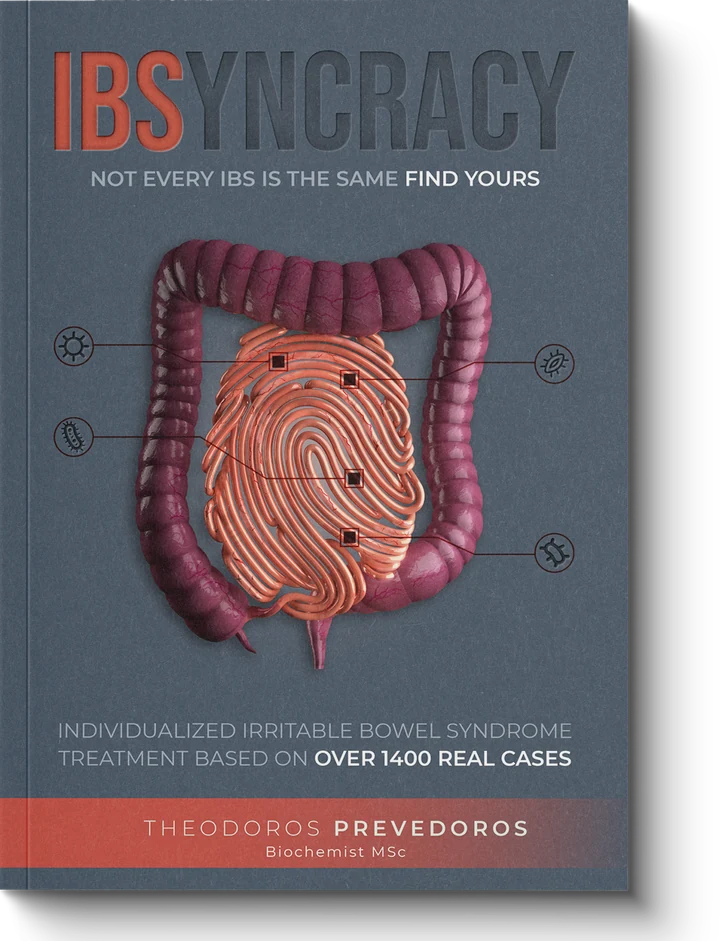
Cover of the book IBSyncrasy

IBSyncrasy

Same symptoms, UNIQUE

Not every IBS is the same. IBSyncrasy explains how the gut works, then walks through ten patterns that show why symptoms differ from person to person.

  • 308 pages
  • Kindle and paperback
  • 7 December 2024
  • By Theodoros Prevedoros

The idea behind the title

IBS and idiosyncrasy share the letter S, so the two words become one title.

idiosyncrasy /ˌɪdɪəˈsɪŋkrəsi/ noun

A way of reacting that belongs to one person and differs from how most other people react.

From the Greek ίδιος (idios), "one's own", and σύγκρασις (synkrasis), "a blending together".

Same symptoms, unique people

IBS is a name for a group of symptoms. The name does not say why the symptoms appear.

The usual subtypes sort people into three groups by their stool pattern, and the gut is more varied than that. IBSyncrasy follows the biochemistry behind the symptoms, and shows ten patterns that can stand behind the same complaint.

  • Constipation
  • Flatulence
  • Abdominal pain
  • Gas
  • Diarrhea
  • Cramps
  • Indigestion
  • Bloating
  • Movement inconsistency

Nine common symptoms: constipation, flatulence, abdominal pain, gas, diarrhea, cramps, indigestion, bloating, movement inconsistency. All of them can carry one label.

  • Post-infectiousWhen everything started after that gastroenteritis.
  • Post-cholecystectomyGut changes after gallbladder removal.
  • ProteusGlutamine is not always an ally.
  • PseudomonasWhen gluten does not cause celiac disease.
  • ProstatitisThe gut-prostate connection in men.
  • Exocrine pancreatic insufficiencyThe metabolic face of IBS.
  • PPI-inducedThe gut effects of long-term acid blockers.
  • sIgA deficiencyMy mama's antibodies are better than yours.
  • SIBO-IBSEating whenever you want is not your choice.
  • PediatricC-section, lack of breastfeeding, early antibiotics.

A pattern shows how a condition can look. It does not predict what will happen in another person.

Demographics, biochemistry, lifestyle, medical history and genetics all shape how a symptom shows up in one person.

IBS is not one disease. It is not even a few diseases. It is a spectrum of symptoms that comes from each person's individuality.

A few things the book takes apart

Bloating ten minutes after a meal?

The food you just ate is about eight meters upstream from the place of the bloating, so it cannot have produced the symptom.

A feeling that something is left behind after the toilet?

Most of the time it is not stool that was left behind. Specific neurotransmitters keep sending the same sensation.

Cranky two hours after eating?

Hunger is a hormonal signal, and it cannot start that soon. Have you checked your parasympathetic activation?

The same safe food gave no trouble yesterday and gives belly pressure today?

The food stayed the same. Your microbiome did not.

What you will find in the book

The theory

  • How digestion works in real life, and not in textbooks
  • Why not eating is as important as eating
  • How your gut is connected with all your organs
  • Why you should treat your gut like an organ that resides outside your body, like your skin (Hint: it does)
  • Food is not the problem, merely the messenger of the symptom
  • How time is imprinted within our genome and dictates digestion

The practice

  • How to recognize your own IBSyncrasy
  • What you may have in common with other people who have the same symptoms
  • Which tests are worth discussing with your doctor, and why
  • How a care plan can differ from one pattern to the next
  • Which everyday habits can support a care plan
  • How to keep track of your symptoms over time

Buy on Amazon

What is inside

Section A explains how the gut works, in three chapters. Section B follows ten patterns, one case study each.

  1. Gastrointestinal biochemistryFrom advanced biochemistry to 4,500 histories

    Why the gut cannot be reduced to a textbook definition, and how one symptom can come from many different molecular changes.

    Biochemistry data mining

    Lab biochemistry, read together with the symptoms, shows which systems deserve a closer look.

    Storytelling

    How a person tells the story of their symptoms matters, and so does how a plan is explained back.

  2. It's NOT all in your headStress is an aggravating factor, not the cause

    Stress makes symptoms louder without being their root. The chapter also explains why "it is all in your head" is not an answer.

  3. ModulesFive everyday tools that can sit beside a care plan
    Stop all-day eatingYour gut has its own stopwatch

    Between meals the gut sweeps itself clean, but only if it gets several hours without food to do it.

    Humans are four-dimension creaturesTime is imprinted in our genes

    Clock genes in our cells regulate much of our biochemistry, digestion included. Light, darkness and meal times matter.

    Precision testingDifferent tests tell different stories

    Most routine tests exclude other diseases. The book looks at which samples can say more, and what each one cannot show.

    Fiber upYour gut is vegetarian

    Fiber can cause bloating. At the right pace and in the right kind, it feeds the microbes of the colon.

    Choosing probiotics with a reasonA random probiotic is a gamble

    Strain, dose and the place in the gut where it settles all matter. Details of your history help to decide which one makes sense.

Section B: ten case studies

Every case study follows the same eight stops. That makes the patterns easy to compare.

  1. Demographics

    Who it concerns

  2. Introduction

    What the pattern is

  3. Meeting

    The history people bring

  4. Diagnostics

    Which tests, and why

  5. Results

    Every result in plain words

  6. Care plan

    How the approach changes

  7. Follow-up

    How a plan is adjusted

  8. Conclusion

    Why it is an individual IBSyncrasy

The ten patterns

  • Post-infectious

    When everything started after that gastroenteritis.

    • dysbiosis
    • visceral hypersensitivity
  • Post-cholecystectomy

    Gut changes after gallbladder removal.

    • altered gut pH
    • reduced fat absorption
  • Proteus

    Glutamine is not always an ally.

    • recurrent UTIs
    • glutamine supplements
  • Pseudomonas

    When gluten does not cause celiac disease.

    • pet owners
    • leaky gut
  • Prostatitis

    The gut-prostate connection in men.

    • chronic antibiotics
  • Exocrine pancreatic insufficiency

    The metabolic face of IBS.

    • insulin resistance
    • obesity
  • PPI-induced

    The gut effects of long-term acid blockers.

    • dysbiosis
    • altered gastrocolic reflex
  • sIgA deficiency

    My mama's antibodies are better than yours.

    • frequent infections
    • alcohol
  • SIBO-IBS

    Eating whenever you want is not your choice.

    • SIBO
    • altered MMC
  • Pediatric

    C-section, lack of breastfeeding, early antibiotics.

Ten patterns. Swipe sideways, or use the left and right arrow keys.

Read the first pages for free

See the writing and the way the book explains, before you decide.

Portrait of Theodoros Prevedoros

Theodoros Prevedoros

The cases in this book come from my experience as a scientific associate of medical practices, working alongside gastroenterologists, pediatricians, endocrinologists and other specialists since 2007. I am a biochemist (MSc, National and Kapodistrian University of Athens). I write about mechanisms, so that a reader can see what may be going on and talk about it with their own doctor.

More about the author

Get new articles by email

Leave your email to get occasional new articles. Unsubscribe any time.

Buy IBSyncrasy on Amazon