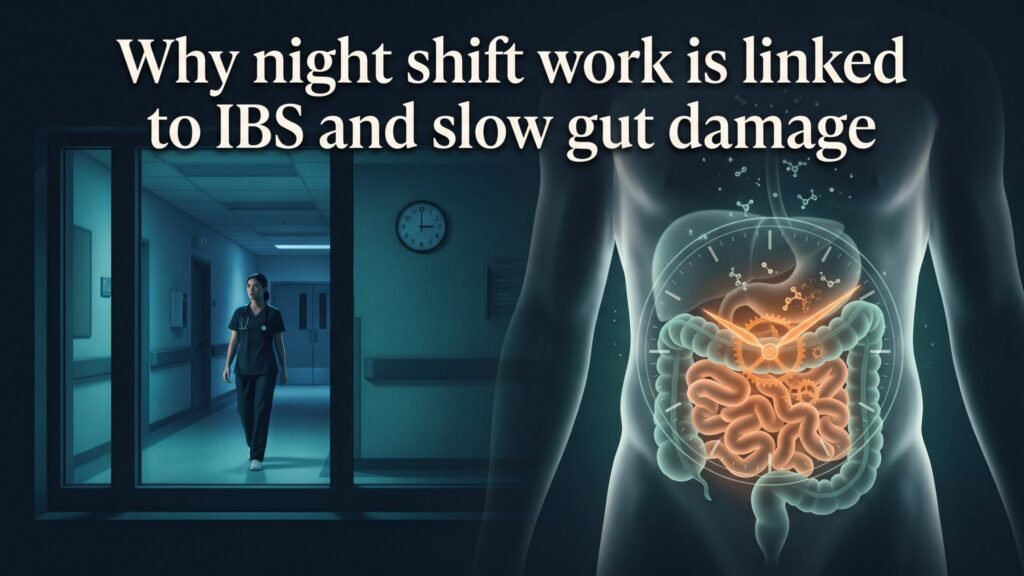
Why night shift work is linked to IBS and slow gut damage
Your gut runs on a circadian schedule, and night shifts pull it out of step. Shift work and IBS now show up together in studies of hundreds of thousands of workers, and the link goes well beyond stress or canteen food. Here is what years of rotating and night shifts can do to your gut, and what still protects it.
What is the connection between night shift work and IBS risk?
Night shift work and IBS are connected through a misaligned body clock, and this is one of the most replicated findings in occupational gastroenterology. In a 2022 meta-analysis of eight observational studies, shift workers had 81% higher odds of irritable bowel syndrome than colleagues on regular day schedules.1 The authors still called the strength of the evidence limited, because most studies looked at one point in time.
Since then, large UK Biobank cohorts have followed workers for years. People who always worked nights had a 36% higher risk of a new IBS diagnosis over a median of nine years.2 In a second analysis of 239,760 workers, risk rose from day workers to occasional night workers to permanent night workers.3 Rotating schedules, the kind that never let the body adapt, look worst of all.
IBS prevalence by work schedule in 399 US nurses
Nojkov 2010, Rome III criteria. Only the rotating versus day difference was statistically significant.
In that study of nurses, rotating schedules went with 2.14 times higher odds of IBS than day work, after adjustment for age, sex and sleep quality.7 Abdominal pain drove much of the difference, reported by 81% of rotating-shift nurses against 54% of day nurses. The link survived adjustment for sleep quality, so something about the schedule itself, beyond lost sleep, seems to push the gut toward IBS.
What 2026 data show in night shift workers
A 2026 study in Clinical Gastroenterology and Hepatology surveyed 392 night shift workers in Australia and the United Kingdom, all working at least eight shifts a month between 11 pm and 3 am. 21.3% met the Rome IV criteria for IBS and 30.4% for functional dyspepsia.4 For comparison, IBS affects about 3.8% of adults worldwide under the same Rome IV criteria.8
Not every study agrees on the schedule itself. In 1,335 Norwegian nurses, IBS tracked with insomnia, daytime sleepiness and shift work disorder, while night work on its own was not linked to IBS.9 Taken together, the data point to the body clock and the sleep it protects as the common thread.
How does shift work disrupt your gut's hormones and neurotransmitters?
Night work disrupts digestion at the level of its chemical messengers. Melatonin, cortisol, serotonin, motilin, bile acids and pancreatic enzymes all keep a circadian rhythm. Local clocks in the gut drive the daily rhythm of digestion, absorption, motility and hormone release, and light, sleep and meal times keep them in step.5, 6 Night work can flatten, delay or mistime every one of these signals.
Each mediator fails in its own way. Some go quiet when they should peak, others fire at the wrong hour, and the gut loses the coordinated maintenance it evolved to expect at night. These are the six that break first.

Melatonin, the night foreman
The gut holds far more melatonin than the pineal gland, and the hormone supports the renewal of the lining.10 Light at night and a delayed bedtime blunt its peak, so the repair crew may start late and finish early.

Cortisol, the inverted curve
Cortisol should peak in the morning and fall at night. Weeks of circadian misalignment lowered cortisol and raised inflammatory proteins in a laboratory study, which may loosen the junctions between gut cells at the very hours they should seal.11

Serotonin, the pain dial
About nine tenths of the body's serotonin is made in the gut, where it sets bowel speed and visceral pain sensitivity.12 Disrupted release may help explain why abdominal pain dominates in shift workers, more than bowel change.

Motilin and the night cleaner
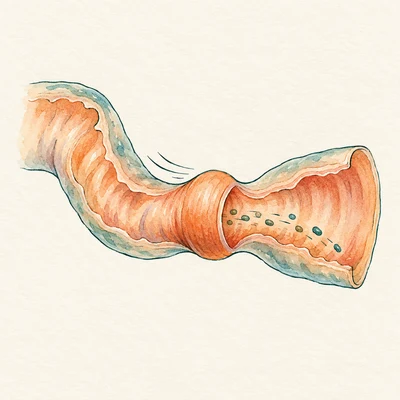
Between meals, motilin fires the migrating motor complex, the wave that sweeps leftovers and bacteria down the small bowel. The wave runs slower at night, and a meal interrupts it, so a 3 a.m. snack stops it.13

Bile acids, a mistimed detergent
Bile release follows the feeding clock. Eating at midnight sends bile into a bowel that expected fasting, which may irritate the lining and draw water into the colon, with urgency and loose stools as a result.

Pancreatic enzymes, the tired workhorse
The pancreas carries its own clock and gears up for daytime meals. In practice, falling pancreatic elastase in stool is one of the first measurable changes I see in people who have eaten at night for years.
Day schedule (outer ring)Night-shift schedule (inner ring)
- Melatonin Day schedule 03:00, Night-shift schedule no clear peak. Peaks in the dark hours on a day schedule. Light during a night shift blunts the peak, so the repair signal stays weak.
- Cortisol Day schedule 07:00, Night-shift schedule no clear peak. Should rise in the morning and fall at night. Weeks of a misaligned clock lowered and flattened it in a laboratory study.
- Stomach acid Day schedule 00:00, Night-shift schedule 00:00. Secretion peaks around midnight. On a night shift the peak stays where it is, and the 3 a.m. meal lands on top of it.
- Cleaning wave (MMC) Day schedule 14:00, Night-shift schedule no clear peak. The wave travels faster by day than at night. A snack during the shift interrupts it, so the night sweep may not run.
- Bile acids Day schedule 13:00, Night-shift schedule 03:00. Bile release follows meal times. Eating mid-shift sends bile into a bowel that expected fasting.
- Pancreatic enzymes Day schedule 13:00, Night-shift schedule 03:00. The pancreas gears up for daytime meals. On night shifts it is asked to work at its quietest hour.
A schematic picture built from the article's sources, not measured times for any one person. Serotonin is left out because its daily peak is not clear in the sources.
On its own, each hit looks small. Together they may explain why a gut that worked fine at 25 starts complaining at 40. In the laboratory, acute sleep loss raised cortisol, while weeks of a misaligned clock lowered it and raised TNF-alpha and C-reactive protein.11 The gastrointestinal tract runs on anticipation, and anticipation is the first casualty of a rotating roster.
The small intestine's cleaning wave slowed from 6.4 cm per minute by day to 2.9 cm per minute at night in healthy volunteers, and the same drop appeared in people with IBS.13
Why is night-time repair so important for your gut lining?
Your gut lining follows a daily rhythm of renewal, and the night hormones act as project managers. While you sleep, melatonin rises, tight junction proteins are rebuilt, goblet cells refresh the mucus layer and stem cells in the crypts divide to restock the surface. Interrupt that window often enough and the barrier may thin. This is where the link between shift work and IBS becomes physical.

An efficient mucosa stands between your microbiome and dysbiosis. As long as the barrier works, bacteria stay in the lumen, their metabolites feed the lining and the ecosystem holds its balance. When repair lags, bacterial products can slip through, immune cells react and the composition of the microbiome itself starts to drift.
In stressed mice, melatonin fell by about 39%, and so did the tight junction proteins ZO-1, occludin and claudin-1, along with goblet cells. Giving melatonin back restored the mucosal barrier.14 In 17 women with IBS, melatonin at night improved bowel symptoms more than placebo in a crossover trial, independently of sleep.15 The night signal seems to matter in people as well as in rodents.
- Light and meals at the wrong hours
The clocks in the gut lose step with the brain clock.
- Clocks out of sync
Mucosal repair at night falls short.
- Weaker repair
The barrier leaks, dysbiosis and low-grade inflammation follow.
- Low-grade inflammation
In the UK Biobank, a small part of the extra IBS risk ran through inflammation markers.
- Symptoms
They often surface years later.
A simplified chain built from animal and human studies, not a proven sequence in every person.
Infographic
Weaker night repair
With the clocks out of sync, repair of the gut lining at night falls short.
Low-grade inflammation
In the UK Biobank, a small part of the extra IBS risk ran through inflammation markers.
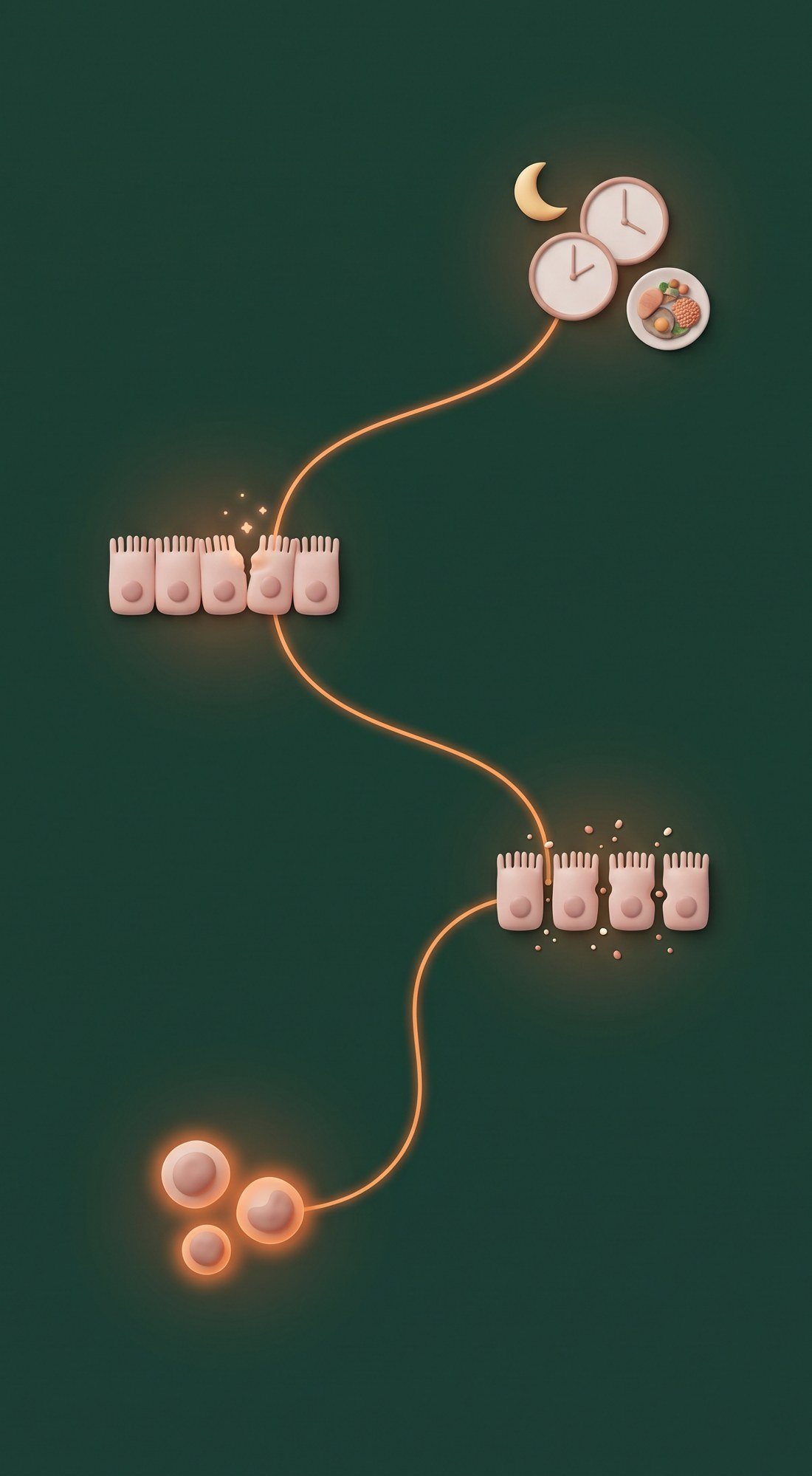
Light and meals at odd hours
The clocks in the gut lose step with the brain clock when light and meals fall at the wrong hours.
A leakier barrier
The barrier leaks, and dysbiosis and low-grade inflammation follow. This is a simplified chain, not proven in every person.
Light and meals at odd hours
The clocks in the gut lose step with the brain clock when light and meals fall at the wrong hours.
Weaker night repair
With the clocks out of sync, repair of the gut lining at night falls short.
A leakier barrier
The barrier leaks, and dysbiosis and low-grade inflammation follow. This is a simplified chain, not proven in every person.
Low-grade inflammation
In the UK Biobank, a small part of the extra IBS risk ran through inflammation markers.
Sources: Lin et al. 2020, Yao et al. 2025.
gutpathways.com
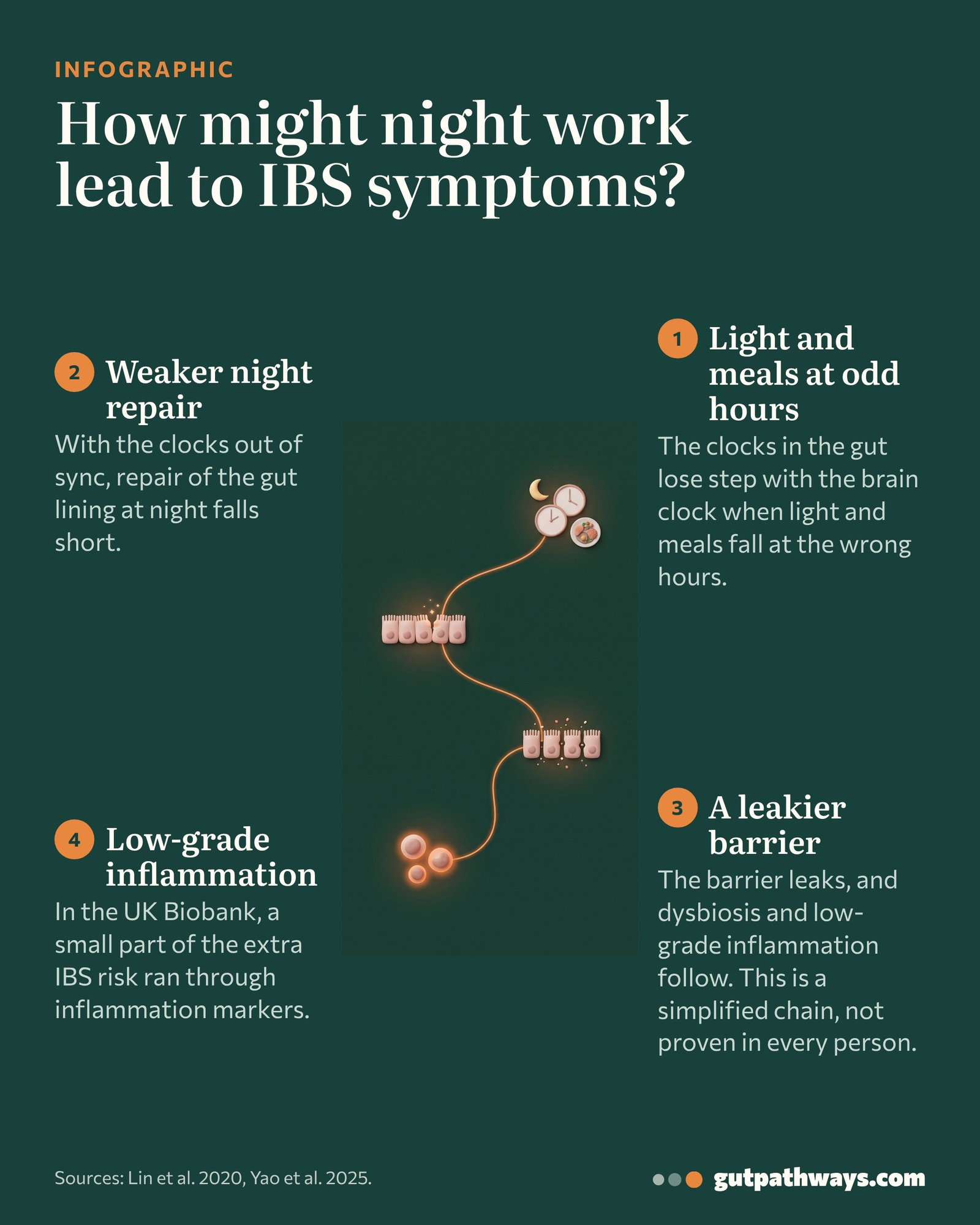 Save this infographicImage 4:5, with sources, from gutpathways.com
Which gut bacteria change when you work nights?
Faecalibacterium prausnitzii matters here. It is one of the most abundant gut species and is closely tied to gut health, largely through butyrate, the fuel the colon lining burns.16 If night work lowers it, the barrier's energy budget may shrink at the same moment the repair shift is cut short. This specific loss in shift workers has not been measured directly, so it remains a likely mechanism rather than a finding.
Animal work shows how diet and the clock act together. In mice, weekly phase shifts of the light and dark cycle changed the microbiota only when the mice also ate a high-fat, high-sugar diet.17 On standard chow, the same disruption left the microbiota unchanged.
In people, the picture is subtler. A US study of 51 nurses found similar overall diversity in day and night workers, yet three bacterial groups differed in nurses who reported IBS symptoms.18 A 2025 systematic review of five studies found lower diversity and more Escherichia/Shigella, Blautia and Dialister in night shift workers, while noting that the studies were small.19
What are the stomach problems associated with working night shifts?
Stomach acid keeps its own schedule. Secretion climbs through the evening and peaks around midnight, which is when a shift worker is most awake and most likely to eat.20 Go to bed late and you stretch that acid peak into the small hours, with food sitting on top of it.
Sleep debt adds a second hit. In a controlled experiment, two nights of four hours of sleep increased acid exposure in the esophagus, and 5 of 11 previously healthy volunteers (45.5%) crossed into abnormal acid exposure.21 Delayed sleep shifts the acid peak, while lost sleep makes the acid more damaging to a sensitive esophagus.
Put the two together and the 3 a.m. heartburn of night workers stops being a mystery. Acid clearance slows because you are upright and snacking instead of lying down fasting, and the stomach keeps producing for a dinner that never ends. For many people the shift work and IBS story starts right here, as reflux in the small hours, sometimes as acid reflux without heartburn.
Why can shift-work gut damage take years to show up?
Nothing about shift work guarantees IBS, and that is what makes it treacherous. The gut has reserve capacity, it repairs, compensates and copes. In the UK Biobank, workers with at least three years of night shifts, or more than seven nights a month, had about 24% higher IBS risk than day workers.3 Low-grade inflammation explained a small part of this, about 3.6%.3
Sleep makes the picture sharper. In another UK Biobank analysis, people who usually worked shifts and also slept too little had 54% higher risk of developing IBS than day workers with enough sleep.22 Those with frequent insomnia on top of shift work had 65% higher risk.22
The honest reading of the data is this: you can do everything wrong for a decade and feel nothing, because symptoms are the last thing to fail, not the first. In practice, long before a diagnosis, elastase may dip, the mucus layer may thin and the night cleaning wave may weaken. A problem that took ten years to surface was still building during those ten years. The link between shift work and IBS is cumulative, not deterministic.
I've worked nights for years and my stomach is fine, so shift work never affected my gut.
Feeling fine is the default state of a barrier that is still compensating. Cohort data show risk rising with cumulative exposure, and in practice the first abnormal markers appear years before the first cramp.
In practice, the share of people with IBS who either work shifts or usually fall asleep after midnight with real sleep debt is very high in the clinics where I work as a scientific collaborator. The pattern repeats too often to be coincidence. If that sounds like you, the useful question is not whether the shifts caused this, but which of the six mediators is failing right now. That question can be tested, and in most cases something can be done about it.
Among 239,760 UK Biobank workers, IBS risk rose with the duration and frequency of night shifts, and low-grade inflammation explained part of the increase.3
What can you do to protect your gut if you work shifts?
You cannot always change the roster, but you can change how much of the night your gut gets back. In practice, two habits do most of the work: sleeping before midnight on at least five nights a week, and finishing your calories as early as your shift allows. Both restore the daily rhythm of repair that shift work chips away at. A 2026 review in Gut reaches a similar conclusion, describing meal timing as a strong signal for the gut clocks and time-restricted eating as a way to restore their rhythm.5
Be in bed before midnight on at least five nights a week, even when two of them follow a late shift.
Then check the machinery. If bloating, urgency or pale loose stools have crept in, ask for a fecal pancreatic elastase test. The pancreas may tire under chronic clock disruption, and a low elastase changes the whole plan, from meal timing to enzyme support.
- Main mealA full meal mid-shiftMain meal before the shift
- Night foodSnacks through the small hoursOne small, low-fat snack
- Last caffeineCoffee near the end of the shiftCoffee only in the first half
- Main sleepShort sleep after a late breakfastFasting sleep in a dark room
This is only an example, built from the practical habits above and not from a study. Adjust the hours to your own roster with your doctor.
Front-load calories
On shift days, eat your main meal before the shift and keep 3 a.m. intake small and low in fat.
Test, don't guess
If symptoms persist, ask for fecal pancreatic elastase. A tired pancreas needs a different plan.

Keep caffeine early
Keep coffee in the first half of the shift, because late caffeine delays melatonin onset on your recovery night.
Give the MMC its quiet hours
Stop eating two to three hours before your main sleep so the cleaning wave can run.
Frequently asked questions
A meta-analysis of eight studies and several UK Biobank cohorts agree: shift workers carry roughly 12% to 81% higher risk of IBS than day workers, depending on the schedule and the study. Rotating rosters and long cumulative exposure carry the highest risk. The driver seems to be body-clock disruption of gut hormones, gut movement, the barrier and the microbiome, not stress alone.
Night shift workers report more abdominal pain, bloating, reflux and bowel changes. In a 2026 survey of 392 night shift workers, 21.3% met the criteria for IBS and 30.4% for functional dyspepsia, and most said their shifts made their symptoms worse. Studies show association, so the shifts are a likely contributor rather than a proven single cause.
Digestion is scheduled. Acid peaks near midnight, the migrating motor complex sweeps between meals, melatonin supports mucosal repair at night and enzymes expect daytime food. Night work runs these programs at the wrong hours, so repair, motility and secretion fall out of step.
Protect five nights a week with a bedtime before midnight, finish eating two to three hours before your main sleep, keep caffeine in the first half of the shift, and use blackout curtains and a fixed wake time after nights. Consistency matters more than total hours.
Keep the first meal after the shift light, sleep in a dark room on an empty stomach and return to daytime meals as soon as your roster allows. Over weeks, a regular pattern of meals and sleep gives the gut clocks the steady signals they use to stay in step.
This is one of the most common profiles in the clinics where I work, and there is a clear workup: fecal pancreatic elastase, calprotectin and a review of meal timing and sleep debt. Get those nights back and the link between shift work and IBS often starts to loosen.
References
22 studies
- Wang N, Liu X, Ye W, Shi Z, Bai T. Impact of shift work on irritable bowel syndrome and functional dyspepsia: a meta-analysis. Medicine (Baltimore). 2022.
- Lu S, Li L, Zhuang Y, et al. Night shift work increases the risk of developing irritable bowel syndrome: a prospective cohort study in the UK Biobank. Front Public Health. 2025.
- Yao Y, You X, Yang S, et al. Associations of long-term night shift work with incident irritable bowel syndrome: a population-based cohort study. J Gastroenterol Hepatol. 2025.
- Pennaneach C, Bonham MP, Kelly T, Gibson R, Biesiekierski JR. High prevalence of disorders of irritable bowel syndrome and functional dyspepsia in night shift workers: a cross-sectional study in Australia and the United Kingdom. Clin Gastroenterol Hepatol. 2026.
- Leng H, Depoortere I. Rewinding the gut clock: from chronodisruption to targeted therapies. Gut. 2026.
- Bishehsari F, Post Z, Swanson GR, Keshavarzian A. Circadian rhythms in gastroenterology: the biological clock's impact on gut health. Gastroenterology. 2025.
- Nojkov B, Rubenstein JH, Chey WD, Hoogerwerf WA. The impact of rotating shift work on the prevalence of irritable bowel syndrome in nurses. Am J Gastroenterol. 2010.
- Oka P, Parr H, Barberio B, et al. Global prevalence of irritable bowel syndrome according to Rome III or IV criteria: a systematic review and meta-analysis. Lancet Gastroenterol Hepatol. 2020.
- Waage S, Pallesen S, Bjorvatn B. Irritable bowel syndrome among Norwegian nurses, associations with insomnia, excessive sleepiness, shift work disorder and shift work schedule. BMC Nurs. 2026.
- Bubenik GA. Gastrointestinal melatonin: localization, function, and clinical relevance. Dig Dis Sci. 2002.
- Wright KP Jr, Drake AL, Frey DJ, et al. Influence of sleep deprivation and circadian misalignment on cortisol, inflammatory markers, and cytokine balance. Brain Behav Immun. 2015.
- Yano JM, Yu K, Donaldson GP, et al. Indigenous bacteria from the gut microbiota regulate host serotonin biosynthesis. Cell. 2015.
- Kumar D, Wingate D, Ruckebusch Y. Circadian variation in the propagation velocity of the migrating motor complex. Gastroenterology. 1986.
- Lin R, Wang Z, Cao J, et al. Role of melatonin in intestinal mucosal injury induced by restraint stress in mice. Pharm Biol. 2020.
- Lu WZ, Gwee KA, Moochhalla S, Ho KY. Melatonin improves bowel symptoms in female patients with irritable bowel syndrome: a double-blind placebo-controlled study. Aliment Pharmacol Ther. 2005.
- Lopez-Siles M, Duncan SH, Garcia-Gil LJ, Martinez-Medina M. Faecalibacterium prausnitzii: from microbiology to diagnostics and prognostics. ISME J. 2017.
- Voigt RM, Forsyth CB, Green SJ, et al. Circadian disorganization alters intestinal microbiota. PLoS One. 2014.
- Rogers AE, Hu YJ, Yue Y, et al. Shiftwork, functional bowel symptoms, and the microbiome. PeerJ. 2021.
- Grasa-Ciria D, Couto S, Samatán E, et al. Disrupted rhythms, disrupted microbes: a systematic review of shift work and gut microbiota alterations. Nutrients. 2025.
- Moore JG, Englert E Jr. Circadian rhythm of gastric acid secretion in man. Nature. 1970.
- Yamasaki T, Quan SF, Fass R. The effect of sleep deficiency on esophageal acid exposure of healthy controls and patients with gastroesophageal reflux disease. Neurogastroenterol Motil. 2019.
- Zhong Y, Bai H, Zhang Y, et al. Association of rotating shift work with incident irritable bowel syndrome: a large population-based prospective cohort study. Front Public Health. 2025.
Found this useful? Share it with someone who needs it.
Cite this article
Prevedoros, T. (2026, July 21). Why night shift work is linked to IBS and slow gut damage. Gut Pathways. https://gutpathways.com/articles/night-shift-work-ibs-gut-damage/