Why bloating after eating can start within minutes
Bloating and gas after eating run on two systems at once, a fast nerve reflex and slower gut bacteria, and the timing tells you which one is leading.

Why does bloating after eating start within minutes?
Bloating and gas after eating can start before your fork is back on the plate, and that timing alone tells you something useful. The food you swallowed is still in your stomach, nowhere near the part of the gut that produces most intestinal gas.
So the tight sense of abdominal bloating and fullness that arrives almost at once comes from a nerve and muscle reflex reacting to the meal's arrival, working alongside a microbiome that is still busy with food from earlier in the day.
Two separate systems drive bloating after eating, one fast and mechanical, one slower and bacterial. Telling them apart is the first step toward understanding your own digestive system and finding relief.
What triggers the gastrocolic reflex?
The gastrocolic reflex is the direct trigger behind most quick post-meal tightness. Stretch receptors in the stomach wall sense the incoming meal and send a signal along the vagus nerve, and the colon answers with a wave of contractions.
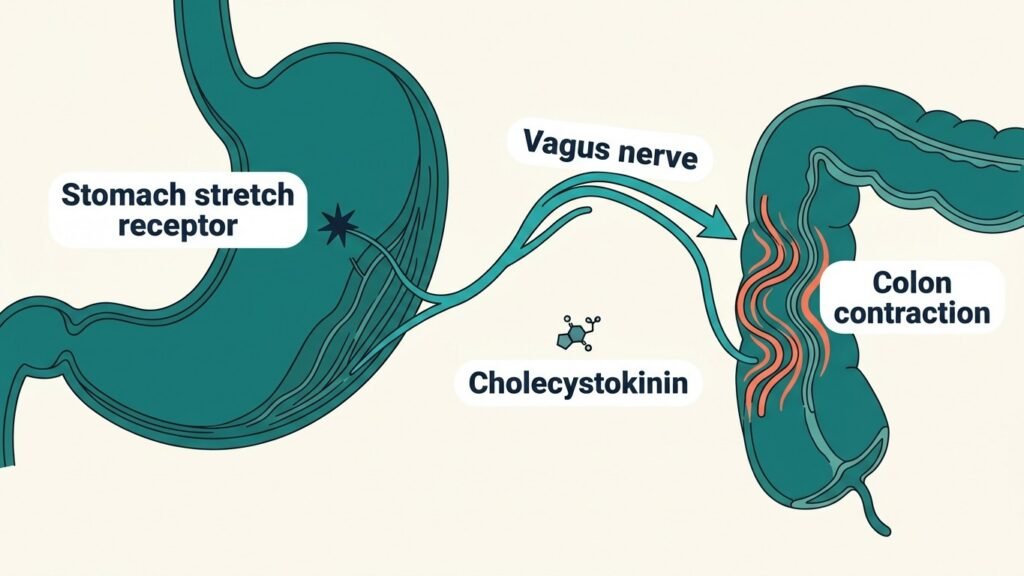
Recordings of colonic electrical activity show this response within minutes of eating.7 A fatty meal can keep the colon active for longer, as the second wave below shows.1
Meal-related hormones add another layer. Cholecystokinin, released as fat and calories reach the small intestine, is one of the suspected messengers of the reflex,7 so a heavier or fattier plate tends to produce a stronger response than a light one.
The gastrocolonic response is a normal rise in colonic motor activity that usually begins within minutes of a meal. Stomach stretch, calories and the fat content of the meal all trigger it, through the vagus nerve and neurohumoral signals.1
Which foods turn up the reflex the most?
Fat and total calories are the two biggest amplifiers of the gastrocolic reflex. A fatty meal drives a second, slower wave of colonic activity on top of the fast wave every meal produces.
- MinutesWave 1Activity in the lower colon rises quickly after both meals.
- 50 minBaselineActivity returns to fasting levels after both meals.
- 70 minWave 2Activity rises again, only after the fat meal.
In that early study, a drug that blocks acetylcholine stopped the first wave after both meals but did not touch the late wave after fat, so the two waves seem to run on different signals.2
Protein seems to have a calming effect on colonic activity, which may be one reason a protein-heavy plate often feels gentler than a carb-and-fat-heavy one.
Why does gas get trapped at the colon's two bends?
Gas tends to collect at the colon's two sharpest bends, the hepatic flexure under the right ribs and the splenic flexure under the left, because that is where the tube changes direction and the flow slows down. Doctors sometimes call a recurring ache under the left ribs splenic flexure syndrome.
Every wave set off by the gastrocolic reflex pushes existing colonic gas along, and at these two corners it tends to pool rather than pass straight through. This can happen while your last meal is still in your stomach, because the reflex reacts to the meal's arrival, well before digestion finishes.
The ache under one side of the rib cage after a filling lunch is often this mechanical squeeze, gas meeting a bend that slows its path. It shows up differently from person to person, sometimes as mild fullness and sometimes as real abdominal discomfort, depending on which bend is holding the gas that day.
Why do I look pregnant after eating?
Visible swelling after a meal is not always a sign of extra gas. In people with functional bloating, the belly can push outward because the diaphragm contracts and moves down instead of relaxing, which forces the abdominal contents forward.
With the same colonic gas load, healthy people relaxed the diaphragm and tightened the front abdominal wall. People who complained of bloating developed more distension, with a paradoxical contraction of the diaphragm.8
In a later study of 45 people with visible episodes of distension, the diaphragm dropped by about 12 mm and girth grew by about 32 mm during an episode. A few sessions of breathing-focused biofeedback reduced girth by about 25 mm.9 This is why breathing and posture can matter as much as diet for some people.
Why do stress, breathing and hormones change how you bloat?
Stress hormones sit right on top of the gastrocolic reflex. Corticotropin-releasing hormone, the signal the brain releases under stress, produced larger increases in colonic motility in men with IBS than in healthy men, and in women with IBS it came with a shifted autonomic balance and lower resting parasympathetic tone.3
In 28 people with IBS and 34 healthy controls, IBS patients showed a larger stress-hormone response to corticotropin-releasing hormone. Men with IBS had greater increases in colonic motility, and women with IBS had lower basal parasympathetic tone.3
How the vagus nerve and slow breathing calm the reflex
The vagus nerve carries both sides of this conversation, the signal that starts the gastrocolic reflex and the calming signal that can turn it back down. In healthy people, higher vagal tone went with lower evening cortisol. That link was missing in people with IBS, where lower vagal tone went with higher adrenaline instead.10
This helps explain why the same lunch can feel routine on a calm day and uncomfortable on a chaotic one. Thyroid hormones and other everyday hormone shifts also feed into gut motility, a link explored in hypothyroidism and SIBO, which is one more reason two people can eat the same plate and end up in very different places.
How does an overgrown microbiome turn the same meal into more gas?
An overgrown population of gas-producing microbes can turn one ordinary portion of carbohydrate, whether beans, broccoli or a slice of bread, into a far bigger gas load than the same food would produce in a balanced gut.
Hydrogen producers such as Klebsiella, Escherichia coli and Enterococcus, and the methane-producing archaeon Methanobrevibacter smithii, show up in greater numbers in people with small intestinal bacterial overgrowth and IBS.12
Which bacteria are usually behind it
Methanobrevibacter smithii deserves particular attention. It converts hydrogen made by other fermenting microbes into methane, and methane slowed intestinal transit by an average of 59% in an animal experiment, giving gas more time to build up and stretch the bowel.13
Symptoms in intestinal methanogen overgrowth (%)
Mehravar 2025, meta-analysis of 19 studies with 1,293 patients. Pooled share of patients reporting each symptom.
Compared with people without methanogen overgrowth, these patients had constipation more often, while diarrhea and nausea were less common.14 Addressing the overgrowth itself is often where lasting relief starts, more than chasing trigger foods one at a time. A probiotic aimed at specific strains can help shift that balance over time, though testing first usually beats guessing which one to try. The cluster of bacteria to look for is described in Klebsiella high in stool.
Enterococcus, Escherichia coli and Klebsiella are increased in people with SIBO and IBS, and Methanobrevibacter smithii is the organism behind a positive methane breath test, linked to constipation-predominant IBS.12
So is your bloating nerves, hormones or bacteria?
Most bloating after eating comes from two systems working together. The neurohormonal side decides how hard and how fast your gut contracts after a meal. The microbiome side decides how much gas a given amount of food generates once it reaches the bacteria.
A stressful, fast-eaten, high-fat lunch on top of an overgrown microbiome stacks both systems at their most reactive. That is the kind of day when bloating can be severe enough to reshape how the rest of the day feels.
This split between motility and microbiology is the axis explored in a case of IBS and Hashimoto's disease, where the fasting-state housekeeping system that runs the migrating motor complex sits next to the fed-state gastrocolic reflex.
Is bloating immediately after eating the same as bloating hours later?
Bloating in the first ten minutes and bloating two hours later usually trace back to different mechanisms, even though they can feel the same from the inside. Fast bloating tends to be reflex and osmotic, driven by stomach stretch and by sugars pulling water into the small intestine. Slow bloating tends to be fermentative, building as carbohydrate that escaped digestion reaches the colon.
An MRI study in 16 healthy volunteers compared drinks of glucose, fructose and inulin. Fructose swelled the small intestine with water, inulin filled the colon with far more gas, and glucose did little on either front.4
Glucose, fructose and inulin, two different timelines
Symptom response within 300 minutes in 29 IBS patients after 40 g of each carbohydrate (Major 2017). Small-bowel water over 5 hours in 16 healthy volunteers (Murray 2014).
In the IBS study, symptoms peaked sooner after fructose than after inulin.5 So a tight, early feeling points toward stomach stretch, a fast-eaten meal or an osmotic sugar, while a slow build over one to two hours points toward fermentation and the state of your microbiome.
People with IBS and healthy controls made similar amounts of colonic gas after inulin, yet the IBS group had more symptoms. The authors concluded that a colon sensitive to stretch, rather than extra gas, drives these carbohydrate-related symptoms.5
In other words, gas volume matters, and so does how sensitive your gut is to it.
What are the five biggest everyday drivers of gas and bloating?
Five everyday habits explain most of the gas and bloating that shows up outside any underlying condition. People who eat quickly or talk through a meal swallow air with each bite, and sparkling drinks add a quick burst of gas high in the stomach. Both end in a burp far more than they shape what collects in the colon, so they sit beside the five core drivers as smaller, upper-gut contributors.

Eating too fast
Less chewing and less time with stomach acid may leave food in bigger pieces when it moves on, so the small intestine and colon handle material that is still underprepared.
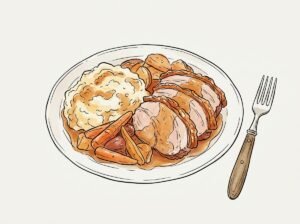
High-fat, high-calorie meals
Fat and total calories are the strongest amplifiers of the gastrocolic reflex, and fat adds a second wave of colonic activity about an hour after the meal.2

Fermentable carbs meeting an overgrown microbiome
The same portion of beans, onion or wheat ferments into very different amounts of gas, depending on how many hydrogen and methane producers are waiting for it.12

Eating while stressed or distracted
Stress hormones change how strongly the colon reacts, so the same meal can land in a different way on a calm day and a chaotic one.3
Chewing gum
Chewing may signal to the gut that food is coming, so it starts contracting before any meal arrives. Many sugar-free gums also contain sorbitol, and heavy use has been linked to chronic diarrhea and weight loss.15
Two of these five, eating too fast and chewing gum, may share a root cause, a weak or mistimed cephalic phase of digestion, the wave of saliva, acid and motility your body is supposed to release before food reaches the stomach. Getting that opening stage right often helps more than any single food swap.
How do you find relief from bloating after eating without guessing?
None of this has to stay a mystery from meal to meal. Once you can tell a fast, stretch-and-stress pattern from a slow, fermentation-driven one, the next steps start pointing in a useful direction: a calmer way of eating, a look at meal composition, or a proper microbiome workup.
If the pattern points to a specific cause, such as a past infection, gallbladder removal or long-term acid blockers, each one is set out in abdominal bloating causes. If fatty meals are the clearest trigger, check the symptoms of fat malabsorption. Matching an enzyme to a specific food is covered in digestive enzymes for bloating.
Frequently asked questions
A few changes help quickly: chewing well, keeping an upright posture while eating and taking a few slow breaths before the meal to settle the nervous system. Lasting relief needs an individual look, since the reflex, hormone and microbiome pattern differs from person to person.
The core causes trace back to behavior and the gastrocolic reflex itself: large or high-fat meals, eating too fast with little chewing, eating while stressed or distracted, and drinking a large amount of water right after a meal, all of which can intensify how hard the gut contracts after eating.
Early tightness usually comes from stomach stretch and the gastrocolic reflex, which starts within minutes of a meal.7 Fat and large portions make it stronger. Tightness that builds over one to two hours points more toward fermentation in the colon.
Gentle movement helps. In healthy volunteers, mild exercise moved gas through the gut faster and reduced abdominal distension compared with lying still.16 A short walk after a meal is a simple way to apply this.
A gut that reacts to stretch more than usual can feel full and bloated after small portions, and a strong gastrocolic reflex adds to it. Early fullness that comes with weight loss or vomiting needs a medical check.
Bloating with unintentional weight loss, blood in the stool, persistent vomiting, fever or pain severe enough to wake you needs medical attention from a doctor or gastroenterologist. The same applies to new bloating after age 50, a family history of colon or ovarian cancer, or symptoms that persist despite changes in diet.
References
16 studies
- Dorfman L, El-Chammas K, Mansi S, Kaul A. Gastrocolonic response. Curr Gastroenterol Rep. 2022.
- Snape WJ Jr, Wright SH, Battle WM, Cohen S. The gastrocolic response: evidence for a neural mechanism. Gastroenterology. 1979.
- Kano M, Muratsubaki T, Van Oudenhove L, et al. Altered brain and gut responses to corticotropin-releasing hormone (CRH) in patients with irritable bowel syndrome. Sci Rep. 2017.
- Murray K, Wilkinson-Smith V, Hoad C, et al. Differential effects of FODMAPs on small and large intestinal contents in healthy subjects shown by MRI. Am J Gastroenterol. 2014.
- Major G, Pritchard S, Murray K, et al. Colon hypersensitivity to distension, rather than excessive gas production, produces carbohydrate-related symptoms in individuals with irritable bowel syndrome. Gastroenterology. 2017.
- Helander HF, Fändriks L. Surface area of the digestive tract, revisited. Scand J Gastroenterol. 2014.
- Malone JC, Thavamani A. Physiology, gastrocolic reflex. StatPearls. 2023.
- Villoria A, Azpiroz F, Burri E, et al. Abdomino-phrenic dyssynergia in patients with abdominal bloating and distension. Am J Gastroenterol. 2011.
- Barba E, Burri E, Accarino A, et al. Abdominothoracic mechanisms of functional abdominal distension and correction by biofeedback. Gastroenterology. 2015.
- Pellissier S, Dantzer C, Mondillon L, et al. Relationship between vagal tone, cortisol, TNF-alpha, epinephrine and negative affects in Crohn's disease and irritable bowel syndrome. PLoS One. 2014.
- Zaccaro A, Piarulli A, Laurino M, et al. How breath-control can change your life: a systematic review on psycho-physiological correlates of slow breathing. Front Hum Neurosci. 2018.
- Takakura W, Pimentel M. Small intestinal bacterial overgrowth and irritable bowel syndrome, an update. Front Psychiatry. 2020.
- Pimentel M, Lin HC, Enayati P, et al. Methane, a gas produced by enteric bacteria, slows intestinal transit and augments small intestinal contractile activity. Am J Physiol Gastrointest Liver Physiol. 2006.
- Mehravar S, Takakura W, Wang J, et al. Symptom profile of patients with intestinal methanogen overgrowth: a systematic review and meta-analysis. Clin Gastroenterol Hepatol. 2025.
- Bauditz J, Norman K, Biering H, Lochs H, Pirlich M. Severe weight loss caused by chewing gum. BMJ. 2008.
- Dainese R, Serra J, Azpiroz F, Malagelada JR. Effects of physical activity on intestinal gas transit and evacuation in healthy subjects. Am J Med. 2004.
Found this useful? Share it with someone who needs it.
Cite this article
Prevedoros, T. (2026, August 7). Why bloating after eating can start within minutes. Gut Pathways. https://gutpathways.com/articles/bloating-and-gas-after-eating/