How to match digestive enzymes for bloating to your meal
The enzyme you choose and when you take it matter more than the brand, and matching the right enzyme to the right meal is where most people go wrong.

What do digestive enzymes do, and why does bloating have more than one cause?
Digestive enzymes for bloating work by finishing a job your gut already starts: breaking large food molecules into pieces small enough to absorb. Amylase, protease and lipase come from your pancreas and handle carbohydrate, protein and fat. If one of them falls short of what a meal demands, undigested material moves on to the colon, where gut bacteria ferment it into gas.
Most people searching this topic want a product name, and that makes sense, since the shelf is confusing. A more useful question comes first, though: which meal, and which trigger, is behind your bloating? The usual triggers behind a flare fall into a short list, and the enzyme that helps depends on which one applies to you. If you are still working out where your bloating comes from, the specific causes of abdominal bloating are a good place to start.
Two completely different kinds of bloating
Bloating splits into two different problems, and mixing them up is the main reason enzyme supplements get blamed for failing. One kind starts in the colon, where bacteria ferment fiber and resistant carbohydrate the gut never absorbed. The other starts earlier, in the small intestine, when a specific food arrives faster than the enzymes on hand can process it.
When bloating comes from your gut bacteria and fiber
Beans, onions, whole grains and many vegetables carry fermentable fibers and oligosaccharides that pass largely untouched through the small intestine. Once they reach the colon, resident bacteria break them down and release hydrogen, methane and carbon dioxide. This kind of bloating tends to build slowly across the day, often peaks in the evening, and responds more to changes in the gut microbiome and fiber load than to a pancreatic enzyme capsule.
When bloating comes from food that outpaces your enzymes
Dairy, a heavy protein serving or a plate of pasta can bring on bloating within an hour, because the problem sits earlier in digestion. Someone with low lactase feels a milkshake quickly, and a pancreas with limited output working through a steak dinner shows up fast too, usually higher in the abdomen and sooner after the meal. This is where a matched digestive enzyme supplement tends to earn its keep. The overlap is also why enzyme deficiencies that get mistaken for IBS matter so much for an accurate diagnosis. The timing side of the story, from the first minutes after a meal to two hours later, is covered in bloating and gas after eating.
Animal-derived vs plant-derived digestive enzymes
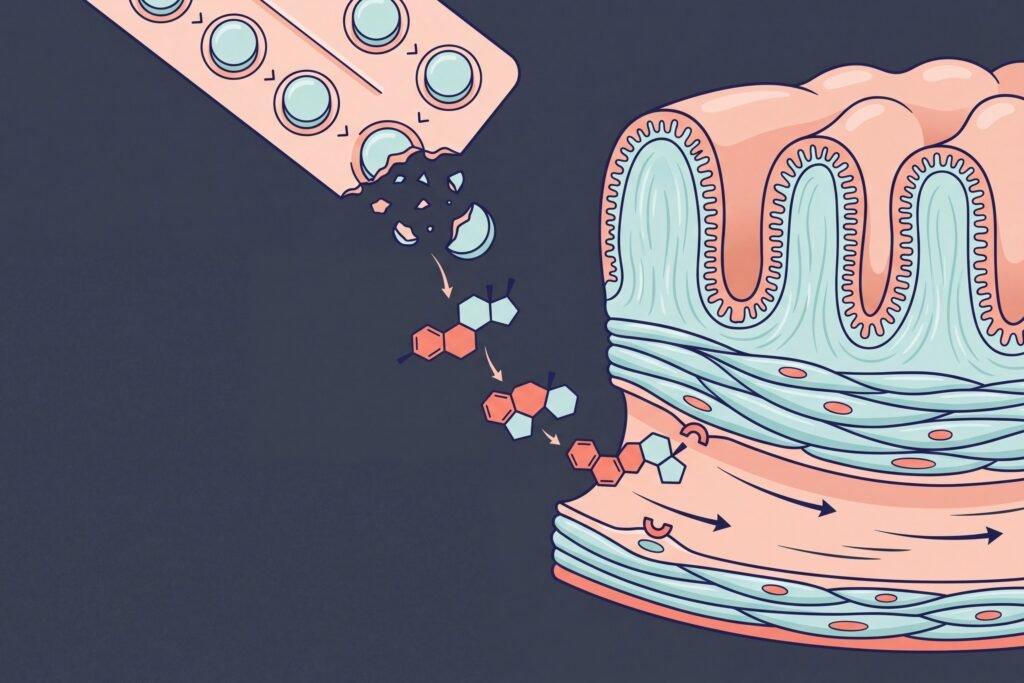
Animal-derived digestive enzymes, usually pancreatin from pork, work best at the near-neutral pH the small intestine keeps after a meal, which is where your own pancreatic enzymes operate. Plant- and microbe-derived enzymes, like the fungal proteases and amylases in many over-the-counter blends, tolerate a wider pH range and stay active from the stomach onward. That may help when a meal is heavy or the stomach empties slowly.
Neither category wins outright. Pancreatin-based products carry the strongest evidence for a real pancreatic shortfall, while broader plant and fungal blends often add extras such as alpha-galactosidase or cellulase that a pancreatin capsule leaves out.
In a multicenter crossover trial in China with 151 adults with dyspepsia, two weeks of a preparation combining pancreatic and fungal enzymes, cellulase included, lowered symptom scores far more than placebo. Abdominal distension was among the symptoms that improved, and no adverse events were reported.5
- Comes from pork pancreas
- Most active at the near-neutral pH of the small intestine
- Strongest evidence for a real pancreatic shortfall
- Covers fat, protein and starch
- Made by fungi or other microbes
- Stays active across a wider pH range
- Often adds alpha-galactosidase or cellulase
- A reasonable choice when several foods are involved
Each has a different strength.
Best digestive enzymes for bloating: a food-by-food guide
The fastest way to a useful digestive enzyme is working backward from the meal that set off your bloating. Below is a food-by-food guide, with the enzyme worth trying first for each trigger.
Milk, ice cream, soft cheese or other dairy: lactase
Lactase breaks down lactose, the sugar in dairy, before it reaches the colon undigested. Without enough of it, that sugar ferments quickly and pulls water into the bowel, which is why the bloating often shows up within an hour of a milky breakfast or dessert.
Beans, lentils, chickpeas or other legumes: alpha-galactosidase
Legumes carry raffinose-family oligosaccharides that the small intestine has no enzyme for, so they travel intact to the colon, where bacteria ferment them into hydrogen and methane.
Fried food, cream sauces or other rich meals: lipase
Lipase splits dietary fat into fatty acids and glycerol so the intestine can absorb it. A fat-heavy meal stays longer in the stomach and small intestine, and that is a common reason fullness and bloating peak an hour or two after a rich dinner.
Steak, eggs, protein shakes or other protein-heavy meals: protease
Protease breaks proteins into the peptides and amino acids the body absorbs. A large, dense serving of protein can outpace what the stomach and pancreas produce, leaving some of it to ferment further down.
Bread, pasta, rice, potatoes or other starchy foods: amylase
Amylase cuts long starch chains into simpler sugars that the small intestine absorbs early, before bacteria further down get the chance to ferment the leftovers.
Desserts, sweetened drinks or table sugar: invertase
Invertase, also called sucrase, splits sucrose into glucose and fructose. Sucrose that is not split behaves like other unabsorbed sugars further down the gut, and fermentation, gas and bloating follow.
Raw vegetables, fruit skins or big salads: cellulase
Human digestion has no enzyme of its own for plant cell walls, so raw, fibrous vegetables often pass through largely intact until gut bacteria take over the job, and that is where the gas comes from.
In a placebo-controlled trial with 52 children aged 4 to 17 who had recurrent gas symptoms, two weeks of alpha-galactosidase reduced the number of days with moderate to severe bloating and the share of children with flatulence. Abdominal distension did not change.6
The same enzyme worked in adults after a bean meal. In eight healthy volunteers who ate 420 g of cooked beans, the higher of two alpha-galactosidase doses lowered breath hydrogen and flatulence.7
None of these enzymes needs a prescription, and most combination products already blend two or three of them. The dose matters as much as the choice of enzyme, which is the next thing to get right.
Why does the dose matter more than the enzyme you pick?
The dose printed on a bottle can differ widely between brands that claim to treat the same thing, and a low dose against a rich meal often explains why a supplement was tried once and shelved. Lactase is the clearest example, because the studies measured it against a known amount of lactose.
So a larger dairy load, such as a big bowl of ice cream or a cream sauce, needs more of the same enzyme to match it.
Pancreatic enzyme products follow the same logic on a bigger scale. They are dosed in lipase units, matched to body weight and to the fat in the meal. In a meta-analysis of pancreatic enzyme therapy, higher doses showed a trend toward better results than lower ones.8 In practice, an undersized dose is a common reason a pancreatic enzyme blend gets written off before it has had a fair test.
In a two-month randomized trial with 120 adults with functional dyspepsia, a daily fungal multi-enzyme blend improved dyspepsia-related quality of life, pain and sleep scores compared with placebo, without side effects.9
When should you take digestive enzymes?
Best timing relative to meals, based on the research
Enzymes work by contact with food, so taking them far from a meal wastes most of the dose. A crossover study in people with pancreatic insufficiency compared three schedules of the same pancreatic enzyme dose. Fat digestion tended to be better when the capsules were taken with the meal or just after it than just before it.2
People whose fat digestion returned to normal, by timing of the dose (%)
Domínguez-Muñoz 2005, 24 people with chronic pancreatitis, the same enzyme dose taken on three schedules.
Across 17 randomized trials in chronic pancreatitis, pancreatic enzyme replacement raised the coefficient of fat absorption from about 63% to about 84% against baseline. The authors note that results may improve with higher doses, enteric coating and taking the enzyme during the meal.8
Fat-specific enzymes have their own small study. Healthy volunteers who took an acid-resistant lipase immediately before a high-fat meal reported less stomach fullness than with placebo, although bloating and nausea did not change.10 For lactase, the enzyme was given together with the lactose in the studies above.1
Why people give up on enzymes before finding what works
In the clinics where I work as a scientific collaborator, the enzyme itself is rarely the problem. Far more often, someone takes a single capsule after finishing a big meal, tries it once and moves on within a week. A fair trial looks like this:
Infographic
Match the trigger food
Pick the enzyme that matches the trigger food, such as lactase for dairy or lipase for fat-heavy meals.
Size the dose to the meal
A low dose against a rich meal often explains why a supplement gets shelved after one try.
Take it with the meal
Enzymes work by contact with food, so taking them far from a meal wastes most of the dose.
Give it time
A fair trial means at least one to two weeks of consistent use before judging it.
Sources: Domínguez-Muñoz et al. 2005.
gutpathways.com
 Save this infographicImage 4:5, with sources, from gutpathways.com
Digestive enzymes after gallbladder removal
A gallbladder stores and concentrates bile between meals, and losing it changes more than bile flow. After cholecystectomy, meal-stimulated cholecystokinin runs higher than in people with an intact gallbladder, and cholecystokinin is the same hormone that tells the pancreas to release its digestive enzymes.
In 25 people who had a gallbladder removed, meal-stimulated cholecystokinin over 60 minutes came back about 50% higher than in 15 controls, a median of 176 against 116.11
Over months and years, that altered signaling may wear down pancreatic output, and the signs can appear long after the surgery has healed. In a Russian follow-up of 72 people, fecal elastase-1 was reduced in 46% of them five years after cholecystectomy.12 The microbiome changes too. A systematic review of 14 studies found significant but inconsistent microbiome changes after gallbladder removal, so no single pattern fits everyone.13 That is one more reason bloating after cholecystectomy often needs more than one fix. The fat side of this problem, from greasy stool to missing vitamins, is covered in symptoms of fat malabsorption.
The same pattern runs through a post-cholecystectomy IBS case: symptoms that trace back to gallbladder removal but were treated as ordinary IBS for years before anyone connected the two. Pancreatic enzyme support, dosed for the size of the meal and matched to its fat content, is usually one part of the answer, alongside rebuilding the gut environment that the bile changes disrupted. The wider picture is in IBS after gallbladder removal and SIBO after gallbladder removal.
Digestive enzymes vs probiotics: which one targets your bloating?
Digestive enzymes and probiotics work on two ends of the same tube. Enzymes act early, in the stomach and small intestine, breaking food down before it reaches the colon. Probiotics work downstream, shaping which bacteria dominate the fermentation that happens once food, or what is left of it, gets there. Reaching for one when the problem sits with the other is a common reason bloating treatment stalls.
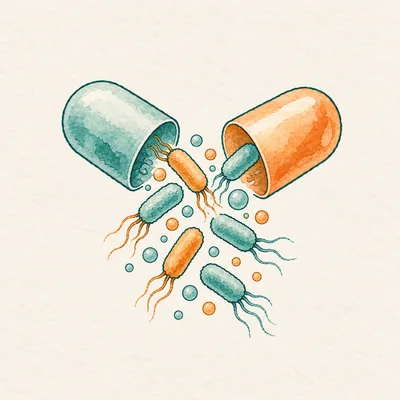
No two guts carry the same mix of bacteria, and matching a fix at random usually goes nowhere. The two make the most sense together once you know which mechanism is driving your case. A probiotic strain chosen for dysbiosis, alongside an enzyme matched to a specific food, covers two separate mechanisms at once.
Low FODMAP helps, but it works best as a short, structured phase
A low FODMAP diet has earned its reputation, and the trials show why. In a controlled crossover trial, 21 days of low FODMAP eating roughly halved overall symptom scores in people with IBS, with less bloating, pain and wind.14 It works by cutting the fermentable carbohydrates that feed colon bacteria, the same process behind the fermentation bloating described earlier.
Across 13 randomized trials with 944 people with IBS, a low FODMAP diet ranked first for global symptoms, abdominal pain and bloating. Most trials did not study reintroduction and personalization.4
The catch sits in what happens after the relief starts. The diet is built as three phases, and the middle phase is where most of the value lives.
- 1
Restriction
A short phase with fermentable carbohydrates cut back, to see whether symptoms settle.
- 2
Reintroduction
Foods come back one group at a time, to find which ones cause trouble.
- 3
Personalization
A long-term pattern that keeps out only what you need to and brings variety back.
A review of the diet's open questions found that the quality of the evidence is lower than its popularity suggests, and it advised caution with prolonged use because of possible gaps in fiber, calcium, iron and several vitamins.15
The low FODMAP diet markedly reduces luminal Bifidobacteria, with limited evidence that it lowers total bacterial numbers. It also lowers the share of people who meet the recommended calcium intake.3
That is why low FODMAP works best as a temporary diagnostic tool, with an end date built in from day one. Years of strict restriction without reintroduction tend to shrink the range of foods someone tolerates comfortably. The same point is made for post-infectious IBS in why low FODMAP is not a long-term solution.
The real decision path for fixing your bloating
Start with the meal that triggers it, before reaching for any bottle. The timing, the specific food and how quickly the bloating shows up point to the mechanism in play: bacterial fermentation, a specific enzyme shortfall, lower pancreatic output after surgery, or a mix of them.
- Name the meal
Write down which meal set off the bloating.
- Note the timing
Within an hour points to the small intestine, a slow build across the day points to the colon.
- Match the enzyme
Lactase for dairy, alpha-galactosidase for legumes, lipase for fat, amylase for starch.
- Size the dose
A bigger meal needs more of the same enzyme.
- Take it with the meal
Close to the food it has to break down.
- Give it two weeks
Judge it after consistent use, not after one capsule.
Each step narrows the guess. Lights up as you scroll.
From there, digestive enzymes for bloating help most people who use them this way, whether the story is a simple lactose mismatch or something layered, such as pancreatic changes after surgery.
Frequently asked questions
It depends on what drives your symptoms. Enzymes solve a breakdown problem in the small intestine, while probiotics work further down in the colon. The two make most sense together once you know which mechanism is behind your bloating.
Yes. They work in different parts of the gut, so they do not compete. Take the enzyme with the meal it is meant for, and judge each one on its own job.
With the meal. In a crossover study, pancreatic enzymes worked slightly better taken with or right after the meal than just before it.2 What matters most is that the enzyme meets the food in the gut at the same time.
Only with the meals that trigger your bloating, unless a doctor has diagnosed pancreatic insufficiency, where enzymes are taken with every meal and snack that contains fat.
The three core enzymes are amylase for carbohydrates, protease for protein and lipase for fat, all made by the pancreas. Specialty enzymes such as lactase, alpha-galactosidase and invertase target specific sugars that the core three leave largely untouched.
References
15 studies
- Lin MY, Dipalma JA, Martini MC, et al. Comparative effects of exogenous lactase (beta-galactosidase) preparations on in vivo lactose digestion. Dig Dis Sci. 1993.
- Domínguez-Muñoz JE, Iglesias-García J, Iglesias-Rey M, et al. Effect of the administration schedule on the therapeutic efficacy of oral pancreatic enzyme supplements in patients with exocrine pancreatic insufficiency: a randomized, three-way crossover study. Aliment Pharmacol Ther. 2005.
- Staudacher HM. Nutritional, microbiological and psychosocial implications of the low FODMAP diet. J Gastroenterol Hepatol. 2017.
- Black CJ, Staudacher HM, Ford AC. Efficacy of a low FODMAP diet in irritable bowel syndrome: systematic review and network meta-analysis. Gut. 2022.
- Ran ZH, Yuan YZ, Li ZS, et al. The efficacy of Combizym in the treatment of Chinese patients with dyspepsia: a multicenter, randomized, placebo-controlled and cross-over study. J Dig Dis. 2009.
- Di Nardo G, Oliva S, Ferrari F, et al. Efficacy and tolerability of alpha-galactosidase in treating gas-related symptoms in children: a randomized, double-blind, placebo controlled trial. BMC Gastroenterol. 2013.
- Di Stefano M, Miceli E, Gotti S, et al. The effect of oral alpha-galactosidase on intestinal gas production and gas-related symptoms. Dig Dis Sci. 2007.
- de la Iglesia-García D, Huang W, Szatmary P, et al. Efficacy of pancreatic enzyme replacement therapy in chronic pancreatitis: systematic review and meta-analysis. Gut. 2017.
- Ullah H, Di Minno A, Piccinocchi R, et al. Efficacy of digestive enzyme supplementation in functional dyspepsia: a monocentric, randomized, double-blind, placebo-controlled, clinical trial. Biomed Pharmacother. 2023.
- Levine ME, Koch SY, Koch KL. Lipase supplementation before a high-fat meal reduces perceptions of fullness in healthy subjects. Gut Liver. 2015.
- McDonnell CO, Bailey I, Stumpf T, Walsh TN, Johnson CD. The effect of cholecystectomy on plasma cholecystokinin. Am J Gastroenterol. 2002.
- Mitusheva EI, Saifutdinov RG, Shaimardanov RS, Badretdinova AR, Saifutdinova TV. The gepatopancreatobiliary system after cholecystectomy. Eksp Klin Gastroenterol. 2015.
- Ang TL, Koo SH, Ang D, et al. Postcholecystectomy gut microbiome changes and the clinical impact: a systematic review with narrative synthesis. J Gastroenterol Hepatol. 2025.
- Halmos EP, Power VA, Shepherd SJ, Gibson PR, Muir JG. A diet low in FODMAPs reduces symptoms of irritable bowel syndrome. Gastroenterology. 2014.
- Catassi G, Lionetti E, Gatti S, Catassi C. The low FODMAP diet: many question marks for a catchy acronym. Nutrients. 2017.
Found this useful? Share it with someone who needs it.
Cite this article
Prevedoros, T. (2026, July 29). How to match digestive enzymes for bloating to your meal. Gut Pathways. https://gutpathways.com/articles/digestive-enzymes-for-bloating/