What causes IBS when one symptom has many biochemical roots
There is no single cause of IBS, and that is the point. The same bloating can grow out of seven different biochemical stories, so the useful question is not what causes IBS in general, but what caused yours.
What causes IBS?
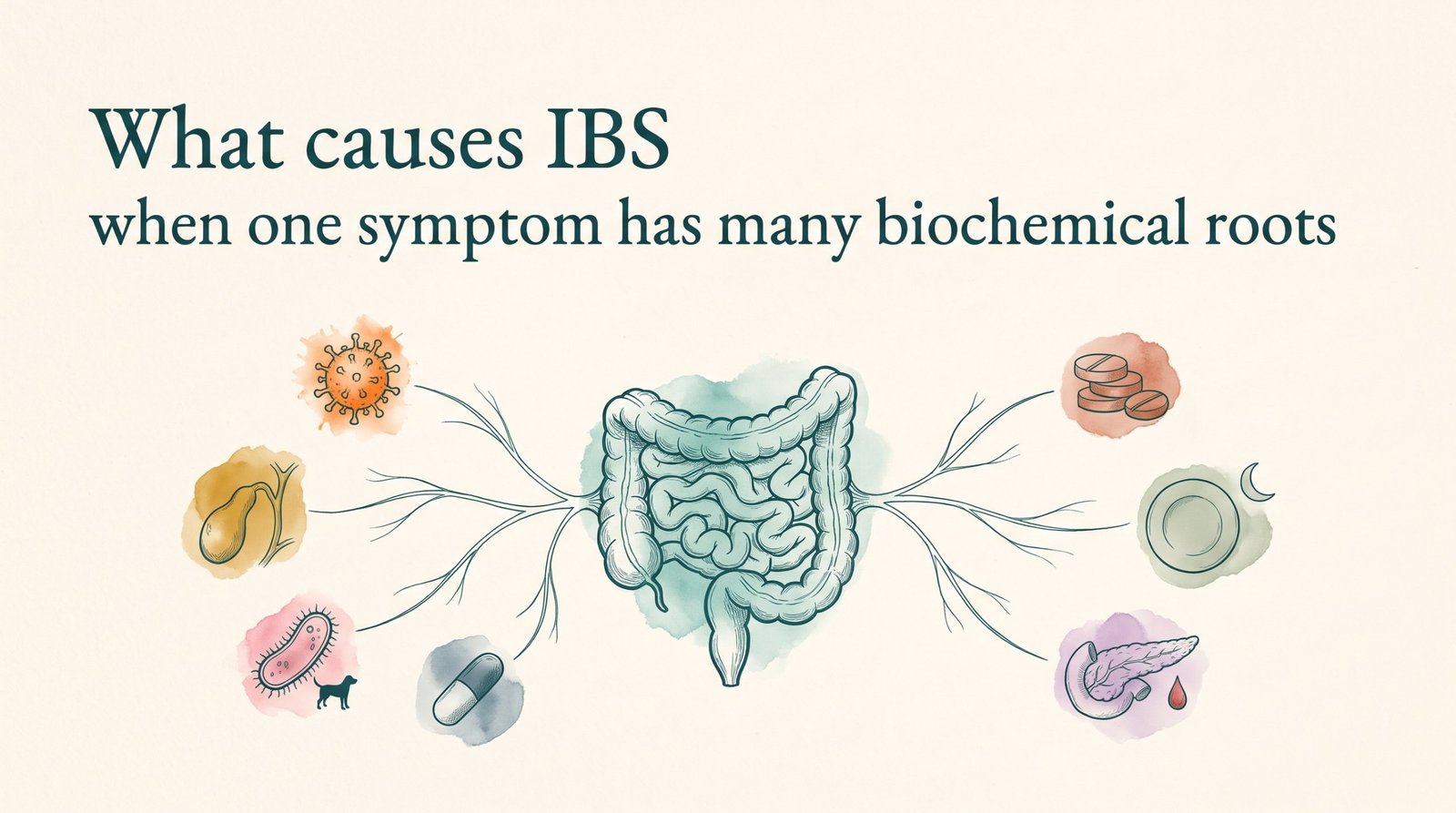
IBS is not caused by one thing. It is a label for a group of gut symptoms, and the biochemistry underneath that label changes from person to person. In one person the engine is a lingering change in gut bacteria after a stomach bug. In another it is bile that flows without a gallbladder to store it, or an enzyme that a bacterium makes, or a pancreas that stopped keeping up.1, 4
That is why the honest medical answer, "the exact cause is unknown", is true and unhelpful at the same time. It is true because no single cause fits everyone. It is unhelpful because it hides the fact that each case usually does have a cause, and that cause can often be found.4
The clinics where I work as a scientific collaborator see this every week. Two people arrive with the same complaint, bloating that builds through the day. Their test results, however, tell two different stories, and so does what finally helps them. Same symptom, different biochemistry.
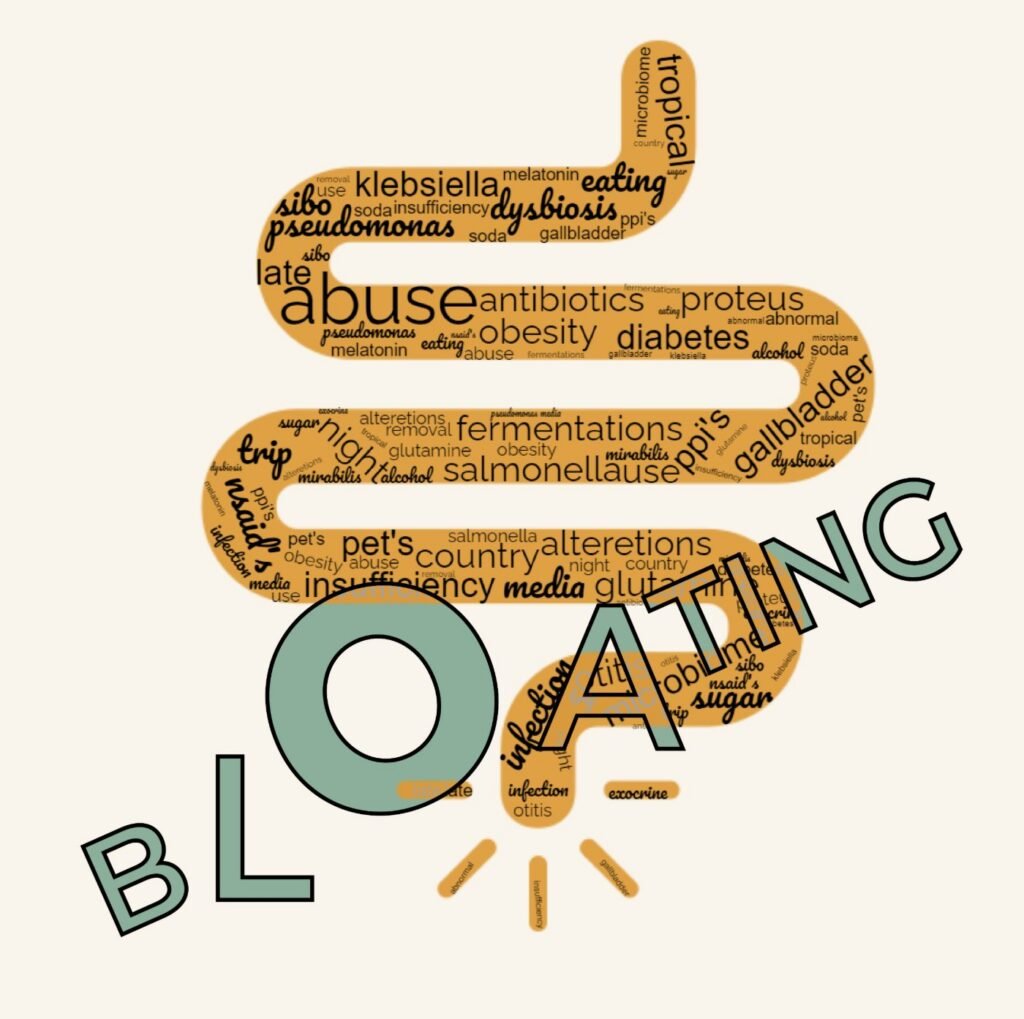
Seven people, one symptom, seven causes
Bloating makes the point better than any theory. Below are seven people whose bloating looked the same from the outside. Inside, the chemistry was different every time, and each branch leads to the full case.
- Pattern 1 of 10After a stomach bug or the flu
The bacteria that grew back after the infection ferment meals in a new way.6
Read Katie's case - Pattern 2 of 10After gallbladder removal
Bile flows without a reservoir, fat digestion suffers and the bowel reacts.7
Read Athina's case - Pattern 4 of 10A Pseudomonas overgrowth, often in pet owners
A bacterial enzyme breaks gluten into irritating pieces. It looks like gluten sensitivity.8
Read Aspa's case - Pattern 3 of 10Proteus in the gut plus a glutamine supplement
Glutamine is the signal that makes Proteus swarm and spread.9
Read Jason's case - Pattern 7 of 10Years of acid blockers
Less stomach acid, more surviving bacteria, and overgrowth in the small intestine.10
Read George's case - Pattern 9 of 10Late dinners most nights
A slow evening stomach and a cleaning wave that never gets its quiet hours.11, 12
Read Colin's case - Pattern 6 of 10Living with diabetes
Fewer pancreatic enzymes, so food travels on undigested and ferments.13
Read Michael's case
Each branch is a real case from this site, and each story is one of the ten patterns of the book IBSyncrasy. The colours match the patterns of the book.
These are seven of the possible causes of bloating, not all of them. Still, the lesson holds for every one of them. Without the specific biochemical trigger, bloating is managed. With it, bloating is explained, and an explained symptom is a symptom you can finally do something about.
Which of these sounds like you?
Most people recognise themselves in one line before they recognise a mechanism. Tap the line that fits and read how it played out in a real person. Nothing here is a diagnosis. These are stories, and only your own history can tell you how close they are.
Which of these sounds like you?
Tap a line. One story opens at a time.
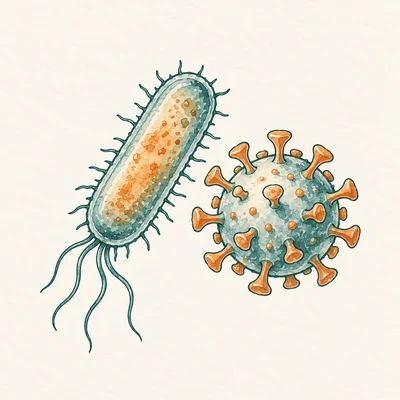 It all started after a stomach bug or a bad flu
The infection cleared, the bloating stayed. The bacterial community that grew back was not the one you had before, and it ferments your meals in a new way.6
In the book: pattern 1 of 10, Post-infectious IBS
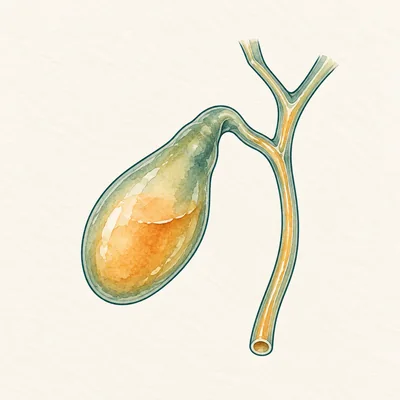 My gallbladder was removed, and my gut never settled
Bile now flows without a reservoir. Fat is digested less well, bile acids reach the colon, and the bowel reacts.7
In the book: pattern 2 of 10, Post-cholecystectomy IBS
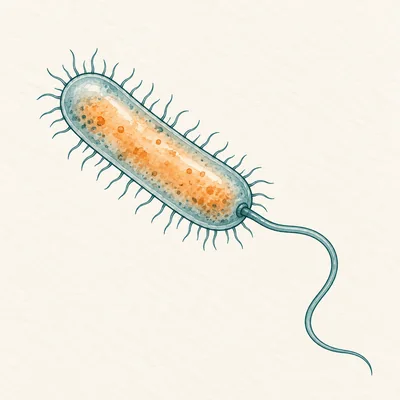 Bread and pasta bloat me, but I am not celiac
A Pseudomonas enzyme can break gluten into irritating pieces. The problem is the bacterium, not the wheat.8
In the book: pattern 4 of 10, Pseudomonas IBS
 A glutamine supplement made everything worse
Glutamine is the signal that makes Proteus swarm. If that bacterium is already there, the supplement feeds the wrong side.9
In the book: pattern 3 of 10, Proteus IBS
 I have taken acid blockers for years
Less acid means more surviving bacteria in the small intestine. Bacterial overgrowth is more common in long-term PPI users.10
In the book: pattern 7 of 10, PPI-induced IBS
 Dinner is late, and mornings are the worst
 I have diabetes, and my digestion is unpredictable
The pancreas may be producing fewer digestive enzymes. Undigested food ferments, and the bloating is blamed on IBS.13
In the book: pattern 6 of 10, Exocrine pancreatic insufficiency
How can one symptom have so many causes?
The answer sits in the arithmetic of biology. Fewer than 20,000 protein-coding genes are written in our DNA.2 Each one is read at particular times, under particular conditions, and its protein has to be folded, modified and delivered to the right place before it can do its job. Every one of those steps can go wrong.
The body supervises all of this with repair and control systems that are accurate most of the time. Even so, each of those molecules can fail in its own way, some often and some rarely, and that alone explains a great deal of the variety behind a diseased state.
Then the numbers multiply. Proteins are changed after they are made, by hundreds of known chemical modifications.3 Correctly built molecules age and get damaged by what we eat, breathe and take. Co-existing conditions and daily habits add their own layers. Taken together, the combinations of biochemical predispositions that can lead to the same disease run into the millions.
- Environment, habits and age Food, medicines, infections, sleep, stress and time all act on molecules that were built correctly.
- Changes after a protein is made Hundreds of chemical modifications tune a protein's activity, and each one can be out of tune.3
- Proteins The working molecules of the gut, from enzymes to transporters, each with its own failure modes.
- Genes Fewer than 20,000 protein-coding genes, read at different times and under different conditions.2
- One symptom Bloating, nausea, pain or diarrhea is the single word the person brings to the appointment.
Outer ring first. Each layer adds its own ways of going wrong, and the symptom in the centre is what the person actually feels.
Millions of combinations, a few hundred symptoms
Clinicians work with a limited vocabulary of symptoms and signs, roughly a few hundred in everyday practice, while the catalogue of diseases runs into the thousands. Orphanet alone lists 6,172 rare diseases, most of them with a molecular cause.5 The maths is simple. Many different malfunctions must share the same few words.
Nausea shows this well. It is a symptom, not a disease, and it can start in the inner ear, the oesophagus, the stomach, the liver and bile system or the brain itself.14 Even blood loss from hemorrhoids can bring it on. Treating the nausea does not repair any of those sources. In practice, each person with nausea needs a different plan, and that is exactly where clinical biochemistry earns its place.
- The inner ear Balance disorders such as Ménière's disease or any labyrinth problem send nausea through the vestibular pathways.14
- The oesophagus Reflux disease irritates the lower oesophagus, and nausea often travels with the burning.
- The stomach A stomach that empties slowly, or a gastritis, signals fullness and nausea long after a meal.
- The liver and bile system Gallstones and bile problems bring nausea with pain under the right ribs, especially after fatty meals.
- The brain Migraine, motion sickness and some medicines act on the brain's own nausea centres.14
The same feeling, five different origins. Tap a point or a line.
So what causes IBS, then?
Now take everything above and apply it to IBS, where things get harder still. IBS is not one disease, and it is not even one cluster of diseases. It is a spectrum of symptoms that grows out of each person's individual biochemistry, history and habits.1, 4
IBS is called a functional disorder, which means the gut works abnormally without a structural lesion that a scope or a scan would show. That definition says what IBS is not. It says little about what, in a given person, it is. The triggers people notice, such as foods, stress or a medicine, sit on top of a biochemical state that was often set years earlier by a gut infection, a course of antibiotics or an operation.1
The clinical, dietary, psychological and pharmaceutical history of each person shapes which state that is. A past gastroenteritis or repeated antibiotics can leave a changed bacterial community that drives symptoms long afterwards, as IBS after antibiotics explains. Stress and anxiety then turn the volume up on whatever the gut is already doing.
- Post-infectious A virus or bacterium starts it. The changed microbiome keeps it going.
- Post-cholecystectomy An operation changes how bile reaches the gut.
- Proteus A urinary bacterium that thrives in the gut when glutamine is around.
- Pseudomonas A soil and water bacterium settles in the upper gut, often in pet owners.
- Prostatitis The gut and the prostate share bacteria and inflammation in men.
- Exocrine pancreatic insufficiency The pancreas produces too few enzymes, often with diabetes or insulin resistance.
- PPI-induced Years of acid suppression reshape the small-intestinal community.
- sIgA deficiency A thin antibody shield on the gut lining lets more pass.
- SIBO-IBS A weak cleaning wave lets bacteria overgrow between meals.
- Pediatric C-section, no breastfeeding and early antibiotics shape the first microbiome.
Not on this scale
- At least twenty more Histamine, bile acids, thyroid, mast cells, parasites and others appear in the articles and case studies of this site.
IBS has at least thirty recognisable sub-patterns. The book focuses on the ten that fill the case files most often, and IBS types are not four describes the full idea. Seven of the ten are the stories above.
What this means for you
If you have been told that you have IBS, you have been given a label, not a cause. The label is real, and the symptoms are real, but the useful work begins when someone asks what, in your particular body, is producing them. Your history usually holds the first clue, whether that is a holiday that ended in a stomach bug, an operation, a long prescription or a habit of eating at midnight.
The seven stories on this page are not a checklist to diagnose yourself with. They are an invitation to read your own history with a biochemist's eye, and then to ask for the specific tests that can confirm or rule out what you suspect. The bloating article adds seven more causes that are worth knowing, and each case study on this site shows how a single cause was pinned down.
Found your story? The book tells all ten.
Buy on AmazonFrequently asked questions
There is no single number one. Among well-studied triggers, a gut infection is one of the clearest: around one in ten people develop IBS after infectious gastroenteritis, and the risk is higher after a longer illness, with antibiotics during the infection or with anxiety at the time.6 In the practice, late eating and long courses of acid blockers are at least as common a starting point.
Usually through an event that changes the gut's biochemistry and then stays in place, such as an infection, an operation on the gallbladder, a long prescription of proton pump inhibitors, a bacterial overgrowth or a pancreas that produces fewer enzymes.1 The symptoms that follow look alike, which is why they share one name.
That depends on what is causing it in the specific person. When a cause can be found and addressed, such as a bacterial overgrowth or a missing enzyme, symptoms can settle for good. When the trigger cannot be removed, the goal becomes long-term control. Either way, the answer starts with finding the cause, not with the label.
Family clustering exists, but IBS is not inherited like a single-gene disease. Shared genes, shared early-life exposures and shared habits all contribute, and the biochemical pattern behind the symptoms still has to be worked out for each person.1
IBS itself is diagnosed from symptoms, after other conditions have been excluded.4 Finding the cause behind the symptoms is a different exercise and uses targeted tests, such as stool microbiology or PCR, breath tests, pancreatic elastase, bile acid assessment or secretory IgA, chosen from the person's history rather than ordered in bulk.
Often because the driver is still active. A late-eating habit, an acid blocker that was never reviewed, a bacterium that was never looked for or a pancreas that keeps slowing down will all push symptoms up over time. Worsening is a reason to revisit the history and the tests, not to add another restriction.
References
19 studies
- Holtmann GJ, Ford AC, Talley NJ. Pathophysiology of irritable bowel syndrome. Lancet Gastroenterol Hepatol. 2016.
- Amaral P, Carbonell-Sala S, De La Vega FM, et al. The status of the human gene catalogue. Nature. 2023.
- Walsh CT, Garneau-Tsodikova S, Gatto GJ. Protein posttranslational modifications: the chemistry of proteome diversifications. Angew Chem Int Ed Engl. 2005.
- Black CJ, Drossman DA, Talley NJ, Ruddy J, Ford AC. Functional gastrointestinal disorders: advances in understanding and management. Lancet. 2020.
- Nguengang Wakap S, Lambert DM, Olry A, et al. Estimating cumulative point prevalence of rare diseases: analysis of the Orphanet database. Eur J Hum Genet. 2020.
- Klem F, Wadhwa A, Prokop LJ, et al. Prevalence, risk factors, and outcomes of irritable bowel syndrome after infectious enteritis: a systematic review and meta-analysis. Gastroenterology. 2017.
- Sauter GH, Moussavian AC, Meyer G, et al. Bowel habits and bile acid malabsorption in the months after cholecystectomy. Am J Gastroenterol. 2002.
- Caminero A, Galipeau HJ, McCarville JL, et al. Duodenal bacteria from patients with celiac disease and healthy subjects distinctly affect gluten breakdown and immunogenicity. Gastroenterology. 2016.
- Armbruster CE, Hodges SA, Mobley HL. Initiation of swarming motility by Proteus mirabilis occurs in response to specific cues present in urine and requires excess L-glutamine. J Bacteriol. 2013.
- Lo WK, Chan WW. Proton pump inhibitor use and the risk of small intestinal bacterial overgrowth: a meta-analysis. Clin Gastroenterol Hepatol. 2013.
- Goo RH, Moore JG, Greenberg E, Alazraki NP. Circadian variation in gastric emptying of meals in humans. Gastroenterology. 1987.
- Deloose E, Janssen P, Depoortere I, Tack J. The migrating motor complex: control mechanisms and its role in health and disease. Nat Rev Gastroenterol Hepatol. 2012.
- Piciucchi M, Capurso G, Archibugi L, et al. Exocrine pancreatic insufficiency in diabetic patients: prevalence, mechanisms, and treatment. Int J Endocrinol. 2015.
- Singh P, Yoon SS, Kuo B. Nausea: a review of pathophysiology and therapeutics. Therap Adv Gastroenterol. 2016.
- Spiller R, Garsed K. Postinfectious irritable bowel syndrome. Gastroenterology. 2009.
- Farrugia A, Attard JA, Khan S, et al. Postcholecystectomy diarrhoea rate and predictive factors: a systematic review of the literature. BMJ Open. 2022.
- Zhou Q, Verne ML, Fields JZ, et al. Randomised placebo-controlled trial of dietary glutamine supplements for postinfectious irritable bowel syndrome. Gut. 2019.
- Imhann F, Bonder MJ, Vich Vila A, et al. Proton pump inhibitors affect the gut microbiome. Gut. 2016.
- Leeds JS, Hopper AD, Sidhu R, et al. Some patients with irritable bowel syndrome may have exocrine pancreatic insufficiency. Clin Gastroenterol Hepatol. 2010.
Found this useful? Share it with someone who needs it.
Cite this article
Prevedoros, T. (2023, January 9). What causes IBS when one symptom has many biochemical roots. Gut Pathways. https://gutpathways.com/articles/what-causes-ibs/