Diabetes hid a weak pancreas behind IBS symptoms
This is case 6 in the book IBSyncrasy
Michael had type 2 diabetes, oily stools and bloating, and every scan said his pancreas was fine. His case of IBS and diabetes shows how low pancreatic enzyme output can sit behind IBS-like symptoms, and what his plan focused on.
 Michael's casecase study
1DemographicsStop 1 of 8
Who Michael is
Michael was a 56-year-old bus driver when he came to the clinic where I work as a scientific collaborator. For 15 years, he had driven the route between the port of Piraeus and Athens airport, in shifts that included night duties every week.
- 56 years old
- Man
- Bus driver on shifts
- Type 2 diabetes since 49
- On insulin
Statistics from the practice for similar cases
- Number of cases
- >147
- Age range
- Over 35
- Success rate
- >90%
- Treatment duration
- 2 to 6 months
- Most common symptom
- Oily stool
- Most common trigger
- Diabetes
Average improvement score
Figures from the practice's own records of cases like this one, not from a published study.
His main complaints were diarrhea with urgency, oily stools, bloating, abdominal pain and feeling full quickly. His full case is described in the book IBSyncrasy.
2IntroductionStop 2 of 8
How diabetes can affect digestion
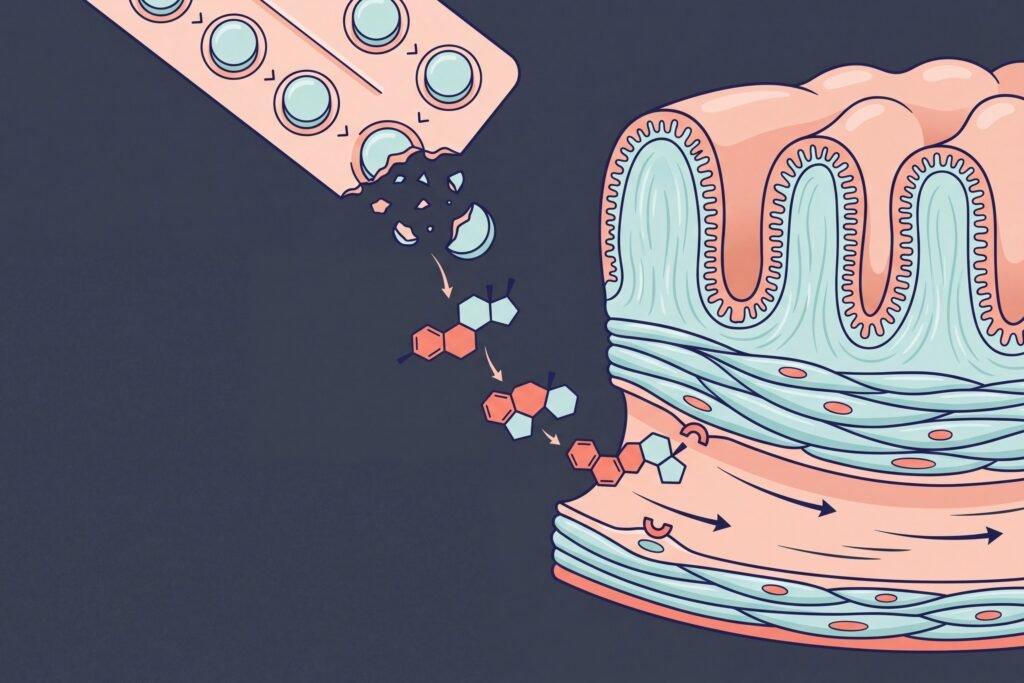
Digesting food depends heavily on the pancreas. Food is prepared in the stomach and then meets pancreatic enzymes in the small intestine, where proteins, fats and carbohydrates are broken down completely. When the pancreas makes too few enzymes, undigested food moves further down the gut, where it can cause bloating, diarrhea and an imbalance of gut bacteria. This is called exocrine pancreatic insufficiency (EPI).
EPI is more common in diabetes than many people think. In different studies, it has been reported in 25% to 74% of people with type 1 diabetes and 28% to 54% of people with type 2 diabetes, and a long duration of diabetes, a high insulin need and poor glucose control seem to raise the risk.1 It also appears with chronic pancreatitis and after some operations.
EPI can also hide behind an IBS diagnosis. Among people diagnosed with IBS with diarrhea, 6.1% had low stool elastase in one study and 5% had EPI in another, and enzyme treatment improved their stool frequency, consistency and pain.2, 3 Because EPI is thought to be rare, it is often missed. Many people with diabetes are told that their pancreas looks normal on ultrasound or CT, but these scans show the structure of the organ, not how much enzyme it makes. More on bowel problems in diabetes is in can diabetes cause bowel problems.
3MeetingStop 3 of 8
Meeting Michael
Michael was diagnosed with type 2 diabetes at 49. He tried to control his blood sugar with diet and exercise, but after a year he started insulin. When bowel changes and bloating appeared, he did not link them to his diabetes, and neither did the six doctors he saw. His story is a common one. Many people with diabetes have told me, "But my pancreas has been checked, and everything looks normal."
Looking back, three factors had built on each other.

Daily habits
Shift work, night duties and irregular meals strained his metabolism and his pancreas over the years.
Diabetes and enzyme shortfall
His diabetes went together with low pancreatic enzyme output, insulin treatment and an imbalance of gut bacteria.
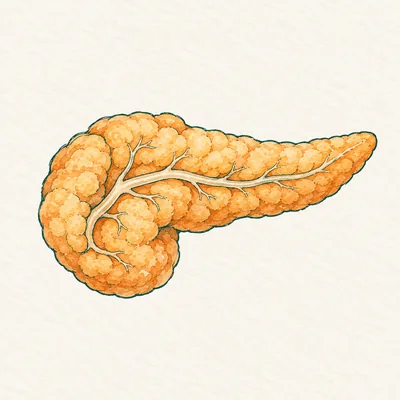
Poor absorption
Undigested fat and food led to diarrhea, weight loss and blood sugar that was harder to control.
4DiagnosticsStop 4 of 8
Diagnostics: three symptoms, one cause?
In Michael's case, type 2 diabetes was a clear contributor to EPI, although a few smaller factors together may have added to his symptoms. My working hypothesis was that his three main gut symptoms, diarrhea with urgency, bloating and abdominal pain, all followed from EPI. Without enough enzymes, proteins, carbohydrates and fats are broken down poorly and ferment abnormally in the colon. This leads to uneven gas production and constant water and mucus release from the gut wall.
Stool consistency depends on the mix of fat-soluble and water-soluble nutrients that reach the colon and on how much the colon can release at that moment.
Without enough enzymes, food is broken down poorly, and undigested particles can cause stomach and bowel cramps.
Bacterial fermentation of unabsorbed food, including fruit and vegetables, is much stronger in people with EPI.
Early fullness is a classic sign of slow stomach emptying in diabetes, but it can also appear with EPI.
Other details completed his picture:
- Type 2 diabetes
- Worse after fatty meals
- Only small portions tolerated
- More than 3 bowel movements a day
- Oily drops on the toilet water
- Undigested food in the stool
5ResultsStop 5 of 8
Results: almost no pancreatic elastase
Michael's pancreatic elastase was almost undetectable, which explained his diarrhea and also made his diabetes harder to manage. Akkermansia muciniphila, a gut bacterium linked with healthy glucose control, was missing. His beneficial bacteria were heavily depleted, the fat in his stool was high (steatorrhea), and several fungi were found, including Geotrichum, which has strong fat-splitting activity.
Of the 8 results we reviewed, four guided the care plan.

Missing Akkermansia muciniphila
Akkermansia is linked with glucose control, and part of metformin's effect seems to work through the gut bacteria. In a randomized trial in people with newly diagnosed type 2 diabetes, metformin strongly changed the gut microbiome, and gut bacteria from treated people improved glucose tolerance in germ-free mice.4 In mice, metformin also increased Akkermansia.5
Exocrine pancreatic insufficiency
Low pancreatic output may explain his poor absorption, urgency and diarrhea, and also part of his blood sugar swings.

Steatorrhea
Poor fat absorption may explain his fatigue, his weight loss and the oily drops on the toilet water.
Low levels of beneficial bacteria
With few beneficial bacteria (what I call probiotic sterility), starch, sugars and fiber ferment abnormally, and bloating and gas are the main symptoms.
6Care planStop 6 of 8
Care plan: enzymes and gut bacteria together
Michael's plan targeted two areas: the low pancreatic output and the imbalance of his gut bacteria. In practice, enzymes alone are rarely enough for full relief, and daily life returns to normal only once the beneficial bacteria are back. His diet therefore started as low FODMAP.
Enzymes could not do the job alone, since his gut bacteria were so depleted that he could not digest plant fiber or complex carbohydrates well. His diabetes made things more complex still, because his blood sugar was hard to control. Treating IBS in someone with diabetes always needs extra attention to metabolic health, so that the body can manage glucose better.
Every case is different, so Michael's plan describes his care and is not a plan for anyone else. Enzyme treatment and any change to diabetes medication are decided by the treating doctor.
7Follow-upStop 7 of 8
Follow-up: blood sugar steadier
I spoke with Michael again after six weeks. His blood sugar had become much easier to stabilize, his digestion was regular and his mood was upbeat. He still had some changes in stool form and occasional bloating, but he reported an 80% improvement overall.
I explained that these small issues would probably fade gradually, possibly as an effect of bacteria dying off, a view from practice rather than from studies. I asked him to keep a strict 15:9 eating window, to avoid alcohol completely and to add more vegetables beyond the low FODMAP list. Six months later, he was stable, and his daily insulin dose had been reduced from 24 to 16 units by his doctor.
8ConclusionStop 8 of 8
Conclusion: IBS and blood sugar can be linked
People with IBS-like symptoms who also have EPI often go undiagnosed for a long time. Their gut symptoms are quickly put down as usual complications of diabetes and left unaddressed, with the promise that controlling diabetes will settle the gut. In my experience, this is not quite true. Until fat absorption is restored, blood sugar swings tend to become more frequent and more severe.
People with EPI should know that the pancreas may not recover fully. I have seen modest improvement in some cases, but usually not a large one. They need to learn how to plan meals and to keep their digestion in check, because otherwise EPI symptoms return, the gut bacteria deteriorate and poor nutrition follows.
What Michael's case shows
- The gut is linked directly and indirectly with almost every other organ, so a team approach is often needed.
- Diarrhea and early fullness are common in this setting, and several bowel movements a day and weight loss are typical.
- EPI is also seen with type 1 diabetes, chronic pancreatitis and after some operations, such as stomach surgery.1
- Imbalanced gut bacteria and a leaky gut have been proposed as links between type 2 diabetes, obesity and depression.6
- In Michael's case, regular fasting periods, a steady daily rhythm and a gut-friendly diet were part of his recovery.
Michael's story is one of the seven cases behind what causes IBS in different people, where the same symptoms have different causes.
Frequently asked questions
It means the pancreas makes too few digestive enzymes, so food, especially fat, is not fully digested. Typical signs are diarrhea, oily or floating stools, bloating, weight loss and feeling full quickly.
It can. Possible causes include nerve damage to the gut, medications such as metformin, bacterial overgrowth and exocrine pancreatic insufficiency.1 More on medication is in metformin and diarrhea.
No. Ultrasound and CT show the structure of the pancreas, not how much enzyme it makes. A stool elastase test measures that output, as in Michael's case.
It depends on the cause. In Michael's case, a low FODMAP diet came first, together with enzymes, and more vegetables were added later. Any diet change with diabetes is best planned with the doctor and a dietitian.
References
6 studies
- Piciucchi M, Capurso G, Archibugi L, et al. Exocrine pancreatic insufficiency in diabetic patients: prevalence, mechanisms, and treatment. Int J Endocrinol. 2015.
- Leeds JS, Hopper AD, Sidhu R, et al. Some patients with irritable bowel syndrome may have exocrine pancreatic insufficiency. Clin Gastroenterol Hepatol. 2010.
- Olmos JI, Piskorz MM, Litwin N, et al. Exocrine pancreatic insufficiency is undiagnosed in some patients with diarrhea-predominant irritable bowel syndrome using the Rome IV criteria. Dig Dis Sci. 2022.
- Wu H, Esteve E, Tremaroli V, et al. Metformin alters the gut microbiome of individuals with treatment-naive type 2 diabetes, contributing to the therapeutic effects of the drug. Nat Med. 2017.
- Shin NR, Lee JC, Lee HY, et al. An increase in the Akkermansia spp. population induced by metformin treatment improves glucose homeostasis in diet-induced obese mice. Gut. 2014.
- Slyepchenko A, Maes M, Machado-Vieira R, et al. Intestinal dysbiosis, gut hyperpermeability and bacterial translocation: missing links between depression, obesity and type 2 diabetes. Curr Pharm Des. 2016.
Found this useful? Share it with someone who needs it.
Cite this article
Prevedoros, T. (2023, May 13). Diabetes hid a weak pancreas behind IBS symptoms. Gut Pathways. https://gutpathways.com/case-studies/ibs-and-diabetes/