PPIs and vitamin B12 deficiency
Long-term PPI use goes with a B12 shortfall more often than most people realize. The mechanism, the real numbers and what protects you fit in one article.
How common is vitamin B12 deficiency in people taking PPIs?
Vitamin B12 deficiency shows up more often in long-term PPI users than in people who never took acid-suppressing drugs. The largest study on the question linked two or more years of use to 65% higher odds. That figure comes from a case-control study of more than 200,000 people in the Kaiser Permanente system in Northern California, which is still the biggest dataset on this specific question.1 Smaller studies place the size of the effect higher or lower, yet most of them point in the same direction.
Patients dispensed a two-year or longer supply of a PPI had 65% higher odds of a B12 deficiency diagnosis (OR 1.65) than patients with no acid-suppressing drugs. For H2 blockers, the odds were 25% higher.1
Left alone for long enough, a falling B12 can progress to megaloblastic anemia or nerve symptoms such as tingling in the hands and feet. Both are classic signs of advanced B12 depletion.3
What the largest study found
The same Kaiser Permanente study found a clear dose pattern. People taking more than 1.5 pills a day had higher odds (OR 1.95) than people taking less than 0.75 pills a day (OR 1.63).1 The association was also reported as strongest in adults under 30 and weakest after age 80. H2 blockers such as famotidine showed a smaller version of the same pattern, which points to acid suppression itself as the shared driver.
A 2023 systematic review and meta-analysis of 25 studies found a more moderate pooled estimate, and its authors noted high heterogeneity and that most studies saw no difference in average serum B12.4 Earlier, a case-control study in older adults in primary care had found a much stronger link after twelve months of use.5 In a cross-sectional study of people with type 2 diabetes on metformin, PPI or H2 blocker use also went with higher odds of B12 deficiency.6 The four numbers below come from four different populations and designs. Their sizes differ, but they all point the same way.
Why does suppressing stomach acid affect vitamin B12 absorption?
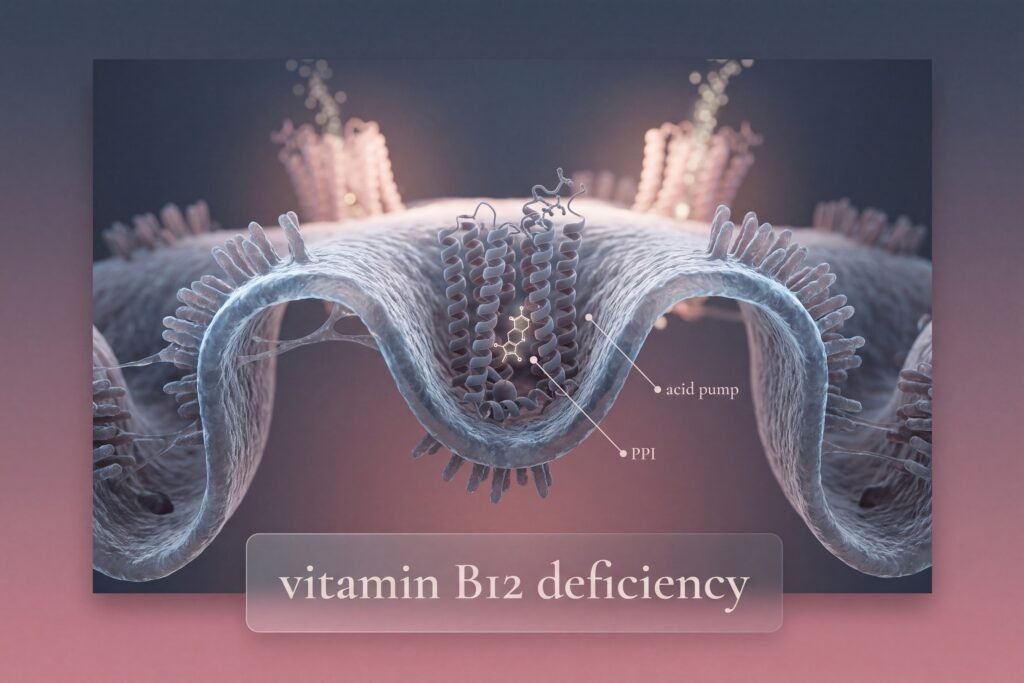
Stomach acid is the tool the body uses to free vitamin B12 from the animal protein it travels with in food. A PPI lowers that acid for as long as the drug stays active. Absorption further down still depends on a separate carrier protein, but the acid step comes first, and blocking it is where the whole chain slows down.3 In a short study, two weeks of omeprazole cut the absorption of protein-bound B12 from 3.2% to 0.9% at 20 mg a day and from 3.4% to 0.4% at 40 mg a day.7
From food to free B12
Meat, eggs and dairy carry vitamin B12 bound tightly to protein. Pepsin, an enzyme that only works in an acidic stomach, cuts that bond and releases the vitamin. The freed B12 then attaches to haptocorrin, a protein made in saliva, for its trip through the stomach into the small intestine. When a PPI raises stomach pH, this first release step slows, so more B12 stays locked to its food protein. Crystalline B12 in supplements skips this step entirely, because it starts out unbound. That is why supplements work well even during PPI therapy.3
The intrinsic factor handoff
Once B12 reaches the small intestine, pancreatic enzymes release it from haptocorrin and hand it to intrinsic factor, a protein made by the same stomach cells that make acid. The B12 and intrinsic factor pair travels to the last part of the small intestine, the terminal ileum, where dedicated receptors absorb the whole complex.3
At usual PPI doses, intrinsic factor production may continue largely as normal. Atrophic gastritis is different: it is another common cause of low stomach acid in older adults, and it lowers intrinsic factor directly.3 So the bottleneck with a PPI sits earlier, at the acid-dependent release from food. That is also why B12 deficiency from a PPI tends to build slowly, over years of continuous therapy.
Infographic
Less stomach acid
A PPI lowers stomach acid for as long as the drug stays active.
B12 stays locked in food
Pepsin only works in an acidic stomach, so more B12 stays bound to its food protein.
Later steps keep working
At usual PPI doses, intrinsic factor production may continue largely as normal.
A slow build
B12 deficiency from a PPI tends to build slowly, over years of continuous therapy.
Sources: Stabler 2013.
gutpathways.com
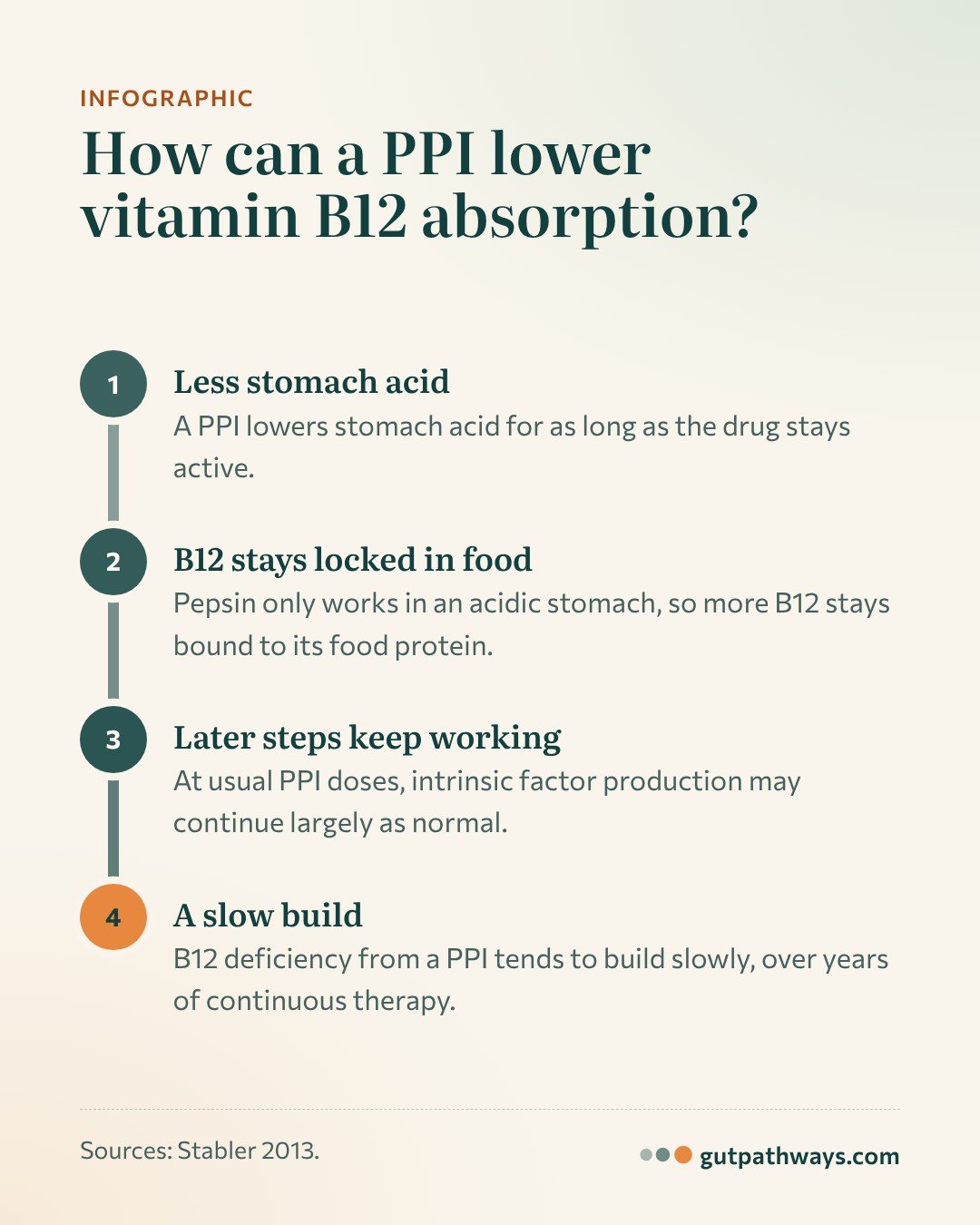 Save this infographicImage 4:5, with sources, from gutpathways.com
Does the type of PPI change the risk?
The type of PPI changes the strength of acid suppression. Because stronger and longer acid suppression is the mechanism behind B12 loss, the choice of drug may matter for long-term risk. A meta-analysis of 57 studies that measured stomach pH found an almost eightfold spread in relative potency, with rabeprazole and esomeprazole suppressing acid the most and pantoprazole the least.2
How potency compares across the five main PPIs
The researchers set omeprazole at 1.00 and compared the others by the mean 24-hour stomach pH each drug achieved. Pantoprazole came out weakest at 0.23, lansoprazole was close to omeprazole at 0.90, and esomeprazole and rabeprazole were well above it at 1.60 and 1.82.2 The authors added a caution: the dose ranges tested were limited and the study conditions were not identical.
Relative acid-suppressing potency, omeprazole = 1.00
Kirchheiner 2009, meta-analysis of 57 studies of mean 24-hour stomach pH.
Meet the six PPIs
Six PPIs cover most prescriptions and pharmacy shelves. Each treats a similar set of acid-related conditions, with small differences in strength, breakdown in the body and approved use.
Approved for gastroesophageal reflux disease (GERD), peptic ulcers and H. pylori eradication together with antibiotics. It is still one of the most widely prescribed.
Cleared more slowly by the liver than omeprazole. Used for GERD, healing and maintenance of erosive esophagitis and lowering ulcer risk during long-term NSAID use.
Often used in hospitals, including by vein, for GERD, erosive esophagitis and conditions with very high acid output such as Zollinger-Ellison syndrome.
Used for GERD, duodenal and gastric ulcers and H. pylori eradication. One of the few PPIs with pediatric approval.
Approved for GERD, duodenal ulcers and Zollinger-Ellison syndrome. It is broken down largely without enzymes, so CYP2C19 gene variants matter less.
A dual-release form of lansoprazole. Used for GERD and erosive esophagitis, with a longer window of acid control from one daily dose.
How does the risk change with how long someone has used a PPI?
The risk of B12 deficiency climbs the longer someone stays on a PPI. Most studies find little signal in the first year and a clearly higher risk after two years. In a 12-month prospective study of adults, B12 and ferritin did fall, but only 2.9% of the participants developed low B12 and 3.8% low iron, and the authors judged that the changes did not reach a level that matters in the clinic.8 That fits the idea that the deficiency needs sustained acid suppression to develop.
- First 12 months2.9%of PPI users developed low B12 in a 12-month prospective study.8
- 12 months or moreOR 4.45in older adults on current H2 blockers or PPIs.5
- Two years or moreOR 1.65in the Kaiser Permanente study.1
- Two years, high doseOR 1.95for more than 1.5 PPI pills a day in the same study.1
Can PPIs create gut problems that look like IBS?
In the practice where I work as a scientific collaborator, people with irritable bowel syndrome often run low on B12, regardless of how carefully they eat or which foods they have already cut out. Stomach acid keeps the small intestine relatively free of bacteria, and a PPI weakens that barrier. That opens the door to small intestinal bacterial overgrowth (SIBO), which mimics IBS symptom for symptom and adds its own hit to nutrient absorption.
The SIBO connection
A 2013 meta-analysis of eleven studies found that PPI users had more than double the odds of SIBO compared with non-users.9 The link was clear in studies that used intestinal aspirate cultures, but not in those that used the glucose breath test. A 2025 meta-analysis of 29 studies found a similar pooled estimate (OR 2.14) and a rise of about 4.3 percentage points in SIBO prevalence for each extra month of PPI use.10
SIBO causes bloating, gas and diarrhea that overlap heavily with IBS. The same low-acid environment that lets bacteria move upward also hinders B12 release from food. That helps explain why low B12 and IBS-type symptoms keep turning up in the same people. The two-way link between histamine intolerance and SIBO runs through the same acid pathway, and long-term PPI use often starts with acid reflux without heartburn. The reason the stomach needs its acid is covered in why stomach acid matters more than an alkaline diet.
PPI users had more than double the odds of small intestinal bacterial overgrowth compared with non-users, pooled across eleven studies (OR 2.28).9
The same low-acid, overgrowth-driven picture appears in a case where SIBO was first mistaken for celiac disease, Nick's celiac-like case. For a direct PPI example, see George's omeprazole case.
What is the MTHFR connection, and why does it matter?
Two separate pathways can push in the same direction when a PPI and a common MTHFR variant meet in the same person. A PPI limits how much B12 is released from food upstream, while a low-activity MTHFR variant limits how well the body uses folate downstream, in the cycle that keeps homocysteine in check.
- MTHFR
- A gene for methylenetetrahydrofolate reductase, an enzyme the body needs to process folate and turn homocysteine back into methionine. Common variants such as C677T lower its activity. In people with lower folate levels, carriers of two copies had about 24% higher homocysteine than people with the usual genotype.11
Each half of this picture is well documented on its own: acid suppression lowers B12 release, and low-activity MTHFR variants raise homocysteine when B vitamin status is low.7, 11 However, a study that follows PPI users grouped by MTHFR genotype has not been published. For someone who carries a low-activity variant and stays on a PPI for years, the overlap may justify watching B12 and homocysteine together. It is a reasonable precaution based on two established mechanisms, even before a combined study exists.
What other nutrients can long-term PPI use affect?
Vitamin B12 gets most of the attention, yet several other nutrients share the same acid-dependent story. A review of PPI-related deficiencies lists vitamin B12, vitamin C, calcium, iron and magnesium, with the risk relatively low in the general population and higher in older or malnourished people and people on dialysis.12
- Magnesium, with case reports of levels low enough to affect heart rhythm and seizure threshold
- Calcium, through lower absorption of the insoluble form found in many supplements
- Iron, tied to the same acid-dependent release step that affects B12
- Vitamin C, and possibly vitamin D, reported at lower levels with sustained use
How the risks compare
B12 deficiency sits in the middle when placed next to other conditions linked to long-term PPI use. SIBO shows the largest relative increase among the four, hip fracture the smallest, and community-acquired pneumonia lands close to B12 deficiency.9, 13, 1, 14
How long should someone take a PPI?
Most PPI courses are meant to last weeks, with a defined stopping point and a review. Guidance for GERD uses an eight-week PPI course as the standard trial.15 Every person on a PPI should have the reason for it reviewed regularly, and anyone without a clear long-term indication should be considered for a trial of stopping or lowering the dose.16
How to protect your vitamin B12 status while on a PPI
A short list of habits covers most of the protection someone on long-term PPI therapy needs, starting with testing before any symptoms appear. None of it requires stopping a medicine that is really needed.

Test B12 with methylmalonic acid
Ask for serum vitamin B12 together with methylmalonic acid. Methylmalonic acid can rise before B12 falls low enough to flag on its own.3
Check early and repeat
Plan the first check about a year after starting the PPI, then repeat it every one to two years while you stay on it.
Choose crystalline B12
Crystalline B12, the form in fortified cereals and most tablets, is absorbed without stomach acid.3
Review the dose
At each follow-up, bring up the lowest effective dose and the original reason for the prescription.16
Taken together, these habits turn B12 deficiency from a slow, years-long drift into something caught early and corrected easily.3 Meanwhile, the original reason for the PPI stays properly managed.
Frequently asked questions
Vitamin B12 in food travels bound to protein, and stomach acid with pepsin frees it. A PPI lowers that acid, so less B12 is released from food and passed on to intrinsic factor, which carries it into the blood.3
Crystalline B12, the form in fortified foods and most tablets, skips the acid step, so it is absorbed well during PPI therapy. The amount and form should be set with your doctor and checked with a follow-up blood test.17
Methylmalonic acid builds up when the body lacks B12 inside the cells. It can rise before serum B12 falls clearly low, so testing both catches an early deficiency.3
A periodic B12 and methylmalonic acid check, together with a talk about the lowest effective dose and whether the original reason still applies, gives the prescriber what they need. That decision belongs with the prescriber, since the condition the PPI treats carries its own risks.16
References
17 studies
- Lam JR, Schneider JL, Zhao W, Corley DA. Proton pump inhibitor and histamine 2 receptor antagonist use and vitamin B12 deficiency. JAMA. 2013.
- Kirchheiner J, Glatt S, Fuhr U, et al. Relative potency of proton-pump inhibitors, comparison of effects on intragastric pH. Eur J Clin Pharmacol. 2009.
- Stabler SP. Clinical practice. Vitamin B12 deficiency. N Engl J Med. 2013.
- Choudhury A, Jena A, Jearth V, et al. Vitamin B12 deficiency and use of proton pump inhibitors: a systematic review and meta-analysis. Expert Rev Gastroenterol Hepatol. 2023.
- Valuck RJ, Ruscin JM. A case-control study on adverse effects: H2 blocker or proton pump inhibitor use and risk of vitamin B12 deficiency in older adults. J Clin Epidemiol. 2004.
- Damião CP, Rodrigues AO, Pinheiro MF, et al. Prevalence of vitamin B12 deficiency in type 2 diabetic patients using metformin: a cross-sectional study. Sao Paulo Med J. 2016.
- Marcuard SP, Albernaz L, Khazanie PG. Omeprazole therapy causes malabsorption of cyanocobalamin (vitamin B12). Ann Intern Med. 1994.
- Qorraj-Bytyqi H, Hoxha R, Sadiku S, et al. Proton pump inhibitors intake and iron and vitamin B12 status: a prospective comparative study with a follow up of 12 months. Open Access Maced J Med Sci. 2018.
- Lo WK, Chan WW. Proton pump inhibitor use and the risk of small intestinal bacterial overgrowth: a meta-analysis. Clin Gastroenterol Hepatol. 2013.
- Khurmatullina AR, Andreev DN, Kucheryavyy YA, et al. The duration of proton pump inhibitor therapy and the risk of small intestinal bacterial overgrowth: a systematic review and meta-analysis. J Clin Med. 2025.
- Jacques PF, Bostom AG, Williams RR, et al. Relation between folate status, a common mutation in methylenetetrahydrofolate reductase, and plasma homocysteine concentrations. Circulation. 1996.
- Heidelbaugh JJ. Proton pump inhibitors and risk of vitamin and mineral deficiency: evidence and clinical implications. Ther Adv Drug Saf. 2013.
- Islam MM, Poly TN, Walther BA, et al. Adverse outcomes of long-term use of proton pump inhibitors: a systematic review and meta-analysis. Eur J Gastroenterol Hepatol. 2018.
- Poly TN, Islam MM, Yang HC, et al. Proton pump inhibitors and risk of hip fracture: a meta-analysis of observational studies. Osteoporos Int. 2019.
- Katz PO, Dunbar KB, Schnoll-Sussman FH, et al. ACG clinical guideline for the diagnosis and management of gastroesophageal reflux disease. Am J Gastroenterol. 2022.
- Targownik LE, Fisher DA, Saini SD. AGA clinical practice update on de-prescribing of proton pump inhibitors: expert review. Gastroenterology. 2022.
- Andrès E, Dali-Youcef N, Vogel T, et al. Oral cobalamin (vitamin B12) treatment. An update. Int J Lab Hematol. 2009.
Found this useful? Share it with someone who needs it.
Cite this article
Prevedoros, T. (2026, August 1). How long-term PPI use can lead to vitamin B12 deficiency. Gut Pathways. https://gutpathways.com/articles/ppi-vitamin-b12-deficiency/