Why metformin causes diarrhea in some people and not others
Metformin and diarrhea go together so often that many people think it is just the price of the drug. Gut side effects affect 20% to 30% of users, and a transporter gene called OCT1 explains part of who suffers. Here is the mechanism, the timeline and the changes that help.
Does metformin cause diarrhea, and how often?
Yes. Gastrointestinal side effects occur in 20% to 30% of people treated with metformin and lead 5% to 10% of them to stop the drug early.1 Among those effects, loose, watery stools are reported more often than any other single symptom.2, 6
In other words, if your stomach has not made peace with metformin yet, you are in large company. Bloating, abdominal pain, nausea, vomiting and constipation follow at lower rates. The chart shows how often each symptom appeared in a meta-analysis of 21 observational studies.2
Gut symptoms reported with metformin
Nabrdalik 2024, meta-analysis of 21 observational studies. The overall 20% to 30% range comes from clinical cohorts.
Is diarrhea the main side effect of metformin?
Diarrhea is the most common side effect, but it is not the only one. Metformin side effects can involve the whole digestive tract, from nausea and bloating to, less often, constipation, plus a few effects that have nothing to do with the bowel. Still, diarrhea is the complaint that sends most people back to their doctor.6
The same drug can also dull the appetite, leave a metallic taste early in treatment or slowly lower vitamin B12 over the years, which is why long-term users should have B12 checked regularly.5 If bloating rather than loose stool is your main problem, the guide on what causes abdominal bloating is a better next read.
- Bloating and pressure after meals
- Abdominal pain or cramping
- Nausea, less often vomiting
- Constipation in a smaller share
- A metallic taste early on
- Low vitamin B12 with long-term use
Why does metformin cause diarrhea in some people but not others?
The short answer is genetics and co-prescribed drugs, not willpower and not diet alone. Some people with type 2 diabetes develop stubborn symptoms while others feel nothing at the same dose and with similar meals. Large cohorts show that women, older people, carriers of certain transporter variants and people taking transporter-blocking drugs are more likely to be intolerant.1, 3
In the practice where I work as a scientific collaborator, when someone has tried everything and still cannot tolerate metformin, the first question is not what they eat. It is how their body moves the drug across cell membranes, which is exactly what a young field of science studies.
- Pharmacogenomics
- The study of how genetic variants shape the way the body absorbs, metabolizes and clears a drug, and therefore how well each person tolerates it. For metformin, the central player is a transporter called OCT1.
What is the mechanism behind metformin-induced diarrhea?
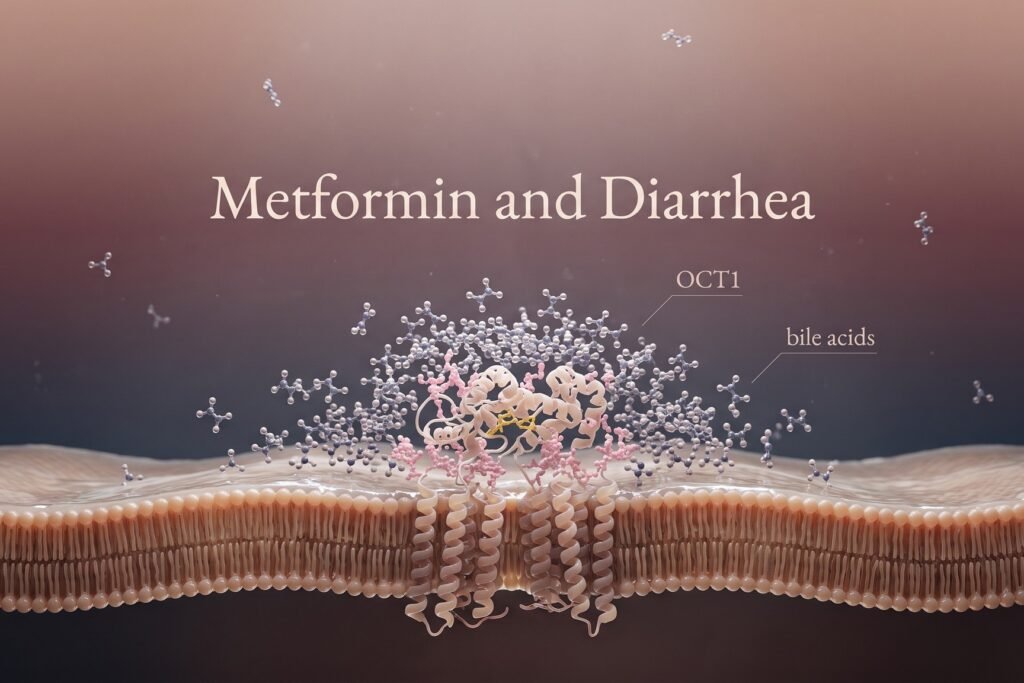
The mechanism starts with how much metformin stays in the gut. OCT1, coded by the SLC22A1 gene, is best known for moving metformin into liver cells.7 In the intestine, it sits on the side of the lining cells that faces the gut contents, and it is one of several transporters that take metformin up from the lumen.8, 9
Metformin concentrations in the jejunum reach 30 to 300 times the levels in blood. In the gut, the drug increases glucose uptake and lactate production, enlarges the bile acid pool and changes the microbiome.9 When OCT1 works below capacity, researchers think even more metformin stays in the intestine, which may raise the risk of loose stools as bile acids and water reach the colon.3, 1
How much does the OCT1 variant raise the risk of metformin diarrhea?
The size of the genetic effect shows up clearly, and it reframes metformin and diarrhea as a pharmacogenetic problem rather than a weak stomach. In a Scottish cohort of 251 intolerant and 1,915 tolerant people, drugs that inhibit OCT1 raised the odds of intolerance, two reduced-function variants raised them further, and the combination raised them more than fourfold.3
A second, independent European cohort of 286 intolerant and 1,128 tolerant people showed a similar picture. Transporter-inhibiting drugs raised the odds of intolerance by 1.72 times, and three or more risk variants more than doubled them.1 Two separate cohorts pointing the same way make the finding hard to dismiss.
How common is the OCT1 reduced-function variant?
The variant is anything but rare. About 40% of people of European ancestry carry one reduced-function OCT1 variant, and about 9% carry two.4 Global data confirm that around 9% of people of European ancestry lack or have very low OCT1 activity, while the share differs widely by ancestry, from almost none in East Asia to about 80% in native South American populations.10
Add everyone with at least one copy and you reach nearly half the people around you. That helps explain why metformin intolerance is so widespread, and why blanket advice like "just push through it" fails so many people with type 2 diabetes.
Does OCT1 affect other medications you take?
Yes. OCT1 is not a private road for metformin. In the liver it also takes up morphine, tropisetron, sumatriptan and fenoterol, and lower OCT1 activity can change how much of these drugs reaches the liver.7, 11 A sluggish OCT1 can therefore change what more than one of your medicines does.
| Drug (class) | What reduced OCT1 may mean |
|---|---|
| Morphine (opioid pain reliever) | Less uptake into the liver and slower clearance |
| Sumatriptan (migraine drug) | Less uptake into the liver and slower clearance |
| Fenoterol (bronchodilator) | Less uptake into the liver and slower clearance |
| Tropisetron (anti-nausea drug) | Higher blood levels |
| Oxaliplatin (platinum chemotherapy) | Altered concentrations inside liver cells |
| Sorafenib (cancer drug) | Lower uptake into target cells, possibly a weaker effect |
Some drugs go further and block the transporter. In a 2025 study, cimetidine, an older stomach-acid drug, raised blood exposure to a single small metformin dose by 24%, mainly by blocking OCT1 in the liver.12 An older study with repeated dosing found an increase of about 50%.13 If you already take a drug that blocks OCT1, the metformin reaching your system may be higher than the dose on the box suggests.
Are there genes beyond OCT1 in metformin intolerance?
Yes. OCT1 is not the only transporter handling metformin. SLC22A2, which codes for OCT2, and SLC47A1, which codes for MATE1, help move and excrete the drug through the kidneys, while the gut transporter PMAT, coded by SLC29A4, takes part in uptake from the intestine.9, 1
In 53 people with side effects and 193 without, two OCT1 variants were linked with gastrointestinal side effects, with no matching signal for OCT2 or MATE1.14 In the IMI DIRECT cohort, a variant that lowers PMAT in gut tissue also raised the odds of intolerance.1 On the other hand, a 2023 meta-analysis of 30 studies found no consistent overall association between OCT polymorphisms and intolerance.15 No single gene explains everything, and a network of transporters works together.
How big is the metformin and diarrhea problem worldwide?
Metformin is the most widely prescribed first-line drug for type 2 diabetes and is listed in the World Health Organization's essential medicines guidance.16 About 589 million adults aged 20 to 79 lived with diabetes in 2024, around 1 in 9, and more than 90% of them have type 2 diabetes.17
Put those numbers next to a side effect that touches 20% to 30% of users, and tens of millions of people are negotiating with their gut every day. That is what makes metformin and diarrhea a global tolerability question rather than a footnote.
Does extended-release metformin cause less diarrhea than immediate release?
The formulation matters more than most people think, and the difference is mechanical. An immediate-release tablet dissolves within minutes and exposes the upper gut to the full dose at once. An extended-release tablet holds the drug in a slow gel matrix, so metformin seeps out gradually along the intestine.

Does switching to extended-release metformin reduce diarrhea?
Switching reduces several gut symptoms, though the effect on diarrhea itself is smaller. In the pooled observational data, extended release lowered bloating, abdominal pain, constipation and vomiting compared with immediate release, while the drop in diarrhea did not reach statistical significance (p = 0.095).2 In randomized trials, immediate release carried a higher risk of bloating and diarrhea than extended release.18
| Symptom | Meta-regression coefficient | p value |
|---|---|---|
| Constipation | -5.78 | 0.0014 |
| Bloating | -4.46 | under 0.001 |
| Abdominal pain | -2.80 | 0.001 |
| Vomiting | -2.47 | under 0.001 |
| Diarrhea | -1.17 | 0.095 |
In practice, if bloating or abdominal pain is your main problem, asking about the extended-release form makes clear sense. If diarrhea dominates, the switch may still help, but expect a partial improvement rather than a guaranteed fix.
Will diarrhea from metformin go away?
For most people, yes. Symptoms are most common in the first weeks and then fade as the gut adapts, and careful titration or a switch to extended release resolves most persistent cases.5 The figures below are commonly quoted estimates of that pattern rather than results of a single study.

Weeks 1 to 4, the peak phase
Diarrhea is most frequent in the opening weeks. Around 30% of people may notice symptoms here, and by the end of month 2 the rate may fall toward 10% as the intestine adjusts.

Chronic cases, about 5%
In a small share, the problem lasts beyond several weeks. Switching to extended release or splitting the dose, for example 500 mg morning and evening instead of one 1,000 mg tablet, may resolve most of these cases, and about 5% eventually stop the drug.


High-fat meals
High-fat meals can change how metformin is absorbed and may keep more of the drug in the gut, so taking it with a regular meal, often the evening meal, is usually gentler.9
What about late-onset metformin-induced chronic diarrhea?
Late-onset diarrhea deserves its own spotlight, because it fools both patients and doctors. A case series in Clinical Diabetes described people on stable metformin for years who developed chronic diarrhea and weight loss, with symptoms resolving after the drug was stopped.19 A short, supervised trial off metformin may therefore come before invasive or expensive tests.
The trap is that this pattern gets labeled as irritable bowel syndrome or celiac disease. If you are comparing your story against the different IBS types, keep metformin on the suspect list, especially when symptoms start years into treatment.
Subramaniam and colleagues reported patients who developed chronic diarrhea and weight loss after years on stable metformin doses, in one case after a diagnosis of IBS. Symptoms resolved after metformin was withdrawn.19
What foods should you avoid or eat to manage diarrhea from metformin?
Diet cannot switch off the OCT1 transporter, but it can calm the loop a great deal. Some foods may worsen diarrhea by changing how the drug is absorbed or by pulling extra water into the bowel, while others ease it by slowing transit gently.
The logic is simple. High-fat meals can reduce how well metformin is absorbed, so more may stay in contact with the intestine.9 Glucose surges may add to the osmotic effect, large portions of raw high-fiber vegetables add fermentation and gas during the adjustment weeks, and sugar alcohols such as sorbitol and mannitol draw water into the bowel.
| Better to limit | Choose instead (and why) |
|---|---|
| Greasy, fried foods | Oatmeal and bananas. Fat may change absorption and keep more metformin in the gut. |
| Sugary desserts | Boiled eggs and yogurt. Glucose surges may add to the osmotic effect. |
| Large portions of raw high-fiber vegetables | White rice, cooked vegetables and applesauce. Less fermentation and gas while the gut adapts. |
| Sugar-free sweets with sorbitol or mannitol | Lean proteins and toast. Sugar alcohols draw extra water into the bowel. |
What can you do to reduce diarrhea from metformin?
If you need to stay on metformin, the diarrhea usually softens with a few deliberate moves. Slow titration and the extended-release form are the standard first steps, and adding probiotics lowered the risk of diarrhea, bloating and constipation in a meta-analysis of randomized trials.5, 20 None of these changes fixes the OCT1 transporter itself.


Take it with a meal
Take metformin with food, often the main evening meal, and never on an empty stomach.

Ask about extended release
Ask your doctor whether the extended-release formulation suits you, especially if bloating or abdominal pain dominate.2
Discuss a probiotic
In pooled trials, adding probiotics to metformin lowered the risk of diarrhea, bloating and constipation.20
Consider psyllium, spaced from the dose
Psyllium forms a gel that increases bile acid excretion in stool.21 Because bile acids are part of the problem, it may help, but keep it 2 to 4 hours away from the metformin dose so the gel does not hold the drug.
When should you see your healthcare provider?
Some situations call for a doctor rather than another home remedy. Diarrhea lasting beyond six weeks, diarrhea with weight loss, greasy or floating stools, or symptoms that wake you at night all deserve a proper work-up. Common supplements can also cause diarrhea in sensitive guts, as the guide on glutamine and diarrhea shows.
One overlooked suspect is exocrine pancreatic insufficiency. In a multicenter study of 1,021 people with diabetes, 22.9% had severely reduced fecal elastase.23 Reviews warn that its milder symptoms, such as abdominal discomfort, diarrhea and gas, can be misread as side effects of metformin.24 Diabetes itself can also cause bowel problems through nerve damage, and Michael's case shows how hidden pancreatic insufficiency can sit behind years of symptoms.
Frequently asked questions
For most people, yes. Symptoms are most common in the first weeks and usually fade as the gut adapts. If they persist, switching to extended release or splitting the daily dose helps most cases. Diarrhea can also appear after years of trouble-free use, so new symptoms late in treatment still deserve a look at the drug.5
More frequent and looser stools are common in the first weeks, because more metformin, glucose and bile acids reach the lower gut. Persistent diarrhea, weight loss or greasy stools are not normal and need a check.9
Limit greasy and fried foods, sugary desserts, large servings of raw high-fiber vegetables and sugar alcohols such as sorbitol and mannitol while the gut adapts. Oatmeal, bananas, white rice, cooked vegetables, eggs, yogurt and lean proteins are usually easier, and metformin is best taken with a meal.
Extended-release metformin releases the drug slowly along the intestine and is better tolerated overall. Its advantage is clearest for bloating, abdominal pain, constipation and vomiting, while the benefit for diarrhea itself is smaller in pooled data.2
References
24 studies
- Dawed AY, Zhou K, van Leeuwen N, et al. Variation in the plasma membrane monoamine transporter (PMAT) (encoded by SLC29A4) and organic cation transporter 1 (OCT1) (encoded by SLC22A1) and gastrointestinal intolerance to metformin in type 2 diabetes: an IMI DIRECT study. Diabetes Care. 2019.
- Nabrdalik K, Hendel M, Irlik K, et al. Gastrointestinal adverse events of metformin treatment in patients with type 2 diabetes mellitus: a systematic review and meta-analysis with meta-regression of observational studies. BMC Endocr Disord. 2024.
- Dujic T, Zhou K, Donnelly LA, Tavendale R, Palmer CN, Pearson ER. Association of organic cation transporter 1 with intolerance to metformin in type 2 diabetes: a GoDARTS study. Diabetes. 2015.
- Liang X, Yee SW, Chien HC, et al. Organic cation transporter 1 (OCT1) modulates multiple cardiometabolic traits through effects on hepatic thiamine content. PLoS Biol. 2018.
- Silverii GA. Optimizing metformin therapy in practice: tailoring therapy in specific patient groups to improve tolerability, efficacy and outcomes. Diabetes Obes Metab. 2024.
- Bonnet F, Scheen A. Understanding and overcoming metformin gastrointestinal intolerance. Diabetes Obes Metab. 2017.
- Bokelmann K, Brockmöller J, Tzvetkov MV. Impact of promoter polymorphisms on the transcriptional regulation of the organic cation transporter OCT1 (SLC22A1). J Pers Med. 2018.
- Han TK, Everett RS, Proctor WR, et al. Organic cation transporter 1 (OCT1/mOct1) is localized in the apical membrane of Caco-2 cell monolayers and enterocytes. Mol Pharmacol. 2013.
- McCreight LJ, Bailey CJ, Pearson ER. Metformin and the gastrointestinal tract. Diabetologia. 2016.
- Seitz T, Stalmann R, Dalila N, et al. Global genetic analyses reveal strong inter-ethnic variability in the loss of activity of the organic cation transporter OCT1. Genome Med. 2015.
- Lozano E, Herraez E, Briz O, et al. Role of the plasma membrane transporter of organic cations OCT1 and its genetic variants in modern liver pharmacology. Biomed Res Int. 2013.
- Ailabouni AS, Singh DK, Thakur A, et al. Quantitative contributions of hepatic and renal organic cation transporters to the clinical pharmacokinetic cimetidine-metformin interaction. Clin Pharmacol Ther. 2025.
- Somogyi A, Stockley C, Keal J, Rolan P, Bochner F. Reduction of metformin renal tubular secretion by cimetidine in man. Br J Clin Pharmacol. 1987.
- Tarasova L, Kalnina I, Geldnere K, et al. Association of genetic variation in the organic cation transporters OCT1, OCT2 and multidrug and toxin extrusion 1 transporter protein genes with the gastrointestinal side effects and lower BMI in metformin-treated type 2 diabetes patients. Pharmacogenet Genomics. 2012.
- Peng A, Gong C, Xu Y, et al. Association between organic cation transporter genetic polymorphisms and metformin response and intolerance in T2DM individuals: a systematic review and meta-analysis. Front Public Health. 2023.
- World Health Organization. Guidelines for the pharmacological treatment of type 2 diabetes in primary care (essential medicines framework).
- International Diabetes Federation. IDF Diabetes Atlas, 11th edition. Diabetes facts and figures.
- Nabrdalik K, Skonieczna-Żydecka K, Irlik K, et al. Gastrointestinal adverse events of metformin treatment in patients with type 2 diabetes mellitus: a systematic review, meta-analysis and meta-regression of randomized controlled trials. Front Endocrinol (Lausanne). 2022.
- Subramaniam K, Joseph MP, Babu LA. A common drug causing a common side effect at an uncommon time: metformin-induced chronic diarrhea and weight loss after years of treatment. Clin Diabetes. 2021.
- Szymczak-Pajor I, Drzewoski J, Wenclewska S, Śliwińska A. Metformin-associated gastrointestinal adverse events are reduced by probiotics: a meta-analysis. Pharmaceuticals (Basel). 2024.
- Marlett JA, Fischer MH. The active fraction of psyllium seed husk. Proc Nutr Soc. 2003.
- Yoon DY, Kim J, Cho JY, Chung JY. Influence of gut bile acid composition on the glucose-lowering effect and safety of metformin. Br J Clin Pharmacol. 2025.
- Hardt PD, Hauenschild A, Nalop J, et al. High prevalence of exocrine pancreatic insufficiency in diabetes mellitus. A multicenter study screening fecal elastase 1 concentrations in 1,021 diabetic patients. Pancreatology. 2003.
- Radlinger B, Ramoser G, Kaser S. Exocrine pancreatic insufficiency in type 1 and type 2 diabetes. Curr Diab Rep. 2020.
Found this useful? Share it with someone who needs it.
Cite this article
Prevedoros, T. (2026, July 25). Why metformin causes diarrhea in some people and not others. Gut Pathways. https://gutpathways.com/articles/metformin-and-diarrhea/