What the evidence shows about psyllium for IBS
Psyllium is the fiber with the most consistent trial results in irritable bowel syndrome. It forms a gel that softens hard stool, firms loose stool and makes little gas, and most of the bloating people blame on it comes from how it is started.

Does psyllium improve IBS symptoms?
Yes, and the evidence is stronger than for almost any other fiber supplement. Psyllium for IBS has been tested in randomized trials for decades, and the results hold up when they are pooled. A 2014 meta-analysis combined 14 trials with 906 people with IBS. Overall, fiber lowered the relative risk of remaining symptomatic to 0.86 compared with placebo.1
Once the researchers split the fiber types, however, the picture became sharper. Soluble fiber, mainly psyllium, cut that risk to 0.83, while bran showed no significant benefit. That gap between fiber types is the main message, and it is why the advice "eat more fiber" misses the point in IBS.
Since then, the guidelines have followed the same line. The American Gastroenterological Association's 2022 update on diet in IBS lists soluble fiber, not fiber in general, as a treatment with evidence for global IBS symptoms.5 Likewise, the American College of Gastroenterology recommends soluble fiber and advises against insoluble fiber for IBS.6
A meta-analysis published in August 2026 pooled 16 trials with 1,293 people. Overall, 52% responded to fiber and 44% to control, and psyllium raised the chance of response by 53% (risk ratio 1.53).2
The same 2026 review adds one caution. In the trials that measured overall symptom scores instead of response, fiber as a group did not clearly beat control, and most trials did not report results by IBS subtype.2 So psyllium helps many people with IBS, but not everyone, and the subtype matters, as the sections below show. The wider question of which fibers suit a sensitive gut, and how much fiber per day makes sense, is covered in fibermaxxing and daily fiber intake for a sensitive gut.
How does psyllium work once it reaches your gut?
Psyllium husk is the outer coat of the seeds of Plantago ovata. Its active part is a highly branched arabinoxylan, a chain of xylose sugars with many side branches.7 When it meets water, this polysaccharide swells into a soft, cohesive gel that holds many times its own weight in liquid. That gel does most of the work.
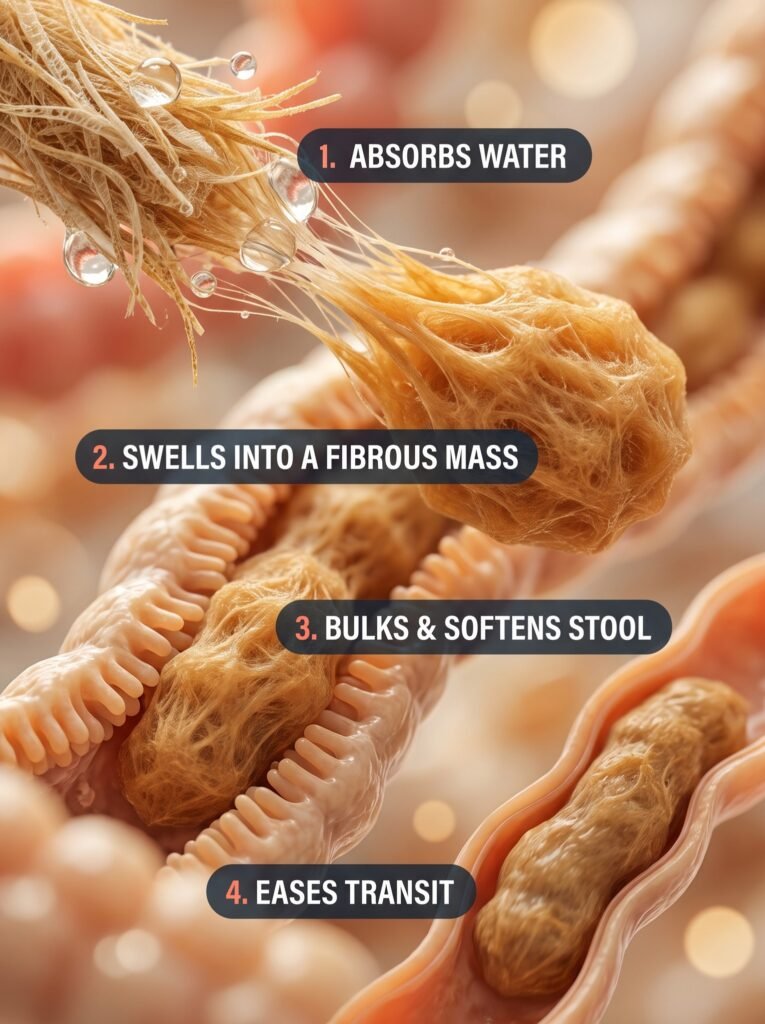
The gel works in four connected steps
First, the fiber absorbs water in the small intestine. Second, it swells into a fibrous gel. Third, the gel adds soft, even bulk to stool and holds water inside the colon, which is why it can soften hard stool in IBS-C and firm loose stool in IBS-D. Fourth, and this is the part most people never hear, psyllium is fermented only slightly by gut bacteria.
In studies of the separate fractions of the husk, the gel-forming part made up about 55% of psyllium and was poorly fermented, and this part raised stool moisture.3 In contrast, short-chain fibers that ferment fast, such as inulin and other oligosaccharides, produce gas quickly and tend to cause pain and bloating in IBS.8
Why psyllium makes less gas than inulin
In a Nottingham crossover trial, 19 people with IBS drank inulin, psyllium, both together or a placebo, and had MRI scans for six hours. Inulin caused the largest rise in colonic gas. Taken together with psyllium, inulin produced much less colonic gas, and total breath hydrogen fell from 7,230 to 1,035 ppm-hours, about sevenfold.4 On its own, psyllium did not raise breath hydrogen.
Two 2026 trials from the same group explain more of the effect. In 30 healthy volunteers, psyllium slowed the early fermentation of inulin, and the authors linked this to the way the psyllium gel quickly re-forms after the gut squeezes it.9 In a second trial with 22 volunteers, psyllium and a methylcellulose gel both reduced colonic gas once the gels reached the colon.10
Psyllium is a laxative that forces the bowel to move.
In practice, this is the difference people notice early. After a switch from wheat bran or an inulin-based blend to psyllium, the bloating that sent them looking for help in the first place often eases within days.
Does psyllium change the gut microbiome?
Psyllium is not a strong prebiotic, but it does shift the microbiome a little. In a small trial, seven days of psyllium raised stool water in people with constipation and increased bacteria that make butyrate, such as Lachnospira, Roseburia and Faecalibacterium.11 The effect was smaller in healthy volunteers. If low Faecalibacterium is part of your picture, see what raises low Faecalibacterium prausnitzii.
Does psyllium work the same in IBS-C and IBS-D?
Yes, and that surprises many people who assume fiber only treats constipation. Psyllium's gel holds water in both directions. In IBS-C it softens and lubricates hard, slow stool, and in IBS-D it takes up extra liquid and firms loose stool, without the gas that fast-fermenting fibers cause.
My gastroenterologist told me to try psyllium for my IBS-C, but every fiber supplement I tried before made my bloating much worse within a day. Will psyllium do the same thing?
It is a fair worry and a common one. Most fiber that backfires fast is highly fermentable, like inulin or chicory root, so gut bacteria break it down quickly and make a lot of gas. Psyllium ferments far more slowly, so it mainly holds water and adds bulk, with much less gas along the way. Starting with a small amount, a full glass of water and a slow build-up over one to two weeks usually makes the difference. Many people who reacted to other fibers find psyllium much easier, as long as the amount rises gradually.
How do you take psyllium husk for IBS without the bloating?
Nearly all of the bloating blamed on psyllium seems to trace back to two mistakes: too much fiber on the first day, and too little water to carry it. When the amount and the water are right, most of that reaction fades within a few days.

Too little water
Psyllium needs fluid to form its gel. Taken with too little water, it can thicken into a dense mass instead of a soft one, and in rare cases it has blocked the esophagus or the bowel.12, 13

Coffee at the same time
Caffeine speeds up gut transit. Taken together with coffee, a fiber that needs time and water to swell may move on before it has formed its gel.
Medicines at the same moment
The gel can slow the absorption of medicines taken at the same time, so the label of most products advises keeping a gap of about two hours.
The trials used fixed amounts. For example, the Dutch primary care trial gave 10 g of psyllium a day,14 and a German study in chronic constipation used 15 to 30 g a day of the whole seeds.15 Daily life is different from a trial, though, and the steps below describe the pattern that tends to work, while the amount itself is best set with your doctor or dietitian.
The gas and bloating of the first few days are usually the amount catching up with the water and the bacteria, and they settle once the two line up. When gas appears very soon after meals, the timing points to other causes as well, which are explained in why bloating after eating can start within minutes.
In practice, the starting amount is by far the most common problem. People start at the full label dose on day one, skip the water, and decide within 48 hours that psyllium does not agree with them. A smaller start and more water usually clear that reaction within days.
Adequate symptom relief with psyllium in primary care (%)
Bijkerk 2009, 275 people with IBS in general practice, share reporting adequate relief.14
In that trial, 57% of people on psyllium reported adequate relief after the first month, against 35% on placebo, and the gap held in the second month. After three months, symptom severity had fallen by 90 points with psyllium, against 49 points with placebo. Bran helped only in the third month, and early dropouts were most common in the bran group, mainly because symptoms got worse.14
Is psyllium safe, and can children take it?
For most adults, yes. Psyllium is a bulk-forming fiber, so daily long-term use is common, and reviews describe it as generally safe when the amount and the fluid are right.12, 8 The main side effects are bloating at the start, allergic reactions in a few people and, rarely, blockage when it is swallowed dry or with too little water.12
Can kids take psyllium for IBS?
The trials in children are encouraging. In a US trial of 103 children with IBS, psyllium reduced the number of pain episodes more than placebo, although pain intensity did not differ.16 A 2026 Indian trial of 109 children with functional abdominal pain, including IBS, found that 86% responded to 12 weeks of psyllium, against 60% on placebo.17 Even so, the amount for a child depends on age and weight, so a pediatrician should guide it.
Why does psyllium husk carry a cancer warning?
The warning that some people see on psyllium products comes from California's Proposition 65 labels, which flag trace amounts of lead found in many plant foods. The threshold for that label is set far below levels shown to cause harm, and it does not mean psyllium causes cancer. Choosing a brand with third-party testing is a sensible way to keep trace contaminants low.
What does it mean when psyllium only gets you partway?
Fiber type matters more than fiber amount, and that cuts both ways. It is possible to eat too much of the wrong fiber and still have IBS symptoms, even on what looks like a healthy diet.
One of our case studies shows the mirror image of everything above. A 23-year-old on a high-fiber vegan diet developed severe bloating and loose stool after years of antibiotics had thinned out her fiber-fermenting gut bacteria. Her fiber was a highly fermentable plant type, and it landed on a microbiome too depleted to keep up with it. That mismatch between fiber type and gut capacity produced the gas and pain.
So if you have given psyllium a fair trial, with a small start, enough water and several weeks, and your symptoms are still stuck, that result is useful information. It usually points to something underneath the fiber question, such as slow transit, a weak cleaning wave between meals, described in how a weak migrating motor complex sets up SIBO, or a deeper dysbiosis that needs its own order of steps, as in how to treat gut dysbiosis in the right order.
I bought psyllium capsules two weeks ago because a friend said they helped her IBS. I take six capsules with my morning coffee, and my stomach feels worse than before I started. Could capsules be the wrong choice for my gut?
Check two things first: the coffee and the all-at-once dose. Caffeine speeds up gut transit, so pairing it with a fiber that needs time and water to swell can push the psyllium on before it has taken up liquid. Six capsules at once is also a big jump, and capsules alone bring far less water than a powder stirred into a full glass. Splitting the amount into two smaller servings, away from coffee and each with a full glass of water, is a simple test. Many people who feel worse on psyllium capsules improve once the timing and the water catch up with the dose.
The bottom line on psyllium, IBS and what helps
Psyllium for IBS is one of the few pieces of gut health advice with real, repeated trial data behind it. It works because of what it is, a gel-forming soluble fiber that the colon ferments only slightly, and that specificity is the whole point. A slow start, enough water and a few weeks give it a fair test. When it only gets you partway, that result is worth investigating on its own terms.
Frequently asked questions
Briefly, yes, if you start too fast. A day or two of extra gas or bloating is common when the amount outpaces the water you drink with it. A smaller start and more water usually settle this within a few days, and true intolerance to psyllium itself is uncommon.
For most people, yes. Psyllium works as a bulk-forming fiber, unlike stimulant laxatives, and reviews describe daily use as generally safe. The main precautions are enough water and a gap from other medicines, since it can slow their absorption.12
No. The warning some people see refers to trace lead levels on California's Proposition 65 labels, a threshold set far below levels shown to cause harm. The research on psyllium points toward digestive and metabolic benefits.
The active fiber is the same. Metamucil is a branded psyllium husk product, and many versions contain added sugar or sweeteners. Plain psyllium husk or powder gives the same fiber in its simplest form, which matters if your gut reacts to sweeteners.
References
17 studies
- Moayyedi P, Quigley EM, Lacy BE, et al. The effect of fiber supplementation on irritable bowel syndrome: a systematic review and meta-analysis. Am J Gastroenterol. 2014.
- Staudacher HM, Rucco V, Mancell S, Dimidi E, Whelan K. Fiber supplementation in irritable bowel syndrome: a systematic review and meta-analysis of randomized controlled trials. Gastroenterology. 2026.
- Marlett JA, Fischer MH. The active fraction of psyllium seed husk. Proc Nutr Soc. 2003.
- Gunn D, Abbas Z, Harris HC, et al. Psyllium reduces inulin-induced colonic gas production in IBS: MRI and in vitro fermentation studies. Gut. 2022.
- Chey WD, Hashash JG, Manning L, Chang L. AGA clinical practice update on the role of diet in irritable bowel syndrome: expert review. Gastroenterology. 2022.
- Lacy BE, Pimentel M, Brenner DM, et al. ACG clinical guideline: management of irritable bowel syndrome. Am J Gastroenterol. 2021.
- Fischer MH, Yu N, Gray GR, et al. The gel-forming polysaccharide of psyllium husk (Plantago ovata Forsk). Carbohydr Res. 2004.
- El-Salhy M, Ystad SO, Mazzawi T, Gundersen D. Dietary fiber in irritable bowel syndrome (review). Int J Mol Med. 2017.
- Reid JESJ, Alhasani AT, MacCalman T, et al. A randomised, placebo-controlled trial in healthy humans of modified cellulose or psyllium evaluating the role of gelation in altering colonic gas production during inulin co-administration. Food Funct. 2026.
- Dellschaft N, Alhasani A, Reid JESJ, et al. Clinical trial: randomised placebo-controlled trial of methylcellulose and psyllium gels on inulin-induced colonic gas. Aliment Pharmacol Ther. 2026.
- Jalanka J, Major G, Murray K, et al. The effect of psyllium husk on intestinal microbiota in constipated patients and healthy controls. Int J Mol Sci. 2019.
- Kumar A, Patel R, Yadav S, et al. Psyllium husk: a comprehensive review of its functional properties, health benefits, mechanisms of action, and potential adverse effects. Curr Nutr Rep. 2026.
- Shin S, Kim JH, Mun YH, Chung HS. Acute esophageal obstruction after ingestion of psyllium seed husk powder: a case report. World J Clin Cases. 2022.
- Bijkerk CJ, de Wit NJ, Muris JW, et al. Soluble or insoluble fibre in irritable bowel syndrome in primary care? Randomised placebo controlled trial. BMJ. 2009.
- Voderholzer WA, Schatke W, Mühldorfer BE, et al. Clinical response to dietary fiber treatment of chronic constipation. Am J Gastroenterol. 1997.
- Shulman RJ, Hollister EB, Cain K, et al. Psyllium fiber reduces abdominal pain in children with irritable bowel syndrome in a randomized, double-blind trial. Clin Gastroenterol Hepatol. 2017.
- Kaur M, Poddar U, Srivastava A, Sarma MS, Mishra P. Randomized placebo-controlled trial of psyllium fiber in functional abdominal pain disorders in children. Dig Dis Sci. 2026.
Found this useful? Share it with someone who needs it.
Cite this article
Prevedoros, T. (2026, August 25). What the evidence shows about psyllium for IBS. Gut Pathways. https://gutpathways.com/articles/psyllium-for-ibs/