Fibre bloated a vegan gut after a course of antibiotics
A 23-year-old woman with vegan IBS developed bloating and loose stools after another course of antibiotics for a urinary infection. Her case shows why a high-fibre diet needs a strong microbiome to stay comfortable.
 Jenny's casecase study
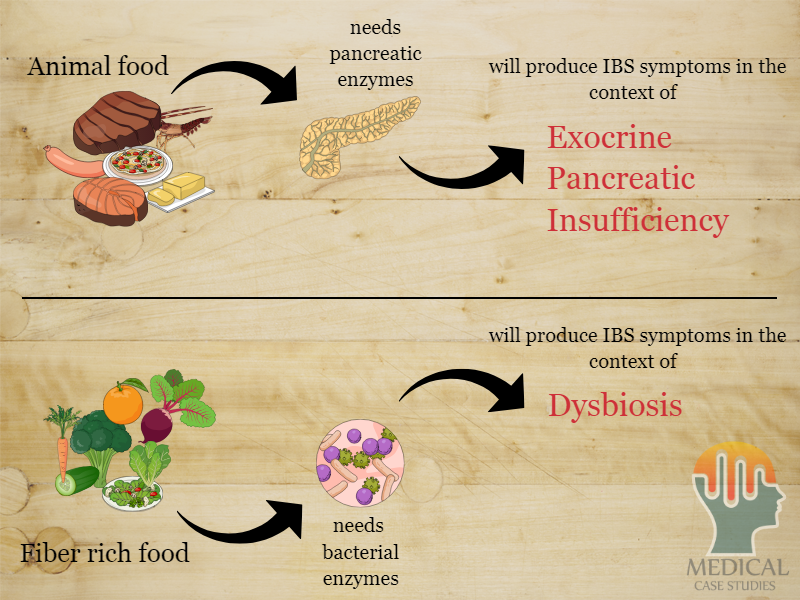
Our pancreas makes amylases, proteases and lipases, but not cellulases or xylanases. Others do that job for us, several trillion of them, right inside our gut. Our gut bacteria have many enzymes that break down fibre, for their own benefit and for ours. But they need to be there when fibre reaches the colon, and their diversity needs to be optimal.
In addition, it is not unusual for vegans to make fewer pancreatic enzymes. This is natural, because they need fewer of them.2, 1 However, when they eat something very fatty, their lipase still needs to be adequate.
Who is Jenny, and how did her IBS start?
A history of urinary infections and antibiotics
Jenny was 23 when she came to the practice where I work as a scientific collaborator, in January 2017. She had just started her first job at a big marketing company, while she was already working as a fashion model. That side job was the main reason why the first thing she asked for help with was bloating and lower abdominal pain.
Her medical history began seven years earlier, with her first urinary tract infection. Over the next seven years, these infections came back at least once a year, and as a result she had taken many antibiotics. Two years before our meeting, after another urinary infection and its antibiotics, she felt extremely bloated during a photo shoot. The bloating went away on its own several hours later.
Loose stools and morning bloating ever since
From that point on, she never had a normal bowel movement again. Her stool was always loose, and occasional diarrhea became the new normal. She woke up bloated almost every day, usually with moderate pain below the navel. In addition, Jenny got much worse a few days before her period, while sometimes the symptoms lasted the whole month.
Meanwhile, she had seen two gastroenterologists, who prescribed antispasmodics and probiotics. Both times she had a mild improvement, but nothing worked for longer than a month. The last time she saw her doctor, he mentioned antidepressants and relaxation. She never went back. Jenny was neither depressed nor stressed. More cases like hers are covered in IBS after antibiotics.
- TriggerRecurrent urinary infectionsEffect
The microbiome deteriorated over the years.
- TriggerMany antibiotic coursesEffect
Antibiotics caused dysbiosis.
- TriggerA vegan dietEffect
Fibre fermented in an abnormal way.
- TriggerIBSEffect
Bloating and loose stools.
Each step weakened the bacteria that a high-fibre diet relies on.
Which clues pointed to the fibre and her microbiome?
One thing had not been properly evaluated in her history: since the age of 18, Jenny had been vegan. And vegan means fibre, a lot of fibre. In fact, almost every vegan meal is full of it.
Main data mined
- Pain below the navel
Pain under the belly button is most often linked with trapped gas and abnormal fermentation of fibre.
- Loose or sticky stool
Loose stool is a sign of more water and mucus in the colon, as the body tries to get rid of undigested fibre.
- Bloating and gas
Extensive fermentation of fibre produces large amounts of gas, which causes bloating.
Useful data mined
Main clues shape the tests, and useful clues help us read the results.
What did her tests show?
The more fibre we eat, the better our microbiome should be. But Jenny had hit her microbiome with at least 150 antibiotic pills in total. At the same time, she followed a diet that needs a very strong gut flora to stay free of symptoms. All these antibiotics had left a low-quality bacterial community, with fewer of the bacteria that break fibre down properly. So the extra fibre that reached Jenny's colon fermented abnormally and produced more gas. That explained the bloating and the lower abdominal pain.
In addition, her pancreatic output was lower than expected for her age, at 280 μg/g of stool, although still within the normal range. In healthy volunteers, one month without meat lowered fecal elastase, and six weeks on a vegan diet lowered both elastase and chymotrypsin, in line with less and different protein in the diet.2, 1 A vegetarian diet also changes how fecal tests of pancreatic function should be read.3
High levels of Candida albicans could also explain part of the gas, as well as the vaginosis. Finally, Klebsiella pneumoniae and Escherichia coli were found in large amounts. These two bacteria had also been isolated from her earlier urine cultures, during testing for urinary infections.

C. difficile toxin A
The toxin was found in medium amounts and could be linked with the many antibiotics Jenny had taken.

Klebsiella and E. coli
Both bacteria in large amounts may explain the loose stool and the frequent urinary infections.
Low elastase for her age
This value is reversible, and without diabetes or other metabolic disorders it is usually linked with a vegan diet.
No beneficial bacteria
There was no sign of Lactobacilli or Bifidobacteria. Fibre is broken down poorly and produces too much gas.

Candida albicans
Yeasts with many enzymes use sugars as fuel. This leads to fermentation of sugars into alcohol and a lot of gas.
I am vegan and bloated every day. Should I stop eating fibre?
Not necessarily. Fibre is valuable, but it needs gut bacteria that can break it down. After many antibiotics, those bacteria may be too few, so fibre ferments abnormally and produces gas. Tests of the microbiome and pancreatic output show where the problem is, and then fibre can be adjusted rather than removed.
How was Jenny treated?
Jenny's treatment combined several approaches. Besides caring for her exhausted gut bacteria, with both probiotics and prebiotics, the overgrown microorganisms needed their own treatments, one antibacterial and one antifungal. A broad antimicrobial treatment was therefore given, together with a suitable enzyme supplement. Diet in such cases is challenging, because all meals are plant-based.
Recovery took about four months
Jenny's dysbiosis was extensive, after too many years of antibiotics and a gradual loss of her gut bacteria. Even after full recovery, caution is needed, and any new antibiotic should come with a suitable probiotic course. A vegan diet is a good diet compared with Western diets, but it brings some restrictions. The treatment works just as well, it simply takes longer for full recovery. In Jenny's case, full recovery came about four months later. Every case is different, so Jenny's plan describes her care and is not a plan for anyone else.
What does Jenny's case show about vegan IBS?
Frequently asked questions
Yes, especially at first or when the gut bacteria are weakened. A vegan diet brings a lot of fibre, and gut bacteria ferment it into gas. When the bacteria that break fibre down are too few, fermentation becomes abnormal and causes bloating and loose stools.
It can be, but it depends on the person and on their microbiome. Some people with IBS react to fermentable fibres that are common in plant foods. Testing first and adjusting fibre types usually works better than removing whole food groups.
Studies in healthy volunteers found that a vegan diet lowered fecal elastase and chymotrypsin within six weeks, in line with less and different protein.1 Lipase did not change.
IBS that starts during or after antibiotics is common. Antibiotics reduce the diversity of gut bacteria, and in Jenny's case the bacteria that break down fibre were the ones missing.
References
3 studies
- Walkowiak J, Mądry E, Lisowska A, et al. Adaptive changes of pancreatic protease secretion to a short-term vegan diet: influence of reduced intake and modification of protein. Br J Nutr. 2012.
- Walkowiak J, Wadolowska L, Szaflarska-Poplawska A, et al. The elimination of meat from the diet selectively decreases pancreatic elastase secretion. Br J Nutr. 2007.
- Walkowiak J, Songin A, Przyslawski J, et al. Vegetarian diet alters the assessment of exocrine pancreatic function with the use of fecal tests. J Pediatr Gastroenterol Nutr. 2004.
Found this useful? Share it with someone who needs it.
Cite this article
Prevedoros, T. (2022, September 21). Fibre bloated a vegan gut after a course of antibiotics. Gut Pathways. https://gutpathways.com/case-studies/vegan-ibs/