How to treat gut dysbiosis in the right order, not a guess
Gut dysbiosis treatment works best as a sequence: confirm what is happening, fix the base, then target what testing shows, matched to your own biology.

Where does gut dysbiosis treatment start?
Gut dysbiosis treatment starts with testing that shows what is happening in your gut. Stool or microbiome analysis shows which bacterial groups are out of range. Blood work rules out conditions that can look like dysbiosis, such as thyroid dysfunction or celiac disease.
Testing comes first because the gut microbiome is large, varied and quick to change. Four numbers make that concrete.
Trillions of neighbors
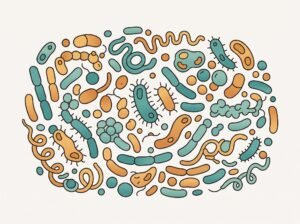
A body of 70 kg carries about 38 trillion bacteria, close to its 30 trillion human cells.6
Hundreds of species
A large European study estimated at least 160 prevalent bacterial species in each person, out of about 1,000 to 1,150 across the whole group.7
It shifts fast
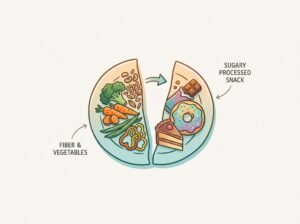
Seven days on a low-fiber, high-sugar diet lowered small intestinal microbial diversity in 16 healthy volunteers.2

No single yardstick
Researchers use many different dysbiosis indexes, built from different methods and patient groups.1
The deeper reasoning, including why recovery time differs so much from person to person, is in the companion piece on how long it takes to heal gut dysbiosis.
What stool and microbiome testing can tell you
A stool test usually reports three layers: which bacterial groups are present, how diverse the community is, and markers such as calprotectin or elastase that flag inflammation or pancreatic output. A 2021 review catalogued the many dysbiosis indexes in use and concluded that dysbiosis is still not a well-defined condition.1
That variety means a number on a lab report needs a reader who knows which index fits your pattern, diet and history. The quality checks for the report itself are covered in gut microbiome test: 6 criteria before you trust it.
Why symptoms alone leave gaps
Bloating, urgency and fatigue can come from an overgrown small intestine, from a gut reacting to stress or from a food intolerance unrelated to bacteria. A Mayo Clinic study found that SIBO defined by duodenal aspirate culture did not match patients' symptoms, while the composition of the small intestinal microbiome was clearly different in symptomatic patients.2
In 126 patients with gut symptoms and 38 healthy volunteers, aspirate culture did not track symptoms, but 16S sequencing of the same aspirates did separate the groups. In a pilot, one week of a low-fiber, high-sugar diet triggered symptoms and lowered small intestinal diversity.2
What is the right order of gut dysbiosis treatment?
Treatment works in a fixed order: behavior first, then diet, then medicines and supplements, and finally targeted steps guided by testing and genetics. Jumping to the third step before the first is done usually means paying for a supplement that never had a fair chance to work.

Step 1, behavior
Sleep, meal timing and stress load reset gut motility before anything else is introduced.

Step 2, targeted diet
Food choices are matched to the bacterial groups a test shows are out of range.
Step 3, medicines and supplements
A targeted antimicrobial, probiotic strain or prokinetic enters once the base is in place.

Step 4, diagnostics and genetics
Findings specific to the person fine-tune every earlier step.
Step 1: behavioral corrections come first
Sleep timing, meal spacing and stress load shape gut motility and the immune signals that steer bacterial populations. Late-night eating, constant grazing between meals and chronic sleep debt all weaken the migrating motor complex, the wave of contractions that sweeps leftover bacteria out of the small intestine between meals.
In the clinics where I work as a scientific collaborator, these changes get two to four weeks before anything else is judged. That gives every later step a cleaner baseline, and it often eases the bloating that keeps returning.
Step 2: diet chosen for the specific imbalance
Diet changes at this stage are picked for their effect on specific bacterial groups, for example favoring the fiber types that feed strains a test shows are depleted. A vegan pattern and a carnivore pattern push protein digestion and fermentation in opposite directions, so the same food swap can raise one person's beneficial bacteria while barely moving another's.
Step 3: when medicines and supplements enter
Medicines and supplements come in once behavior and diet have had a real chance, because each targets a narrower problem. A targeted antimicrobial, a specific probiotic strain or a prokinetic each answers a distinct finding, timed to when the gut can hold the change. Starting them earlier hides whether the first two steps would have worked on their own.
Step 4: steps guided by diagnostics and genetics
The final step adds findings specific to the person: a genetic variant, a strain-level result or a diagnosed autoimmune condition. A gene study in people taking metformin is a good example, because variants of two transporter genes changed who tolerated the drug, as described in the section on hidden risks below.
The same logic applies to choosing a probiotic strain or a supplement dose for a person's own biology. More on the drug example in metformin and diarrhea.
Infographic
Test before treating
Stool or microbiome analysis shows which bacterial groups are out of range. Blood work rules out look-alike conditions.
Results need a reader
Dysbiosis has no single agreed definition, so a lab number needs a reader who knows which index fits your pattern.
Behavior comes first
Sleep, meal timing and stress load reset gut motility before anything else is introduced.
Diet is matched next
Food choices are matched to the bacterial groups a test shows are out of range.
Then medicines and supplements
A targeted antimicrobial, probiotic strain or prokinetic enters once the base is in place.
Personal findings fine-tune
Findings specific to the person fine-tune every earlier step.
Sources: Wei et al. 2021, Saffouri et al. 2019.
gutpathways.com
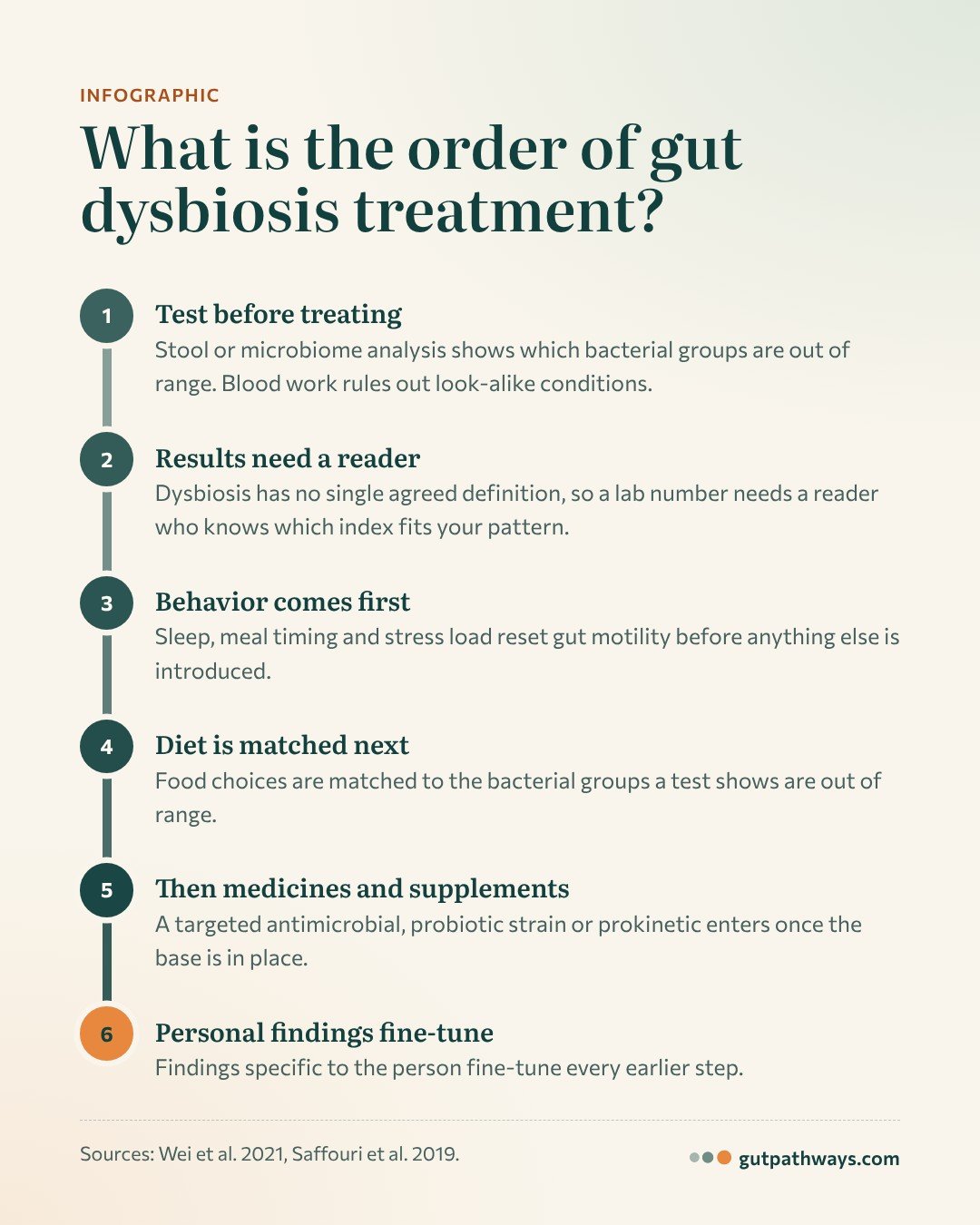 Save this infographicImage 4:5, with sources, from gutpathways.com
Why does the same probiotic work differently in different people?
A probiotic that helps one person can do nothing, or shift symptoms the wrong way, in someone with a different baseline microbiome. A 2018 study at the Weizmann Institute gave volunteers an identical 11-strain probiotic and sampled their gut lining directly. Each person showed a different colonization pattern, predictable from their baseline host and microbiome features and invisible in stool samples.5
The probiotic strains survived the trip through the gut, but some people resisted colonization of the gut lining and others allowed it. The effect on the mucosal community was temporary and individual.5
Can the same lab result mean different things?
Yes. The same number can lead to opposite conclusions depending on diet, health status and what else lives in the gut. Three examples show how.
Low elastase in a vegan and in an omnivore
Pancreatic elastase helps digest protein. In 21 healthy omnivores who switched to a vegan diet for six weeks, fecal elastase-1 and chymotrypsin output fell, and the drop tracked with lower protein intake and the change from animal to plant protein.3 In an omnivore, a low result points toward reduced pancreatic output and a closer look at the pancreas.
That exact pattern, a vegan whose enzyme results looked like pancreatic insufficiency, sits at the center of the vegan IBS case, where the answer had nothing to do with the pancreas.
Higher Akkermansia in multiple sclerosis
Akkermansia muciniphila is usually framed as a marker of a healthy gut. In 34 pairs of identical twins in which only one twin had multiple sclerosis, some taxa, Akkermansia among them, were higher in the untreated twins with the disease. Gut microbiota from the affected twins also triggered brain autoimmunity in susceptible mice more often than microbiota from the healthy twins.4
Fusobacterium with Candida
Fusobacterium nucleatum is a well-documented passenger in colorectal tumors. A 2026 study found that the fungus Candida albicans binds it through a protein pair, Flo9 on the fungus and RadD on the bacterium. In animal models, the pair reached the colon lining more easily and sped up tumor growth beyond either microbe alone.8 In the same models, L-arginine disrupted the interaction.
Which medicines and supplements carry hidden risks?
A medicine or supplement can solve one problem and create another, often in a different system from the one being treated. Gastrointestinal upset affects about 30% of people taking metformin, and about 5% find it intolerable and stop.9 In a gene study of 1,520 people taking metformin, each low-expressing allele of the serotonin transporter gene raised the odds of severe intolerance by about 31%, and the effect interacted with variants of a second transporter, OCT1.9
Long-term acid suppression raises the odds of vitamin B12 deficiency, which is easy to miss when the two prescriptions come from different specialists.10 More in PPIs and vitamin B12 deficiency.
| Medicine or supplement | The hidden risk |
|---|---|
| Metformin | Gut intolerance, more likely with certain transporter gene variants, often mistaken for a food problem9 |
| Proton pump inhibitors | Higher odds of vitamin B12 deficiency after two or more years of use10 |
| Broad-spectrum antibiotics | Loss of beneficial strains alongside the target organism |
| High-dose iron | In one infant trial, iron powders raised enterobacteria and gut inflammation11 |
Do DIY and practitioner-guided treatment reach different outcomes?
Self-directed and practitioner-guided treatment can start from the same result and end in different places, mainly because of what happens when a first attempt only partly works. A self-guided plan usually means one change at a time, adjusted by trial and error over months. A practitioner reading the full panel with your history and medicines can combine several steps and catch an interaction, such as metformin with a PPI, before it derails progress.
| Point | Self-directed | Practitioner-guided |
|---|---|---|
| Interpretation | One index or number read alone | The full panel read with history, diet and medicines |
| Adjustments | Trial and error, one change at a time | Several targeted steps layered in order |
| Interactions | Often noticed only after symptoms appear | Checked before a new medicine or supplement starts |
| Timeline | Often longer, because each restart resets the clock | Shorter when the order is right from the start |
When should you see a specialist?
A specialist adds two things a generic protocol or home kit rarely can: the full clinical picture across every system involved, and pattern recognition from hundreds of similar cases. A stool report alone will not flag that a supplement interacts with a prescription, or that a persistent symptom comes from a different organ.
See a doctor promptly for weight loss, blood in the stool, anemia, night-time symptoms, fever or symptoms that start after the age of 50, because these need a medical work-up before any dysbiosis plan.
The bottom line on gut dysbiosis treatment
Gut dysbiosis treatment works best as a sequence: confirm with real testing, correct behavior and diet first, then bring in medicines, supplements and targeted steps once the base is in place. The same result can mean opposite things in a vegan and an omnivore, or in a healthy adult and someone with an autoimmune condition, which is why matching each step to your own biology beats copying someone else's protocol.
Frequently asked questions
There is no single best treatment. The approach that works most often is a sequence: confirm the problem with testing, correct sleep, meal timing and stress, adjust the diet, and only then add targeted antimicrobials, probiotics or prokinetics matched to the findings.
Remove the driver first, for example a medicine that slows the gut, constant snacking or repeated antibiotics, then rebuild with a steady daily rhythm and a varied diet. Targeted support works best when it answers a specific test result.
Most often with a stool microbiome test, sometimes with breath testing for the small intestine and blood tests to rule out other conditions. Dysbiosis has no single agreed definition, so results are best read with your history.1
They can help as one tool inside a broader plan. An identical probiotic colonized each person's gut lining differently, so matching the strain to the person matters more than the label on the bottle.5
Ultra-processed foods and restrictive mono-diets narrow the fuel available to a diverse bacterial community. A diet low in fiber and high in simple sugar lowered small intestinal diversity within a week in one study.2
It depends on how long the imbalance has been present, how many antibiotic courses a person has taken and how consistently the behavior and diet changes are kept. The full picture is in the companion article on healing time.
No. Dysbiosis describes an imbalance anywhere in the gut, most often measured in stool from the colon. SIBO means too many microbes in the small intestine and is tested differently, as explained in how to test for SIBO.
References
11 studies
- Wei S, Bahl MI, Baunwall SMD, Hvas CL, Licht TR. Determining gut microbial dysbiosis: a review of applied indexes for assessment of intestinal microbiota imbalances. Appl Environ Microbiol. 2021.
- Saffouri GB, Shields-Cutler RR, Chen J, et al. Small intestinal microbial dysbiosis underlies symptoms associated with functional gastrointestinal disorders. Nat Commun. 2019.
- Walkowiak J, Mądry E, Lisowska A, et al. Adaptive changes of pancreatic protease secretion to a short-term vegan diet: influence of reduced intake and modification of protein. Br J Nutr. 2012.
- Berer K, Gerdes LA, Cekanaviciute E, et al. Gut microbiota from multiple sclerosis patients enables spontaneous autoimmune encephalomyelitis in mice. Proc Natl Acad Sci U S A. 2017.
- Zmora N, Zilberman-Schapira G, Suez J, et al. Personalized gut mucosal colonization resistance to empiric probiotics is associated with unique host and microbiome features. Cell. 2018.
- Sender R, Fuchs S, Milo R. Revised estimates for the number of human and bacteria cells in the body. PLoS Biol. 2016.
- Qin J, Li R, Raes J, et al. A human gut microbial gene catalogue established by metagenomic sequencing. Nature. 2010.
- Li J, Zhang C, Huang X, et al. Candida albicans synergizes with Fusobacterium nucleatum in colorectal cancer progression via the Flo9-RadD interaction. Cancer Cell. 2026.
- Dujic T, Zhou K, Tavendale R, Palmer CNA, Pearson ER. Effect of serotonin transporter 5-HTTLPR polymorphism on gastrointestinal intolerance to metformin: a GoDARTS study. Diabetes Care. 2016.
- Lam JR, Schneider JL, Zhao W, Corley DA. Proton pump inhibitor and histamine 2 receptor antagonist use and vitamin B12 deficiency. JAMA. 2013.
- Jaeggi T, Kortman GAM, Moretti D, et al. Iron fortification adversely affects the gut microbiome, increases pathogen abundance and induces intestinal inflammation in Kenyan infants. Gut. 2015.
Found this useful? Share it with someone who needs it.
Cite this article
Prevedoros, T. (2026, August 3). How to treat gut dysbiosis in the right order, not a guess. Gut Pathways. https://gutpathways.com/articles/how-to-treat-gut-dysbiosis/