IBS and low testosterone
IBS and low testosterone are linked in both directions. Low androgens may slow the colon and change how the gut handles pain, while an inflamed, leaky gut releases bacterial LPS that can switch off testosterone production in the testis. Here is the two-way axis, study by study, and what it means for a man with gut symptoms.
IBS and low testosterone: is the link real?
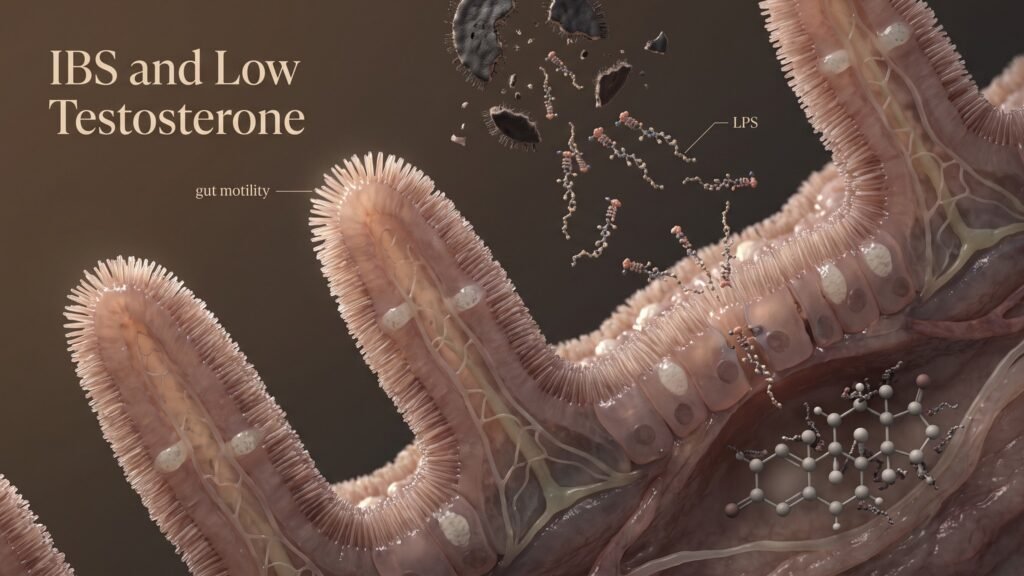
Yes, and it runs in both directions. Most research has asked how testosterone shapes gut function, but the reverse path is now documented as well. Dysbiosis and a leaky gut barrier can lower testosterone production, at least in experimental models and in short human studies.
There is no single IBS hormone. The gut carries receptors for estrogen, progesterone, cortisol, serotonin, melatonin, thyroid hormones and androgens, so almost any hormonal shift can change how it behaves. Sex steroids leave the most visible marks. IBS affects about twice as many women as men in Western countries, and reviews describe sex hormones as modulators of pain, motility, barrier function and gut immunity.3, 4
The male side of the data is smaller, but it is consistent enough to take into account. A 2021 review describes two-way cross-talk between sex steroids and gut bacteria. Hormones shape the gut microbiome, and gut bacteria transform and recycle steroids back into active forms.5
Twice as many women as men have IBS in Western countries. Ovarian hormones modulate pain processing and stress reactivity, and the authors call for more research on male hormones.3
How does testosterone shape overall gut function?
Inside the digestive tract, testosterone works more like a maintenance signal than a reproductive one. The androgen receptor sits in the gut wall, in immune cells and in the gut's own nervous system. When androgen signaling drops, several gut functions may weaken at the same time, which is one reason IBS and low testosterone can appear in the same man. Four targets carry most of the weight.

The motility switch
About 17% of the neurons in the colon's myenteric plexus carry the androgen receptor in mice. These neurons organize the contraction waves that move contents forward, and they become androgen-responsive at puberty.1

The pain dial
In animal stress models, testosterone dampens visceral pain, while estradiol makes it stronger.6 Human data are more mixed, as the pain section below shows.
The barrier guard
Sex hormones influence barrier function and immune activation in the gut lining, according to reviews of IBS.4 Lower androgen levels may tilt that balance toward a more reactive gut wall.
The strongest human evidence comes from a 2022 study. It measured androgens with mass spectrometry in people with IBS and then tested cause and effect in mice. Its findings anchor much of what follows.
In 208 adults with IBS, free testosterone was lower than in healthy controls, and a lower percentage of free testosterone went with higher symptom scores (r = –0.19, P = 0.009) in both sexes. In mice, removing gonadal androgens caused a profound transit deficit, and a single androgen restored it.1
| Study | What it showed |
|---|---|
| Rastelli 2022, J Clin Invest | Lower free testosterone in IBS, with more severe symptoms at lower levels. Androgen loss slowed colonic motility in mice.1 |
| Lagomarsino 2026, Nat Neurosci | Gut bacteria reactivate androgens in the intestine, and this local pool keeps enteric neurons responsive.8 |
| Houghton 2000, Am J Gastroenterol | Men with IBS felt rectal distension at lower volumes. LH was lower, and testosterone did not differ from controls.9 |
| Kim 2008, Digestion | Young men with IBS had higher testosterone and SHBG than controls.10 |
| Ji 2018, J Pain | Testosterone dampened stress-induced visceral pain in rats, while estradiol increased it.6 |
| Harada 2016, Sci Rep | Castration changed the gut microbiota of male mice on a high-fat diet.7 |
Can low testosterone slow gut motility?
Yes, at least in mice, and the colon is where it shows first. Four weeks after the testes were removed, gut transit was 40% slower than in sham-operated mice. Small bowel transit did not change, while one-hour pellet output fell by 60%. The pellets were 25% larger and drier, which in human terms looks like constipation.1
What androgen loss did to bowel function in mice (%)
Rastelli 2022. Change against sham-operated mice, four weeks after removal of the testes.
The site of action surprised the team. The smooth muscle worked normally without androgens, and the problem was in the neurons. Mice lacking the androgen receptor only in enteric neurons showed the same picture. In addition, DHT pellets given three weeks after surgery brought transit back toward normal.1 The enteric nervous system becomes androgen-responsive at puberty and appears to depend on that signal in adult life.
The newest piece arrived in 2026. Gut bacteria use enzymes called beta-glucuronidases to reactivate androgens inside the intestine, and this local pool keeps the motility neurons responsive. In mice whose microbes were depleted with antibiotics, serum testosterone fell, the neurons lost their androgen receptor and motility slowed.8 In other words, the microbiome helps set the hormone level, and the hormone helps set the motility.
- Testosterone circulates after puberty
Androgen levels rise and stay high in adult males.
- Myenteric neurons switch on the androgen receptor
A large subset of colonic neurons becomes androgen-responsive.1
- Gut bacteria reactivate androgens locally
Bacterial beta-glucuronidases free active androgens inside the colon.8
- Colonic contractions stay organized
Transit time and stool form stay normal.
A simplified chain based on mouse studies.
Does low testosterone make IBS symptoms hurt more?
The answer is less simple than it first seems. In 50 men with IBS, rectal urgency and discomfort appeared at lower balloon volumes than in 25 healthy men. The only hormone that differed clearly was LH, which was lower in IBS. However, the men with higher testosterone and free testosterone had the lowest sensory thresholds, so the link with pain did not run in the expected direction.9
Rectal balloon thresholds in men (ml)
Houghton 2000, 50 men with IBS and 25 controls. A lower volume means a more sensitive rectum.
Other studies add to the uncertainty. Young men with IBS had higher testosterone and SHBG than controls in a Korean study.10 On the other hand, the larger 2022 study found lower free testosterone in IBS and more severe symptoms at lower levels.1 The relationship probably shifts with age, with SHBG and with the type of measurement.
Animal work points to a protective role. In a rat stress model, estradiol increased visceral pain, while testosterone dampened it, and removing the testes made male rats more sensitive.6 Testosterone also binds TRPM8, a channel found in sensory neurons and in the prostate.11 Bloating and pain rarely come from low testosterone alone. They have many causes, which are covered in what causes abdominal bloating.
How does gut health affect testosterone levels?
This is the direction almost nobody checks, and it starts with bacterial debris. Dying gram-negative gut bacteria shed lipopolysaccharide, better known as LPS. A healthy barrier keeps most LPS inside the gut. Dysbiosis and a leaky barrier let more of it reach the blood, a state researchers call metabolic endotoxemia.12
Leydig cells, the testosterone factories of the testis, carry TLR4, the receptor that LPS binds. When it fires, they release inflammatory cytokines and their steroid production drops.13 In mice, one large dose of LPS cut serum testosterone by 90% within two hours, together with a loss of StAR, the protein that carries cholesterol into the mitochondria to start testosterone production.14
The human data come next. Healthy lean men received a small intravenous dose of endotoxin, and their testosterone fell by about 30% within six hours, after a short inflammatory response, and recovered by the next day. LH and FSH, the brain's signals to the testis, did not change.2 The brain kept sending the signal, and the testis answered less. In the same paper, men with more signs of endotoxin exposure had lower testosterone. Cytokines alone can do the same, since injected IL-6 lowered testosterone in healthy men, by about 40% at 24 hours with the stronger doses, for up to two days.15

A low-dose endotoxin challenge in lean men produced a short inflammatory response, followed by a fall in serum testosterone without changes in LH or FSH. In a second group of 75 men, endotoxin exposure (LBP) went with lower testosterone.2
Why would an inflamed gut switch off reproduction?
Because the body treats the two as competing priorities. Fighting infection and repairing the gut are urgent and costly. Reproduction is costly too. A body that turns down the gonadal axis while the gut is inflamed may be delaying one task to finish another.
The idea has a formal name, the GELDING theory, short for Gut Endotoxin Leading to a Decline IN Gonadal function. It was proposed to explain why men with obesity so often develop low testosterone.16 In 50 men, endotoxin exposure and inflammation went with lower testosterone.17 The same logic may apply to a long-standing irritable bowel. A low-grade endotoxin leak, day after day, could keep the brake on the testis.
There is a second layer. Endotoxin-driven suppression may protect the testis during severe infection, when fertility matters less than survival. With a chronic gut disorder, however, the crisis never quite ends, and the pause may become the new normal.
The GELDING theory describes late-onset low testosterone in obese men as a gut-driven process, in which endotoxin from a permeable gut suppresses testicular testosterone production.16
Can testosterone treatment help IBS symptoms?
Nobody knows yet. No randomized trial has tested testosterone therapy for IBS, so any claim that it fixes the gut runs ahead of the evidence. There is, however, a plausible reason to study it, since testosterone dampens visceral pain in animals and supports colonic motility in mice.6, 1
There is also a practical reason to mind the order. If the gut is suppressing the testis, adding testosterone from outside corrects the number but not the cause. Working on the gut first may let hormone levels recover by themselves, and it answers a useful question, whether the testis is damaged or only paused. Testosterone therapy still has its place when low testosterone is confirmed and persists, ideally alongside work on the gut. One example of the gut side of therapy is Anestis's case of bloating on testosterone.
My testosterone is low and I have IBS, so testosterone therapy will fix my gut.
No trial supports testosterone as an IBS treatment. Because the axis runs both ways, work on the gut may raise testosterone by itself. Testosterone therapy is a treatment for confirmed low testosterone, decided on standard endocrine criteria, and it makes most sense when the gut is treated in parallel.
When both problems show up together, the useful question is which loop drives the other. The overlap with the prostate is explained in can gut bacteria cause prostatitis?, and a real example is Nick's case of prostatitis and IBS.
IBS and low testosterone: what should you check?
If you recognize yourself somewhere on this axis, the work-up has a few rules. Testosterone is measured in the morning, on two separate days, and together with SHBG and albumin, so that free testosterone can be calculated. One low afternoon reading means little.
On the gut side, map the pattern before testing: constipation or diarrhea, bloating timing, pain triggers and antibiotic history. The plan has to work on both ends of the loop at once. Men whose IBS symptoms start in adulthood deserve this double look, especially when fatigue, low libido or mood changes come along.
The men who do best stop treating these as two separate problems. Work on the gut, and hormone levels often follow. Protect the hormones, and the gut gets its maintenance signal back.
Frequently asked questions
No single hormone causes IBS. Estrogen and progesterone, cortisol, serotonin, thyroid hormones, melatonin and androgens such as testosterone can all influence the gut. IBS is best understood as a disorder of gut-brain interaction, in which hormones tune the system up or down.4
Low testosterone may. In mice, androgen loss slowed colonic transit by 40% and produced larger, drier pellets, and restoring an androgen reversed it.1 Constipation in a man has many causes, though, so testosterone is one factor to check, not the only one.
Not directly. Testosterone keeps colonic neurons responsive in mice, which supports normal transit. Restoring a missing androgen normalized transit in those mice, but there is no evidence that extra testosterone speeds up a normal bowel.1
IBS affects about twice as many women as men in Western countries, so men are a minority of patients, not a rare exception.3 Men also show more diarrhea and a frequent overlap with prostate symptoms.
Possibly, but it has not been tested in a randomized trial. Testosterone therapy remains a treatment for confirmed low testosterone, best used alongside work on the gut and not as a replacement for it.
References
17 studies
- Rastelli D, Robinson A, Lagomarsino VN, et al. Diminished androgen levels are linked to irritable bowel syndrome and cause bowel dysfunction in mice. J Clin Invest. 2022.
- Tremellen K, McPhee N, Pearce K, et al. Endotoxin-initiated inflammation reduces testosterone production in men of reproductive age. Am J Physiol Endocrinol Metab. 2018.
- Meleine M, Matricon J. Gender-related differences in irritable bowel syndrome: potential mechanisms of sex hormones. World J Gastroenterol. 2014.
- Mulak A, Taché Y, Larauche M. Sex hormones in the modulation of irritable bowel syndrome. World J Gastroenterol. 2014.
- So SY, Savidge TC. Sex-bias in irritable bowel syndrome: linking steroids to the gut-brain axis. Front Endocrinol (Lausanne). 2021.
- Ji Y, Hu B, Li J, Traub RJ. Opposing roles of estradiol and testosterone on stress-induced visceral hypersensitivity in rats. J Pain. 2018.
- Harada N, Hanaoka R, Horiuchi H, et al. Castration influences intestinal microflora and induces abdominal obesity in high-fat diet-fed mice. Sci Rep. 2016.
- Lagomarsino VN, Robinson A, Mitchell PE, et al. Microbial reactivation of host androgens directs enteric neuronal regulation of gut motility. Nat Neurosci. 2026.
- Houghton LA, Jackson NA, Whorwell PJ, Morris J. Do male sex hormones protect from irritable bowel syndrome? Am J Gastroenterol. 2000.
- Kim BJ, Rhee PL, Park JH, et al. Male sex hormones may influence the symptoms of irritable bowel syndrome in young men. Digestion. 2008.
- Asuthkar S, Elustondo PA, Demirkhanyan L, et al. The TRPM8 protein is a testosterone receptor: I. Biochemical evidence for direct TRPM8-testosterone interactions. J Biol Chem. 2015.
- Cani PD, Amar J, Iglesias MA, et al. Metabolic endotoxemia initiates obesity and insulin resistance. Diabetes. 2007.
- Shang T, Zhang X, Wang T, et al. Toll-like receptor-initiated testicular innate immune responses in mouse Leydig cells. Endocrinology. 2011.
- Bosmann HB, Hales KH, Li X, et al. Acute in vivo inhibition of testosterone by endotoxin parallels loss of steroidogenic acute regulatory (StAR) protein in Leydig cells. Endocrinology. 1996.
- Tsigos C, Papanicolaou DA, Kyrou I, Raptis SA, Chrousos GP. Dose-dependent effects of recombinant human interleukin-6 on the pituitary-testicular axis. J Interferon Cytokine Res. 1999.
- Tremellen K. Gut Endotoxin Leading to a Decline IN Gonadal function (GELDING): a novel theory for the development of late onset hypogonadism in obese men. Basic Clin Androl. 2016.
- Tremellen K, McPhee N, Pearce K. Metabolic endotoxaemia related inflammation is associated with hypogonadism in overweight men. Basic Clin Androl. 2017.
Found this useful? Share it with someone who needs it.
Cite this article
Prevedoros, T. (2026, July 24). IBS and low testosterone. Gut Pathways. https://gutpathways.com/articles/ibs-and-low-testosterone/