How early life stress raises the risk of IBS later in life
Stress before birth and in childhood leaves a mark on the gut. Large studies up to 2026 link early adversity with a higher risk of IBS in adulthood, and a study in Gut points to gut bacteria that make calming GABA lipopeptides.

Can early life stress cause IBS?
Early life stress does not cause IBS on its own, but it is one of the best documented risk factors for developing IBS in adulthood. Irritable bowel syndrome affects about 9% of adults worldwide under the Rome III criteria and about 4% under the stricter Rome IV criteria.8 It has always been hard to explain, because many different paths lead to the same symptoms.
Childhood adversity is one of those paths. In a Los Angeles study of 294 people with IBS and 435 controls, people with IBS more often reported emotional abuse (54.9% against 27.0%), general trauma, physical punishment and sexual events before age 18.9 Emotional abuse was the strongest predictor, and the link held after taking psychological distress into account.
What the 2026 data show
Two 2026 studies confirm the link at a much larger scale. In the UK Biobank, 126,735 adults without IBS were followed for a median of 14.5 years. Compared with people who had few adverse childhood experiences, those with a pattern of childhood abuse had 64% higher risk of IBS, and those with emotional neglect had 38% higher risk.1 Adversity in adulthood added to the risk, and the combination raised it by 39% to 161%.
A 2026 three-level meta-analysis pooled 22 studies with almost half a million participants. Childhood maltreatment raised the odds of adult bowel disorders overall (OR 1.53), and IBS was linked with nearly every type of maltreatment, with odds 44% to 91% higher.2 By contrast, functional dyspepsia and inflammatory bowel disease showed no clear link, which points to something specific about IBS.
What did the 2023 Gut study on prenatal stress find?
A study published in Gut by an international team led by Dr Nicolas Cenac at INSERM in Toulouse looked deeper into the link between gut microbes, stress and IBS. It identified bacterial lipopeptides that contain gamma-aminobutyric acid (GABA) as one possible link between early stress and gut pain.3
What the study is about
The team used a mouse model to study how stress during pregnancy, called prenatal stress, affects the gut microbiota and visceral hypersensitivity of the offspring in adulthood. Visceral hypersensitivity, an amplified pain response to stimuli in the gut, is a typical feature of IBS. The researchers then used mass spectrometry to measure GABA-containing lipopeptides in one bacterial strain, in the colons of the mice and in stool from people with IBS and healthy volunteers.3
- Lipopeptide
- A small molecule made of a fatty acid joined to a short chain of amino acids. Some gut bacteria attach GABA to it, and these GABA lipopeptides can calm sensory nerves in the gut wall.
The lipopeptide link between stress and gut pain
In prenatally stressed mice, the researchers found dysbiosis with less Ligilactobacillus murinus. The lower this species, the stronger the pain response to distension of the colon. The adult mice had no clear inflammation of the colon and no barrier damage, only the changed microbiota.3
Ligilactobacillus murinus produced several GABA-containing lipopeptides, including one named C14AsnGABA. After the researchers placed this lipopeptide in the colon of prenatally stressed mice, visceral sensitivity to colorectal distension went down.3
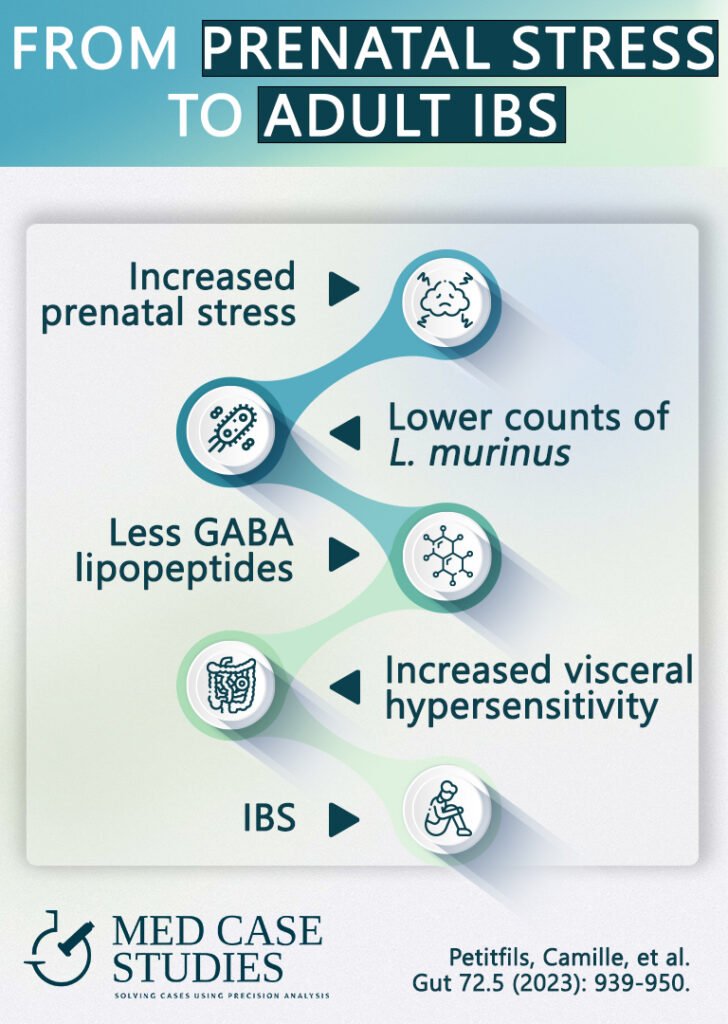
Increased prenatal stress
The chain starts with increased prenatal stress.
Lower counts of L. murinus
Prenatal stress is followed by lower counts of L. murinus.
Less GABA lipopeptides
Lower counts of L. murinus are followed by less GABA lipopeptides.
Increased visceral hypersensitivity
Less GABA lipopeptides are followed by increased visceral hypersensitivity.
IBS
The chain ends with IBS in adults.
Source
Petitfils, Camille, et al. Gut 72.5 (2023): 939-950.
Of humans and mice
In human stool, the researchers found a similar pattern. C16LeuGABA, another GABA-containing lipopeptide, was lower in people with IBS than in healthy volunteers. In the laboratory, this lipopeptide inhibited the activation of sensory neurons, which may explain a role in lowering gut pain.3
These results are persuasive, but most of the chain comes from mice. IBS is a complex disorder with many contributing factors. Other research has linked IBS with gut infections and with bacteria such as Escherichia coli, as well as with diet and genetics.11 Understanding and managing IBS likely involves an array of elements.
How does early life stress change the gut-brain axis?
The Gut study shows one bacterial path, but a 2026 review describes several layers working together. Early stress can reset the brain's stress system, sensitize pain pathways in the spinal cord and change the gut wall itself.12 In the gut, the changes include more serotonin-producing cells, activated mast cells, a weaker barrier and dysbiosis.
- Brain stress system The HPA axis and corticotropin-releasing factor become more reactive, with lasting epigenetic changes in limbic circuits.
- Spinal cord Pain signals from the gut are amplified, partly through more BDNF and changes in nerve channels.
- Gut wall Mast cells activate, serotonin-producing cells increase, glial cells change and the barrier weakens.
- Gut microbiota The balance of bacteria shifts, including the species that make calming metabolites.
Based on Tao 2026. The rings show where the changes happen, from the brain to the gut contents.
The human data fit this picture. In 108,365 UK Biobank participants, psychological adversity carried the largest share of the link between childhood maltreatment and IBS, about 15% to 17%, followed by socioeconomic status, lifestyle and biological changes.13 Mast cells deserve a special mention, because they link stress with gut pain, as explained in IBS and mast cells.
Can good childhood experiences protect the gut?
Adversity is only half of the story. In a 2026 US study, people with many adverse childhood experiences but also many benevolent ones, such as supportive relationships, had no extra IBS risk.4 Low benevolent and high adverse experiences were almost twice as common in IBS. Resilience, in other words, seems to buffer the risk.
Why does this study matter for irritable bowel syndrome?
Given the role of gut bacteria in IBS, dietary changes that support a healthy microbiome could help. Prebiotic and probiotic foods, such as yogurt, kefir and fermented vegetables, may help support beneficial gut bacteria. Several eating behaviors and everyday habits also shape the gut microbiome. Reducing stress is common advice but not easy to put into practice, so the sections below describe specific ways to support GABA.
The study shows the potential of bacterial lipopeptides, specifically those containing GABA, in modulating visceral hypersensitivity in IBS. It also points to the subtle role that early life stress might play in predisposing someone to the condition.
Should you use GABA to manage stress and IBS?
In practice, GABA can be a useful adjunct for people with IBS whose symptoms get worse with stress. GABA is an important signaling molecule in the enteric nervous system, the network of nerves in the gut wall.14 Bacteria use it as a signal too.15 Especially where IBS started after an infection, in the clinics where I work as a scientific collaborator it often helps to rebalance the gut-brain axis.
GABA also plays a part in intestinal motility, an important piece when addressing IBS. If the movement of the intestinal tract becomes irregular, a range of symptoms can follow, from altered bowel movements to constipation. GABA's influence on the nervous system may help with these problems.
Stress relief through GABA
One way GABA may help people with IBS is by regulating abdominal discomfort and the frequency of bowel movements. By reducing irregularity, it may also ease constipation. GABA and its receptors take part in the regulation of intestinal motility and inflammation, which affects stool consistency and frequency.16 This may help with the bloating that often accompanies IBS.
4 surprising ways to increase GABA
Mindful meditation
Mindfulness meditation is one way to manage stress, and it may help calm an overactive gut in all IBS types. In a randomized trial of 75 women with IBS, mindfulness training cut symptom severity by 26.4% against 6.2% in a support group, and by 38.2% against 11.8% three months later.5 Whether it does this through GABA is not proven. Yoga, a related mind-body practice, raised brain GABA in a small trial, and the rise went with better mood and less anxiety.17
Lower GABA activity, which can follow major life events or stress, may make the gut too active, with irregular bowel movements and abdominal pain as a result. This link is a plausible mechanism rather than a proven cause.
Resistance exercise
Regular resistance exercise can help people with IBS. Resistance training raised circulating BDNF after exercise in a training study.18 BDNF is thought to support GABA signaling, and in developing neurons the two signals strengthen each other.19 In a randomized trial, people with IBS who increased their physical activity improved their symptom score by 51 points, against 5 points in the control group.6 More balance in the gut may also mean less inflammation and discomfort.
Deep breathing
Deep breathing exercises may counteract the motility problems that low GABA can cause. Low GABA activity is thought to make mast cells overactive, and overactive mast cells release histamine and other substances that drive inflammation and discomfort in the gut.14 One guinea-pig study, though, found that GABA did not change histamine release from isolated mast cells.20 This response can worsen IBS and other functional bowel disorders that go with anxiety and depression.
Ready
Breathe in for 4 seconds and out for 6 seconds. A longer exhale is a simple way to bring down the stress response. Try a few minutes before meals.
Peppermint tea
In guinea-pig intestine, GABA receptors directly hold back serotonin release from enterochromaffin cells.21 Low GABA activity may therefore allow too much serotonin release, which can speed up the bowel and add discomfort. This is one example of how stress may disrupt the balance of the gut. Peppermint contains menthol, which blocks the 5-HT3 serotonin receptor in laboratory tests, a target of some IBS medicines.22
Most of the clinical evidence comes from peppermint oil capsules rather than tea. In a meta-analysis of 12 trials with 835 people, peppermint oil roughly doubled the chance of global symptom improvement compared with placebo (RR 2.39).7 Peppermint tea is a gentler, untested form, so its effect is likely smaller.
Frequently asked questions
Stress during early life can contribute to IBS. Early adversity can disrupt gut balance and alter the gut microbiota, and large studies link childhood abuse and neglect with a higher risk of IBS in adulthood. The Gut study adds a possible bacterial mechanism, which shows how early experiences can shape gut health.
Stress alone rarely causes IBS, but it is a well known trigger and risk factor. Stress changes gut motility, pain sensitivity, the gut barrier and the microbiota through the gut-brain axis. In people who already have IBS, stress often makes symptoms worse.
Childhood trauma is strongly linked with IBS. In 2026 data from the UK Biobank, a pattern of childhood abuse went with 64% higher risk of IBS. Not everyone with a difficult childhood develops IBS, and supportive relationships seem to buffer the risk.
Yes. Many people develop IBS in adulthood, sometimes years after early adversity, an infection or a period of heavy stress. New symptoms after age 50, weight loss, blood in the stool or symptoms at night need a medical check to rule out other conditions.
Peppermint oil capsules have the strongest evidence, with better global symptoms and less abdominal pain than placebo across 12 trials. Peppermint tea has not been tested in the same way, but it contains the same menthol and is a gentle option for many people.
GABA is an important signaling molecule in the gut's nervous system, and in practice it can help when stress makes IBS worse. Clinical trials of GABA supplements in IBS are still limited, so it works best as one part of a wider plan.
References
22 studies
- Zhou Y, Liu S, Xie S, et al. Long-term risk of irritable bowel syndrome associated with adverse childhood and adulthood experiences: a large-scale prospective cohort study. Transl Psychiatry. 2026.
- Ding H, Chen S, Xie F, et al. The association between childhood maltreatment and adult intestinal disorders: a three-level meta-analysis. Trauma Violence Abuse. 2026.
- Petitfils C, Maurel S, Payros G, et al. Identification of bacterial lipopeptides as key players in IBS. Gut. 2023.
- Anumolu A, Hamal A, Petrovski R, et al. Resilience in the face of adversity: adverse and benevolent childhood experiences in irritable bowel syndrome. J Psychosom Res. 2026.
- Gaylord SA, Palsson OS, Garland EL, et al. Mindfulness training reduces the severity of irritable bowel syndrome in women: results of a randomized controlled trial. Am J Gastroenterol. 2011.
- Johannesson E, Simrén M, Strid H, Bajor A, Sadik R. Physical activity improves symptoms in irritable bowel syndrome: a randomized controlled trial. Am J Gastroenterol. 2011.
- Alammar N, Wang L, Saberi B, et al. The impact of peppermint oil on the irritable bowel syndrome: a meta-analysis of the pooled clinical data. BMC Complement Altern Med. 2019.
- Oka P, Parr H, Barberio B, et al. Global prevalence of irritable bowel syndrome according to Rome III or IV criteria: a systematic review and meta-analysis. Lancet Gastroenterol Hepatol. 2020.
- Bradford K, Shih W, Videlock EJ, et al. Association between early adverse life events and irritable bowel syndrome. Clin Gastroenterol Hepatol. 2012.
- Bureychak T, Sjödahl J, Barazanji N, et al. Exploring associations of different types of childhood trauma with symptomatology in irritable bowel syndrome. Neurogastroenterol Motil. 2026.
- Spiller R, Garsed K. Postinfectious irritable bowel syndrome. Gastroenterology. 2009.
- Tao E. Early life stress and the pathogenesis of visceral hypersensitivity: mechanisms and implications for disorders of gut-brain interaction. Front Cell Dev Biol. 2026.
- Peng S, Liu Q, Ni Y, Tao J, Guo L. Childhood maltreatment and its pathways to irritable bowel syndrome in adulthood: insights from sequential mediation analysis. Stress Health. 2026.
- Krantis A. GABA in the mammalian enteric nervous system. News Physiol Sci. 2000.
- Quillin SJ, Tran P, Prindle A. Potential roles for gamma-aminobutyric acid signaling in bacterial communities. Bioelectricity. 2021.
- Auteri M, Zizzo MG, Serio R. GABA and GABA receptors in the gastrointestinal tract: from motility to inflammation. Pharmacol Res. 2015.
- Streeter CC, Whitfield TH, Owen L, et al. Effects of yoga versus walking on mood, anxiety, and brain GABA levels: a randomized controlled MRS study. J Altern Complement Med. 2010.
- Yarrow JF, White LJ, McCoy SC, Borst SE. Training augments resistance exercise induced elevation of circulating brain derived neurotrophic factor (BDNF). Neurosci Lett. 2010.
- Porcher C, Hatchett C, Longbottom RE, et al. Positive feedback regulation between gamma-aminobutyric acid type A (GABA(A)) receptor signaling and brain-derived neurotrophic factor (BDNF) release in developing neurons. J Biol Chem. 2011.
- Gentilini G, Franchi-Micheli S, Mugnai S, Bindi D, Zilletti L. GABA-mediated inhibition of the anaphylactic response in the guinea-pig trachea. Br J Pharmacol. 1995.
- Schwörer H, Racké K, Kilbinger H. GABA receptors are involved in the modulation of the release of 5-hydroxytryptamine from the vascularly perfused small intestine of the guinea-pig. Eur J Pharmacol. 1989.
- Walstab J, Wohlfarth C, Hovius R, et al. Natural compounds boldine and menthol are antagonists of human 5-HT3 receptors: implications for treating gastrointestinal disorders. Neurogastroenterol Motil. 2014.
Found this useful? Share it with someone who needs it.
Cite this article
Prevedoros, T. (2023, May 15). How early life stress raises the risk of IBS later in life. Gut Pathways. https://gutpathways.com/articles/early-life-stress-ibs/