Crohn's disease appeared after a trip to Colombia
A healthy 36-year-old swimmer learned he had Crohn's disease a few weeks after a trip to Colombia, with almost no gut symptoms. His case of parasites and Crohn's disease shows how a sudden change of microbiome and a heavy parasite load can bring a predisposition to the surface.
 Jim's casecase study
Everyone's microbiome has been shaped by many factors, from the mother's vaginal bacteria at birth to the antibiotics taken over a lifetime, and it keeps changing. Geography and the food habits of a nation, however, make the microbiome of a population fairly similar.2 In this context, people in Japan have a very different microbiome from people in Mexico. And while raw fish is very common in Japan, someone from Mexico may well have gut trouble after that sushi.
In several cases, a sudden shift in someone's diet can cause a large change in the microbiome and even bring a predisposition to autoimmunity to the surface. In a study of gut biopsies from Germany, Lithuania and India, the geographic origin of the samples shaped the bacterial patterns more than the disease itself, although some markers of IBD were shared everywhere.1
Who is Jim, and what happened after his trip?
A healthy swimmer who loved to travel
Jim was a perfectly healthy 36-year-old swimmer who had never had gut symptoms. The only time his stomach had bothered him, as far as he could remember, was a gastroenteritis at the age of nine. He loved surfing and travelling around the world, and his last trip was to Colombia. Before leaving, he had the recommended yellow fever vaccine, without any side effects.
Bites, a moving swelling and a small change in stool
He came back from Colombia after 15 days, and the only incident he could remember was being bitten by many mosquitoes during an excursion inland. A few days later he noticed a swelling in his lower abdomen. The swelling kept moving, until his testicles swelled as well. It lasted about a week and then went away on its own.
The only reason Jim saw a doctor was a slight change in the shape of his stool. The gastroenterologist ordered several blood tests and found a raised CRP, which was raised again ten days later. Then he ordered a calprotectin test, which came back at 880 and showed strong activation of white blood cells. A colonoscopy confirmed the diagnosis, showing a picture of Crohn's disease that certainly did not match the lack of gut symptoms. Jim started prednisone and mesalazine, and two months later he came to the practice where I work as a scientific collaborator.
- Before the tripVaccineYellow fever vaccine, without side effects.
- Colombia15 daysMany mosquito bites during an inland excursion.
- A few days laterSwellingA moving swelling of the lower abdomen that reached the testicles.
- Diagnosis880Raised CRP twice, calprotectin 880 and Crohn's disease on colonoscopy.
- After treatment336Calprotectin much better, but still not normal.
Following his course was hard, because Jim had no symptoms at all. This is rare, but I have seen it before. He had just finished his first treatment and was asked to repeat calprotectin. The value was much better, at 336, but still not normal. I decided to take it a step further.
Which clues pointed beyond Crohn's disease?
During his trip, Jim had been exposed to a completely different diet. That may not be enough to bring an autoimmune disorder to the surface. In a person who is already predisposed, however, genetically or through the environment, such a violent change of the microbiome could do it.
Main data mined
- Loose stool
Parasitic infections can mimic inflammatory bowel disease, both in symptoms and in tests.
- Urgency
A sudden urge to open the bowels can be a symptom of IBD, but also of a strong parasitic infection.
- Fatigue
Fighting a parasitic infection costs the immune system a lot of energy.
- Mucus in the stool
Mucus is the first passive defence of the gut, and it increases during an active infection.
Useful data mined
Main clues shape the tests, and useful clues help us read the results.
How are parasites linked with inflammatory bowel disease?
Some protozoa and worms are linked with the main immune-mediated gut conditions, including celiac disease, IBD and IBS, and some can change the host's immune responses.4 Whether they drive the disease or simply find a good place to live in an inflamed gut is not yet clear.
What did his stool tests show?
The lack of beneficial bacteria was clear, and so were the two other inflammation markers besides calprotectin, eosinophil protein X (EPX) and secretory IgA. The most striking finding, though, was a large number of Blastocystis hominis, both cysts and active forms. In addition, several strains of Citrobacter were found in very large amounts.

Blastocystis hominis
Parasites such as Blastocystis have long been suspected of playing a part in inflammatory bowel disease.

High secretory IgA
High secretory IgA points to a long-lasting inflammatory reaction to infection. IgA in the blood was normal.
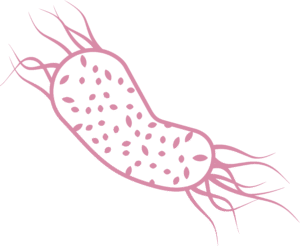
Citrobacter species
Too many Citrobacter means constant alkalinisation of the gut lining, because they produce ammonia.

Low vitamin D
Vitamin D matters in all autoimmune disorders, including Crohn's colitis.

High EPX
A very sensitive marker of eosinophil activation.
I was diagnosed with Crohn's after a trip abroad. Could a parasite be involved?
It is worth checking. Parasitic infections can mimic IBD in both symptoms and tests, and some parasites are found more often in people with IBD.4 A detailed stool test before or alongside IBD treatment can show whether a parasite or overgrown bacteria add to the inflammation. Your gastroenterologist decides how to combine the treatments.
How was Jim treated?
Parasites are hard to clear. Despite the usual view, protozoa such as Blastocystis hominis are often not cleared by metronidazole alone. A recent systematic review found reports of resistance and treatment failure, and in some studies metronidazole even increased the number of viable parasites.3 Repeated antiparasitic courses within a few months are more effective, as long as every other part of the disease is covered at the same time.
In this case, the large number of gram-negative bacteria (Citrobacter) called for antibiotic treatment at the same time, at least during the first antiparasitic course. A third medicine suited this case as well, budesonide, because the large number of activated eosinophils, probably caused by the parasites, needed to be calmed.
A clear colonoscopy
In Jim's case, budesonide was first given after the first month of antibiotic treatment, and that is when he felt much better. His urgency disappeared and his stools became completely formed. Finally, vitamin D was given until his blood level rose above 60 (63.3). Jim was able to stop prednisone without relapse, and he stayed on mesalazine with budesonide at intervals, as decided by his gastroenterologist. His last colonoscopy was clear, without any sign of relapse, and he feels less tired. Every case is different, so Jim's plan describes his care and is not a plan for anyone else.
Infographic
Diet shift
In several cases, a sudden shift in diet changes the microbiome a lot and may bring a predisposition to autoimmunity to the surface.
Look-alike infections
Parasitic infections can mimic inflammatory bowel disease, both in symptoms and in tests.
Parasites and IBD
Some parasites are found more often in people with IBD. Whether they drive the disease is not yet clear.
Stool findings
In this case, stool tests showed many Blastocystis hominis, very large amounts of Citrobacter and signs of eosinophil activation.
Hard to clear
Metronidazole alone often does not clear Blastocystis. Repeated courses worked better when the bacteria and eosinophils were treated too.
The outcome
In this case, the last colonoscopy was clear, without any sign of relapse.
Sources: Gaulke et al. 2018, Mohammadi et al. 2015, Ulusan Bağcı et al. 2025.
gutpathways.com
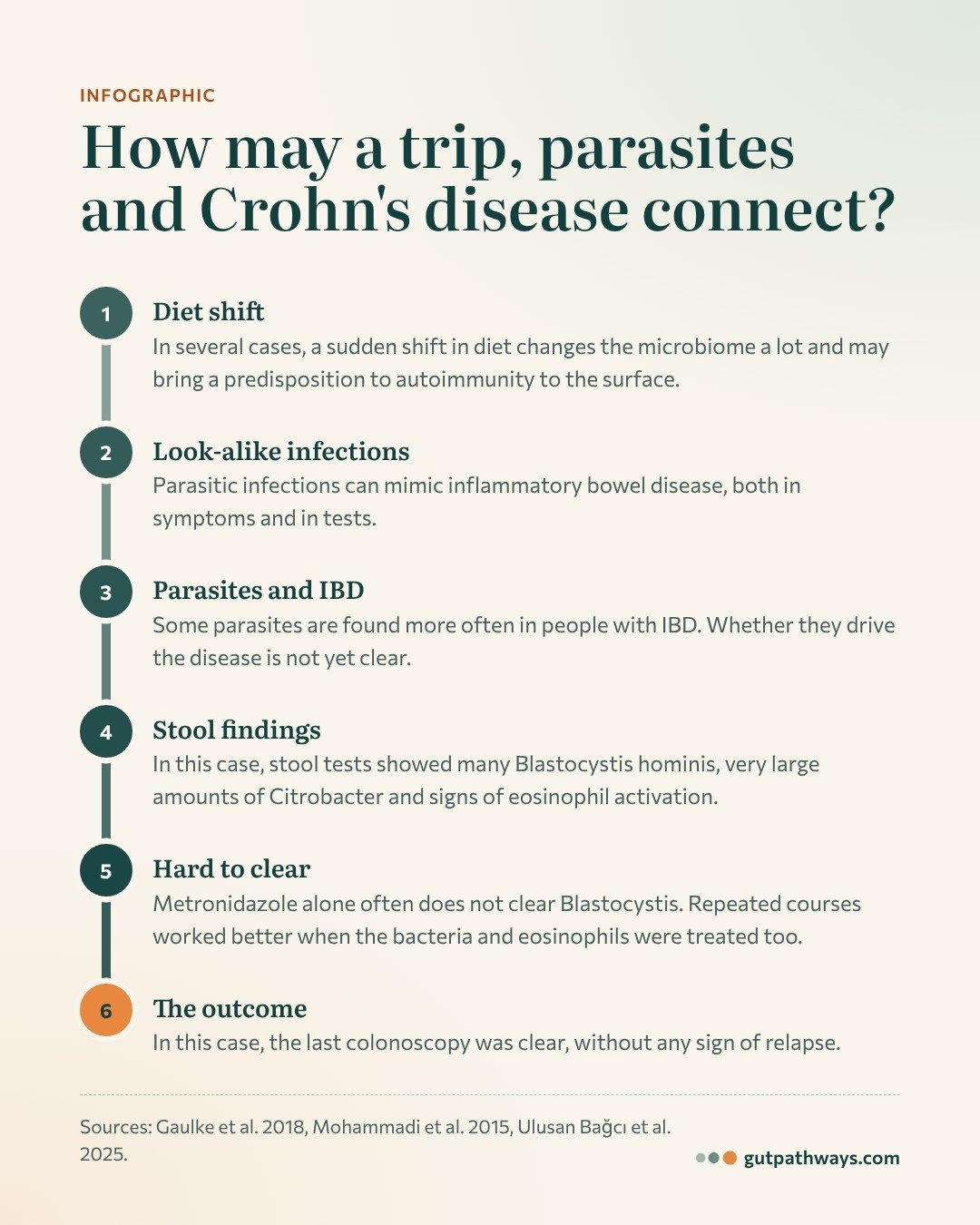 Save this infographicImage 4:5, with sources, from gutpathways.com
What does Jim's case show about parasites and Crohn's disease?
Frequently asked questions
There is no proof that a parasite causes Crohn's disease. However, parasitic infections can mimic IBD, and some parasites are found more often in people with IBD.4 In a predisposed gut, an infection may help bring the disease to the surface.
Not always. A systematic review found increasing reports of resistance and treatment failure, and in some studies metronidazole increased the number of viable parasites.3 Other agents are being studied, and the choice belongs to the doctor.
Yes. Diet and geography shape the microbiome, so a sudden change of food, water and environment during travel can shift it quickly.2
References
4 studies
- Rehman A, Rausch P, Wang J, et al. Geographical patterns of the standing and active human gut microbiome in health and IBD. Gut. 2016.
- Gaulke CA, Sharpton TJ. The influence of ethnicity and geography on human gut microbiome composition. Nat Med. 2018.
- Ulusan Bağcı Ö, Aral Akarsu G. A systematic review about the efficacy of antiparasitic agents in the treatment of Blastocystis species. Acta Parasitol. 2025.
- Mohammadi R, Hosseini-Safa A, Ehsani Ardakani MJ, et al. The relationship between intestinal parasites and some immune-mediated intestinal conditions. Gastroenterol Hepatol Bed Bench. 2015.
Found this useful? Share it with someone who needs it.
Cite this article
Prevedoros, T. (2022, September 23). Crohn’s disease appeared after a trip to Colombia. Gut Pathways. https://gutpathways.com/case-studies/crohns-after-visiting-tropical-country/