Why did she feel depressed on thyroxine with a normal TSH?
A 52-year-old woman with Hashimoto's hypothyroidism and depression had normal blood tests on thyroxine. Her case shows how a common variant of the DIO2 gene can leave tissues short of active thyroid hormone while the blood looks fine.
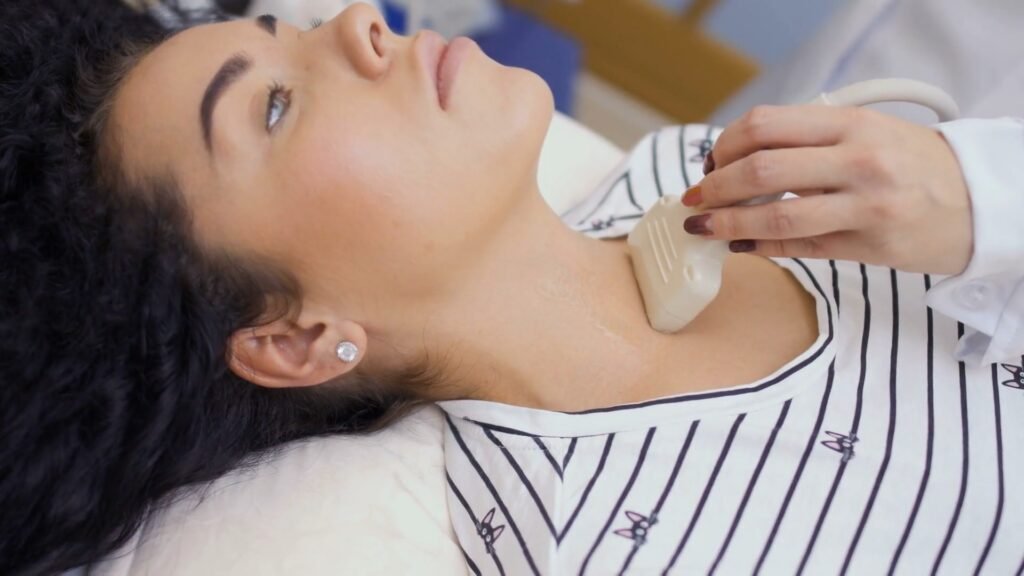 Mary's casecase study
I often hear from people I consult that, despite taking their thyroid medicine for Hashimoto's, they still have thyroid symptoms. These usually include low mood, skin and hair problems, poor focus, irritability, menstrual problems, chronic fatigue and more. In other words, taking the hormone does not always reverse the symptoms. Strange, isn't it? Not so strange, if we think about the biochemical distance between swallowing a medicine and its final destination.
In addition, blood tests show whether a substance is present in adequate amounts, and not necessarily whether it works. A medicine passes several stages before it acts.
- Absorption in the gut
The tablet must be absorbed in the intestine.
- Inactivation in the liver
Part of the hormone is processed by the liver.
- Reaching the target organ
The blood carries the hormone to each organ.
- Distribution in the tissue
The hormone spreads inside the tissue.
- Uptake by the cell
Carrier proteins take it into the cell.
- Carrier molecules
There must be enough carrier molecules.
- Binding to the receptor
Finally, the active hormone binds its receptor and acts.
A change in any protein along this path can separate taking the medicine from feeling its effect.
In fact, the line between taking a thyroid medicine and its effect can depend on one small variation in any of the proteins along this path. Just like in Mary's case.
Who is Mary, and why did her low mood keep coming back?
Hashimoto's, fatigue and low mood
Mary was a 52-year-old homemaker and the mother of three boys when she came to the practice where I work as a scientific collaborator. She gave birth to her youngest son at 41, and three years later he was diagnosed with a mild intellectual disability. Mary had been diagnosed with Hashimoto's hypothyroidism six years earlier. At first she felt tired for no clear reason. A few months later, low mood and depressive thoughts appeared.
She had been on levothyroxine ever since, and her endocrinologist was sure that her thyroid was well controlled. His only guide, however, was her TSH and T4 in the blood.
Four psychiatrists, short-lived relief
Mary saw her first psychiatrist at 47 and three more since then. All of them prescribed treatment, and each time it helped for a few months and then stopped working. All of these treatments included at least one SSRI. These medicines let serotonin act longer, and in this way they reduce depressive thoughts. Desperate, Mary also tried controversial treatments, but again found no help.
When I took her detailed history, I could not find one strong clue for a diagnostic plan. The only detail I weighed a little more was that her youngest son has an intellectual disability. As it turned out, it was enough.
- TriggerEarly menopauseEffect
The thyroid gland adapts to a new hormonal state.
- TriggerA stressful eventEffect
Stress hormones change how the thyroid works.
- TriggerDepressionEffect
Changes in serotonin affect thyroid levels further.
- TriggerSSRIsEffect
Antidepressants affect thyroid function directly and indirectly.
Each event changes how the body uses thyroid hormone.
How does the DIO2 gene affect active thyroid hormone?
Making the active T3 hormone takes several steps. First, the pituitary gland in the brain produces thyroid-stimulating hormone (TSH). Next, TSH travels to the thyroid gland and tells it to release T4, the inactive pro-hormone with four iodine atoms. Then another enzyme, deiodinase 2 (DIO2), removes one iodine atom and produces the active hormone, T3. Finally, T3 binds its receptors throughout the body and does its work.
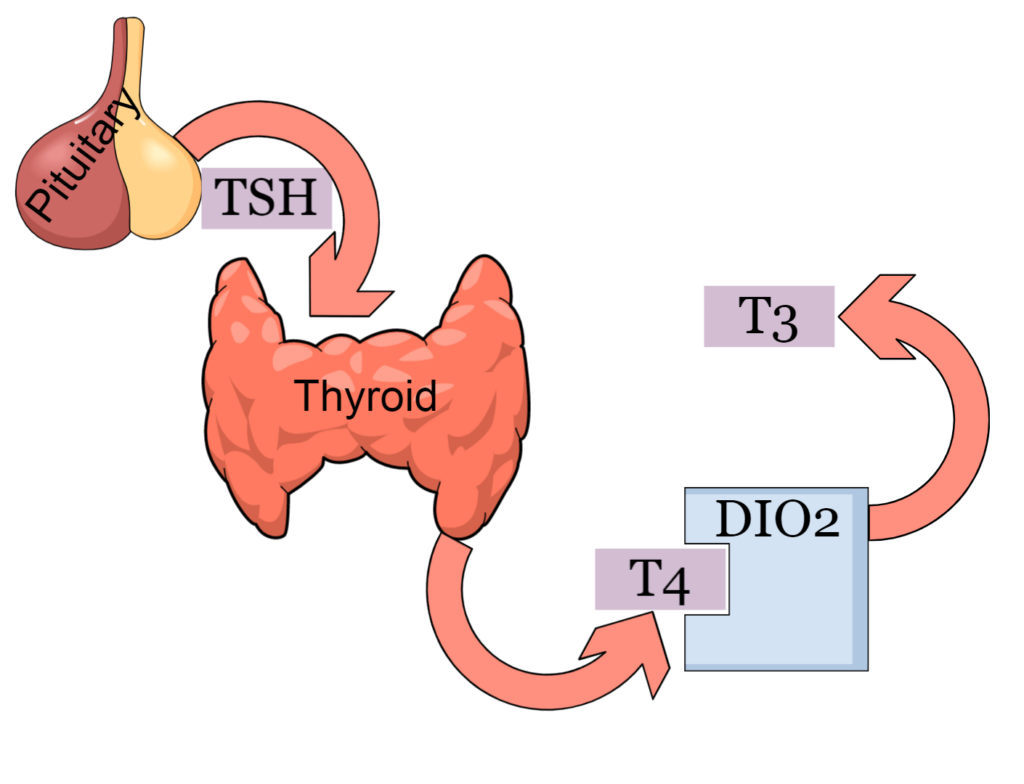
Why blood tests can miss it
Several variants of the DIO2 gene make the enzyme less productive. Under certain conditions, when more T3 is needed, the enzyme cannot keep up. One of the best-studied variants is rs225014. In a study of 552 people on thyroxine, 16% carried two copies of this variant (the CC genotype), and they had worse psychological well-being at baseline.1 Animal studies suggest that up to 80% of the T3 inside the brain is made locally from T4, which helps explain why the variant had no effect on blood thyroid levels.1
Other variants of the same gene, closely linked with rs225014, were associated with intellectual disability in iodine-deficient areas of China.3 So I asked Mary to do whole genome sequencing and several biochemical and vitamin tests. A urine test for reverse T3, although of low diagnostic value, could also rule out inactivation of the hormone.
What did Mary's tests show?
Mary's DNA showed two copies of the rs225014 variant. This variant has been linked both with poorer psychological well-being on thyroxine and with a better response to combined T4 and T3 treatment, without any change in blood thyroid levels.1 The authors noted that the results need replication.
DIO2 (rs225014)
Lower production of active T3 in selected tissues of the body.
Low vitamin D
Low vitamin D has been linked with depression in observational studies.
In a meta-analysis of observational studies, people with depression had lower vitamin D, and in cohort studies the lowest vitamin D category carried about twice the risk of depression (hazard ratio 2.21).4 Whether vitamin D treats or prevents depression still needs trials.
How was Mary treated?
According to the literature, two approaches can support DIO2 function. Kaempferol, a natural flavonoid found in apples, grapes, onions, broccoli and several berries, raised DIO2 activity about 10-fold in human muscle cells.2 The second option is combined T4 and T3 treatment.1, 5 After a discussion with her endocrinologist, Mary agreed to proceed with both.
- A natural flavonoid in plant foods
- Apples, grapes and onions
- Broccoli and several berries
- About 10-fold higher DIO2 activity in human muscle cells
- Adds the active hormone directly
- Better well-being in people with the CC genotype
- Blood thyroid levels did not change
- Decided and adjusted by the endocrinologist
Kaempferol was studied in cells, while combined treatment is a medical decision for the endocrinologist.
Mary reported an impressive benefit from the combined treatment, and she has stayed on it until today. Afterwards, she kept coming only to adjust her treatment and to do preventive tests. This case shows the need for personalised treatment, because small changes to a treatment someone already takes can bring large improvements. Every case is different, so Mary's plan describes her care and is not a plan for anyone else.
Infographic
A long path
A thyroid tablet passes several steps before it acts. One small change along the path can separate taking it from feeling it.
What blood tests show
Blood tests show whether a substance is present, not necessarily whether it works.
DIO2 inside tissues
The DIO2 enzyme turns inactive T4 into active T3 inside tissues, so its activity does not show in blood tests.
A common variant
One DIO2 variant went with worse well-being on thyroxine and a better response to combined T4 and T3. Results need replication.
Treatment choices
Combined T4 and T3 treatment is a medical decision for the endocrinologist. Kaempferol was studied in cells.
Sources: Panicker et al. 2009, da-Silva et al. 2007.
gutpathways.com
 Save this infographicImage 4:5, with sources, from gutpathways.com
What does Mary's case show about thyroid and mood?
Frequently asked questions
Low thyroid hormone is a known cause of low mood, fatigue and poor focus. Some people on thyroxine still have these symptoms with normal blood tests. One reason studied is the DIO2 gene, which affects how much active T3 is made inside tissues.1
DIO2 makes deiodinase type 2, the enzyme that turns the inactive T4 into the active T3 inside tissues such as the brain. Common variants such as rs225014 can make the enzyme less productive without changing blood thyroid levels.1
TSH and T4 show what circulates in the blood, and not how much active T3 each tissue makes. Absorption, conversion by DIO2 and uptake by cells all play a part.
References
5 studies
- Panicker V, Saravanan P, Vaidya B, et al. Common variation in the DIO2 gene predicts baseline psychological well-being and response to combination thyroxine plus triiodothyronine therapy in hypothyroid patients. J Clin Endocrinol Metab. 2009.
- da-Silva WS, Harney JW, Kim BW, et al. The small polyphenolic molecule kaempferol increases cellular energy expenditure and thyroid hormone activation. Diabetes. 2007.
- Guo TW, Zhang FC, Yang MS, et al. Positive association of the DIO2 (deiodinase type 2) gene with mental retardation in the iodine-deficient areas of China. J Med Genet. 2004.
- Anglin RE, Samaan Z, Walter SD, McDonald SD. Vitamin D deficiency and depression in adults: systematic review and meta-analysis. Br J Psychiatry. 2013.
- Bianco AC, McAninch EA. The role of thyroid hormone and brown adipose tissue in energy homoeostasis. Lancet Diabetes Endocrinol. 2013.
Found this useful? Share it with someone who needs it.
Cite this article
Prevedoros, T. (2022, September 21). Why did she feel depressed on thyroxine with a normal TSH?. Gut Pathways. https://gutpathways.com/case-studies/depression-and-euthyroid-function/