How C-section birth shapes allergy and asthma risk through the gut
Babies born by C-section start life with a different set of gut bacteria. That difference may nudge the immune system toward allergies and asthma, and 2026 research shows how the gut microbiome at age one carries part of that risk.
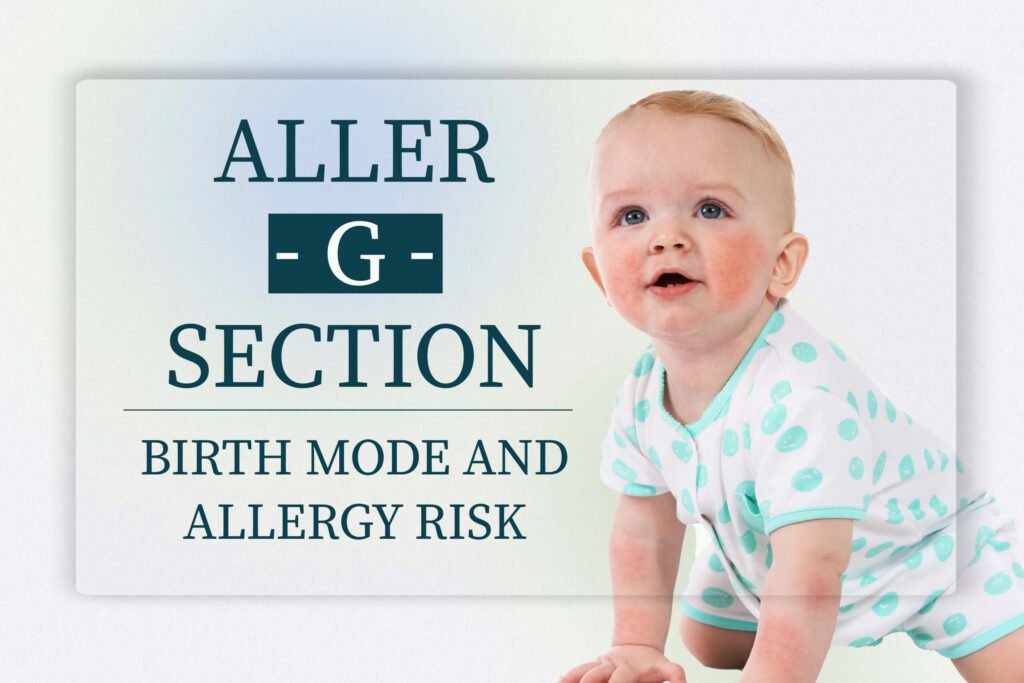
Does a C-section raise the risk of allergies and asthma?
The short answer is yes, but the rise is modest. C-section and allergies are linked in dozens of studies, and the link is strongest for asthma and food allergy. The minutes a baby spends in the birth canal deliver the first and most important batch of microbes, the ones that grow into the gut microbiome.
The first large meta-analysis, published in Clinical & Experimental Allergy in 2008, pooled 26 studies. C-section went with higher odds of food allergy (OR 1.32), allergic rhinitis (OR 1.23) and asthma (OR 1.18), but not with eczema.10 Since then, the evidence has grown a lot. A 2024 review of 113 studies confirmed higher risks for asthma, allergic rhinitis, eczema, food allergy and allergic sensitization.1
The reasoning behind these numbers goes back to the first hours of life. During vaginal birth, the baby meets a rich mix of maternal bacteria, and these first commensals help train the immune system. A C-section skips most of that exposure, which may skew immune maturation toward allergic reactions.11
Why the evidence is mixed
Even so, birth mode does not decide allergies on its own. In the Australian HealthNuts study, which confirmed food allergy with food challenges in 2,045 infants, C-section was not linked to food allergy at 12 months (aOR 0.95).12 In addition, genetics, early antibiotics and the reason for the C-section itself all play a part.
A 2026 meta-analysis puts this into proportion. Across 190 studies and 2.8 million children, C-section raised the odds of food allergy only slightly (OR 1.16). By comparison, antibiotics in the first month of life raised them about fourfold (OR 4.11).8 Among all these factors, one stands out because it links most of them, the gut microbiota.
How does birth shape a baby's gut microbiome?

In utero
Development in the womb is a key factor of gut microbiome maturation.
Birth mode
The way a baby is born is a key factor of gut microbiome maturation.
Breastfeeding
Breastfeeding is a key factor of gut microbiome maturation.
Solids introduction
The introduction of solid food is a key factor of gut microbiome maturation.
Contact with nature
Contact with nature is a key factor of gut microbiome maturation.
Antibiotics
Antibiotics are a key factor of gut microbiome maturation.
How babies acquire their gut microbiota at birth
The gut ecosystem starts forming at birth. Before birth, the baby relies on the mother's immune system. Its own microbial load is low, and whether real colonization begins in the womb is still debated. In a Finnish study, placenta and amniotic fluid showed almost no bacterial DNA, while the first stool, the meconium, already carried a distinct microbiome.13
The main batch of microbes, though, comes during the passage through the birth canal. The newborn's lips and tongue take in vaginal and gut bacteria from the mother, and this first contact may also start immune tolerance. That is why a vaginal environment free of infection matters during and right before labor.
How delivery mode changes the infant microbiome
Babies born vaginally and babies born by C-section meet different microbes. C-section babies tend to pick up bacteria from skin and the hospital environment rather than from the mother's birth canal. In 700 Danish children, C-section went with Klebsiella, Enterococcus, Clostridium, Citrobacter and Staphylococcus aureus at one week, while vaginal birth went with Escherichia coli.2
In a Dutch study, doctors postponed maternal antibiotics until after cord clamping, so the antibiotics could not explain the difference. Even so, vaginally born babies had more Bifidobacterium and less Enterococcus and Klebsiella throughout the first year.3 In addition, C-section babies in a Finnish cohort lacked Bacteroides for the first 6 to 18 months.4
What does 2026 research show about the microbiome and asthma after C-section?
Two large 2026 studies changed the question. It is no longer only whether C-section babies start differently, but whether their gut catches up by their first birthday. The answer seems to decide part of the asthma risk.
In the Canadian CHILD cohort of 3,089 children, 22% were born by C-section. The C-section signature in stool was strong at 3 months and weaker at one year. However, only the one-year signature predicted asthma at age five (OR 1.41, adjusted OR 1.30).5 Children born by C-section had about 4.8 percentage points more asthma, and around 25% of that extra risk ran through the one-year microbiome.
The same study found a chemical trace. Stool from one-year-olds with a strong C-section signature held more tryptamine and other bacterial tryptophan products, and less indole-3-propionic acid, a metabolite usually linked with a healthy gut.5
- Birth by C-section
The baby misses most maternal vaginal and gut bacteria.
- Different first colonizers
Klebsiella and Enterococcus rise, Bifidobacterium and Bacteroides lag.
- Slow catch-up
Part of this pattern is still there at age one.
- Altered tryptophan metabolism
Bacteria make more tryptamine and less indole-3-propionic acid.
- Higher asthma risk at age five
The one-year signature carried about a quarter of the extra risk.
A simplified chain from the 2026 CHILD and COPSAC studies, not a proven cause in every child.
A second 2026 study from the Danish COPSAC cohort measured how far each C-section baby's microbiome had caught up by age one. Certain bacteria present at one week predicted a better catch-up. In addition, having older siblings went with more restoration, and better restoration went with lower asthma risk, a pattern repeated in the Canadian cohort.14
The gut microbiome at age one, not only at birth, carries part of the asthma risk after C-section. This makes the first year a window where feeding, siblings and antibiotics may matter.
What makes C-section babies more prone to asthma and allergies?
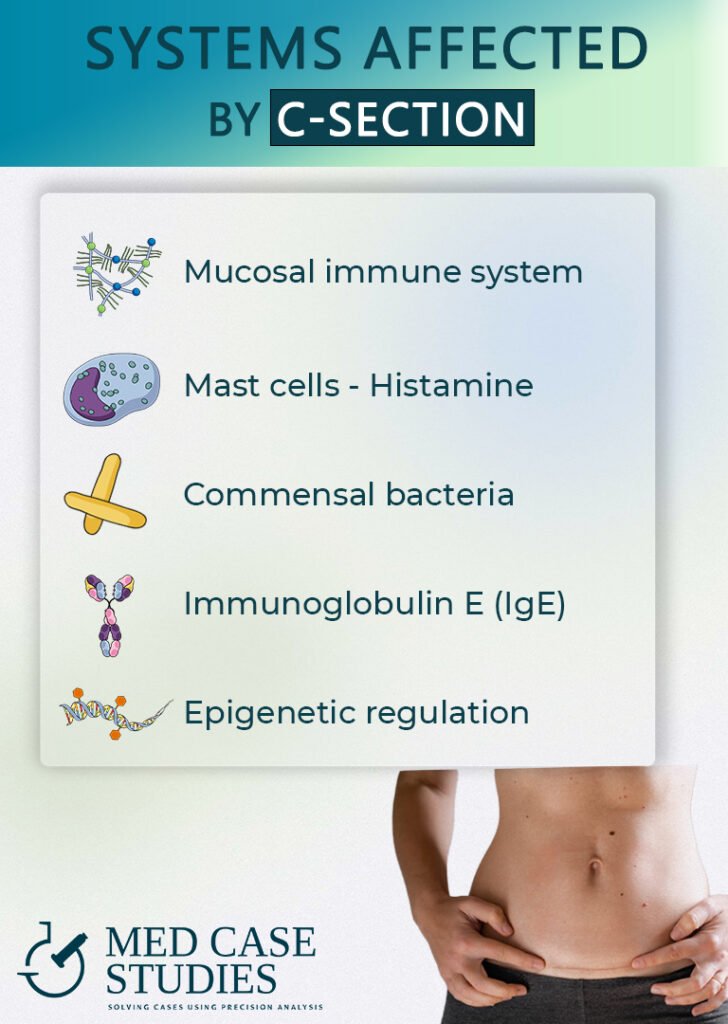
Mucosal immune system
The mucosal immune system is affected by C-section.
Mast cells and histamine
Mast cells and histamine are affected by C-section.
Commensal bacteria
Commensal bacteria are affected by C-section.
Immunoglobulin E (IgE)
Immunoglobulin E (IgE) is affected by C-section.
Epigenetic regulation
Epigenetic regulation is affected by C-section.
Several mechanisms seem to work together. No single one explains the risk, although each may lean the young immune system toward allergy.

A smaller surge of new immune cells
In 6,014 Swedish newborns, C-section before labor went with lower formation of new T cells at birth (aOR 1.32 for the lowest levels). Its meaning for later health is still open.15
More histamine-making bacteria
C-section babies carry more Klebsiella early on, and some Klebsiella strains make large amounts of histamine from the amino acid histidine.2, 16 Histamine-secreting microbes were also more common in the gut of adults with asthma.17 So C-section babies may produce more histamine in the gut, although this has not been measured directly in infants.
Antibiotics around delivery
Mothers usually get antibiotics during a C-section, and these also reach the baby. They add to the shift in the first microbiome.18
Allergen-specific IgE and allergic sensitization
Immunoglobulin E (IgE) is the antibody behind classic allergic reactions. In 432 children with a parent with allergies, those born by C-section had twice the odds of allergic sensitization at school age (OR 2.1) and higher odds of allergic rhinitis (OR 1.8), but not of asthma.19 A conference report also described more sensitization to dust and pet allergens by age two in C-section babies exposed at six months.20
Epigenetic changes at birth
Epigenetic changes alter gene activity without changing the DNA sequence. A 2024 meta-analysis of 9,833 newborns found six DNA methylation sites in cord blood linked with C-section, including genes involved in immune signaling. However, none of them was still different at age 6 to 10.21 Therefore, epigenetics may play a role around birth, while the long-term effect remains unclear.22
Is there a link between C-section and IBS?
Within the atopic picture, irritable bowel syndrome (IBS) deserves a mention. Researchers now see IBS as a disorder shaped in part by the gut microbiota, with histamine, mast cells and IgE playing a part in many cases, and serotonin regulating gut motility. Histamine made by gut bacteria such as Klebsiella aerogenes caused pain hypersensitivity through mast cells in mice colonized with stool from people with IBS.16 More on this is in IBS and mast cells.
A Swedish national cohort of almost two million people found that birth by C-section went with a 10% higher risk of adult IBS (HR 1.10), after adjusting for other perinatal factors.23 On the other hand, a 2025 meta-analysis did not find C-section to be a statistically significant childhood risk factor.24 So the link is plausible, but it is small and not settled.
Amelia, nine months, born by C-section
Skin rashes, signs of allergy and persistent colic since the early months.
- Background
Amelia was born by C-section and developed atopic symptoms, skin rashes and colic that did not settle.
- The thinking
The pediatrician I work with as a scientific collaborator saw a possible link between her symptoms and her birth mode.
- The plan
In this case, Amelia took a probiotic designed for infants, and her mother took a probiotic blend with mostly histamine-lowering strains.
- Result
Over 40 days, her mother reported much less colic. By the end, Amelia was colic-free and her skin had cleared.
Every case is different, and colic has many causes. Still, in a randomized trial, the probiotic Lactobacillus reuteri DSM 17938 cut crying and fussing time in breastfed babies with colic.25
How can you reduce the risk of asthma and allergies in C-section babies?
Some practices seem to help the microbiome of a baby born by C-section. They work best together and over months, and none of them replaces medical advice.
Breastfeed beyond six months, directly when possible
The World Health Organization recommends breast milk alone for the first six months and continued breastfeeding up to two years of age or beyond.26 Breast milk seeds the infant gut. Babies who got at least 75% of their milk from the breast received about 28% of their gut bacteria from milk in the first month.27 In 3,296 Canadian children, formula-only feeding at three months went with higher asthma risk at age three (aOR 2.14) compared with direct breastfeeding.6 More in breast milk and bacteria.
Use infant probiotics with care
In a trial of 1,223 mother-infant pairs, probiotics plus a prebiotic lowered IgE-associated allergy by age five only in C-section children (24.3% vs 40.5%).9 In practice, varied strains seem wiser than one strain for months, to avoid narrowing the developing microbiome.
Consider maternal probiotics and prebiotics
In the same Finnish trial, mothers took the probiotic in the last month of pregnancy and infants continued it for six months.9 A balanced maternal microbiome may soften the effect of a C-section on the baby.
Offer a wide variety of first foods
Each extra food introduced in the first year went with about 26% lower odds of asthma (OR 0.74), with similar effects for food allergy.7 If you pump milk or use formula, ask your pediatrician how to bring in diverse vegetables and fruits.
Avoid antibiotics that are not needed
Antibiotics in the first month of life were the strongest early risk factor for food allergy in the 2026 meta-analysis.8 Use them when a doctor confirms they are needed, not as a precaution.
Hold them close, a lot
Skin contact passes skin and household microbes to the baby. Oxytocin, the hormone of closeness, interacts with gut bacteria, and in animal work the bacterium L. reuteri raised oxytocin.30 How much hugging itself reshapes the infant microbiome has not been measured.
For a closer look at feeding choices, see the infant microbiome of breast milk vs formula.
Frequently asked questions
On average, yes, but the difference is modest. Across 113 studies, C-section went with about 35% higher odds of food allergy and 20% higher odds of asthma, while most C-section babies never develop either.1
Mostly, within the first year. However, a 2026 study found that when a C-section signature was still present at age one, asthma risk at age five was higher.5
It means wiping a baby born by C-section with gauze soaked in the mother's vaginal fluids, to pass on maternal bacteria. Studies show possible microbial changes but limited proof of health benefit so far.29
Not weaker as such, but different at the start. C-section before labor went with fewer newly formed T cells at birth, and the early microbiome trains the immune system differently.15
References
30 studies
- Liu X, Zhou J, Chen J, et al. Risk of asthma and allergies in children delivered by cesarean section: a comprehensive systematic review. J Allergy Clin Immunol Pract. 2024.
- Stokholm J, Thorsen J, Chawes BL, et al. Cesarean section changes neonatal gut colonization. J Allergy Clin Immunol. 2016.
- Reyman M, van Houten MA, van Baarle D, et al. Impact of delivery mode-associated gut microbiota dynamics on health in the first year of life. Nat Commun. 2019.
- Yassour M, Vatanen T, Siljander H, et al. Natural history of the infant gut microbiome and impact of antibiotic treatment on bacterial strain diversity and stability. Sci Transl Med. 2016.
- Jiang J, Dai DLY, Poulsen CS, et al. Microbial-derived tryptophan metabolites in the infant gut associate with increased risk of asthma following cesarean section. Nat Commun. 2026.
- Klopp A, Vehling L, Becker AB, et al. Modes of infant feeding and the risk of childhood asthma: a prospective birth cohort study. J Pediatr. 2017.
- Roduit C, Frei R, Depner M, et al. Increased food diversity in the first year of life is inversely associated with allergic diseases. J Allergy Clin Immunol. 2014.
- Islam N, Chu AWL, Sheriff F, et al. Risk factors for the development of food allergy in infants and children: a systematic review and meta-analysis. JAMA Pediatr. 2026.
- Kuitunen M, Kukkonen K, Juntunen-Backman K, et al. Probiotics prevent IgE-associated allergy until age 5 years in cesarean-delivered children but not in the total cohort. J Allergy Clin Immunol. 2009.
- Bager P, Wohlfahrt J, Westergaard T. Caesarean delivery and risk of atopy and allergic disease: meta-analyses. Clin Exp Allergy. 2008.
- Mueller NT, Bakacs E, Combellick J, Grigoryan Z, Dominguez-Bello MG. The infant microbiome development: mom matters. Trends Mol Med. 2015.
- Currell A, Koplin JJ, Lowe AJ, et al. Mode of birth is not associated with food allergy risk in infants. J Allergy Clin Immunol Pract. 2022.
- Turunen J, Tejesvi MV, Paalanne N, et al. Presence of distinctive microbiome in the first-pass meconium of newborn infants. Sci Rep. 2021.
- Jiang J, Poulsen CS, Boulund U, et al. Early life bacteria and sibling exposure associate with restoration of the infant gut microbiome after cesarean section. Nat Commun. 2026.
- Schlinzig T, Johansson S, Stephansson O, et al. Surge of immune cell formation at birth differs by mode of delivery and infant characteristics, a population-based cohort study. PLoS One. 2017.
- De Palma G, Shimbori C, Reed DE, et al. Histamine production by the gut microbiota induces visceral hyperalgesia through histamine 4 receptor signaling in mice. Sci Transl Med. 2022.
- Barcik W, Pugin B, Westermann P, et al. Histamine-secreting microbes are increased in the gut of adult asthma patients. J Allergy Clin Immunol. 2016.
- Hoang DM, Levy EI, Vandenplas Y. The impact of Caesarean section on the infant gut microbiome. Acta Paediatr. 2021.
- Pistiner M, Gold DR, Abdulkerim H, Hoffman E, Celedón JC. Birth by cesarean section, allergic rhinitis, and allergic sensitization among children with a parental history of atopy. J Allergy Clin Immunol. 2008.
- Conference abstract on cesarean delivery and allergen-specific IgE at age 2. J Allergy Clin Immunol. 2013 (meeting abstract, not indexed in PubMed).
- Wang S, Casey E, Sordillo J, et al. Cesarean delivery and blood DNA methylation at birth and childhood: meta-analysis in the Pregnancy and Childhood Epigenetics Consortium. Sci Adv. 2024.
- Tribe RM, Taylor PD, Kelly NM, et al. Parturition and the perinatal period: can mode of delivery impact on the future health of the neonate? J Physiol. 2018.
- Waehrens R, Li X, Sundquist J, Sundquist K, Zöller B. Perinatal and familial risk factors for irritable bowel syndrome in a Swedish national cohort. Scand J Gastroenterol. 2018.
- Lenover Moyer MB, Jasani K, Waldman AB, Chinchilli VM, Shenk MK. The developmental origins of irritable bowel syndrome: a systematic review and meta-analysis. Am J Hum Biol. 2025.
- Chau K, Lau E, Greenberg S, et al. Probiotics for infantile colic: a randomized, double-blind, placebo-controlled trial investigating Lactobacillus reuteri DSM 17938. J Pediatr. 2015.
- World Health Organization. Infant and young child feeding. Fact sheet, updated 4 August 2026.
- Pannaraj PS, Li F, Cerini C, et al. Association between breast milk bacterial communities and establishment and development of the infant gut microbiome. JAMA Pediatr. 2017.
- Albenberg LG, Wu GD. Diet and the intestinal microbiome: associations, functions, and implications for health and disease. Gastroenterology. 2014.
- Jurgiel J, Gromowski T, Król J, et al. The impact of maternal microbial transfer on the infant gut microbiome after cesarean delivery: a systematic review. Am J Obstet Gynecol. 2026.
- Erdman SE, Poutahidis T. Microbes and oxytocin: benefits for host physiology and behavior. Int Rev Neurobiol. 2016.
Found this useful? Share it with someone who needs it.
Cite this article
Prevedoros, T. (2023, May 19). How C-section birth shapes allergy and asthma risk through the gut. Gut Pathways. https://gutpathways.com/articles/c-section-allergies-asthma/