How the gut microbiome and TMAO are linked to systemic sclerosis
Systemic sclerosis, also called scleroderma, affects the gut in most people who have it. Research now shows a distinct gut microbiome and higher levels of TMAO, a bacterial metabolite, in people with the disease.
Is there a link between the gut microbiome and systemic sclerosis?
Systemic sclerosis (SSc), also known as scleroderma, is a rare autoimmune disease of the connective tissue. It causes fibrosis, a thickening and hardening of tissue, in the skin and internal organs. The exact cause remains unclear, and there are few established markers of how severe the disease is or how much it involves the gut.
The gut matters a great deal here. The esophagus is affected in about 90% of people with systemic sclerosis, and problems can appear in every part of the digestive tract, from reflux to bacterial overgrowth and fecal incontinence.4
In recent years, researchers have explored the link between the gut microbiota and SSc. In colon samples taken during colonoscopy, people with SSc had fewer beneficial commensal bacteria such as Faecalibacterium and Clostridium, and more pathobionts such as Fusobacterium.5 Those with moderate to severe gut symptoms had less Bacteroides fragilis and more Fusobacterium.5
A 2026 multi-omics study added a chemical layer. It found 11 bacterial species and 266 blood metabolites that differed in SSc, with more Escherichia coli and fewer butyrate producers.7 Against this background, a 2023 study in the Journal of Inflammation Research found a link between one gut microbial metabolite, trimethylamine N-oxide (TMAO), and specific complications of SSc.1
What is TMAO and where does it come from?
- TMAO
- Trimethylamine N-oxide is a molecule made in two steps. Gut bacteria turn choline and carnitine from food, mainly red meat and eggs, into trimethylamine, and the liver then turns it into TMAO.
TMAO depends on both diet and gut bacteria. In a randomized trial, four weeks of a red-meat diet more than doubled blood TMAO, while white meat and plant protein did not. After people stopped eating red meat, TMAO fell within four weeks.8
TMAO also has effects of its own. In more than 4,000 people, higher TMAO predicted heart attack and stroke over three years, and in laboratory work TMAO made platelets more reactive.9
What did the TMAO study in systemic sclerosis find?
The study measured TMAO in people with systemic sclerosis and looked at how it related to specific features of the disease, including the gut. Researchers used high-performance liquid chromatography to measure TMAO in 63 patients with SSc and 47 matched controls.1 They then compared it with markers of heart involvement (left ventricle ejection fraction and NT-proBNP), a marker of interstitial lung disease (ILD) severity and the Scleroderma Clinical Trials Consortium Damage Index.
TMAO in systemic sclerosis, median plasma levels in ng/mL
Stec 2023, 63 patients with systemic sclerosis and 47 controls.
Plasma TMAO was clearly higher in SSc (283.0 ng/mL) than in controls (205.5 ng/mL). In addition, it was higher in patients who also had ILD or esophageal dysmotility, two complications of the disease.1 TMAO also correlated with the heart markers, the lung severity marker and the damage index. This matters because heart involvement is a known and serious complication of SSc.10
The authors concluded that TMAO is raised in systemic sclerosis, above all in patients with advanced organ involvement. This was the first study of plasma TMAO in the disease, and they suggested that bacterial metabolites may link gut dysbiosis with organ involvement.1 Still, the study measured TMAO at one time point and cannot show that TMAO causes these complications.
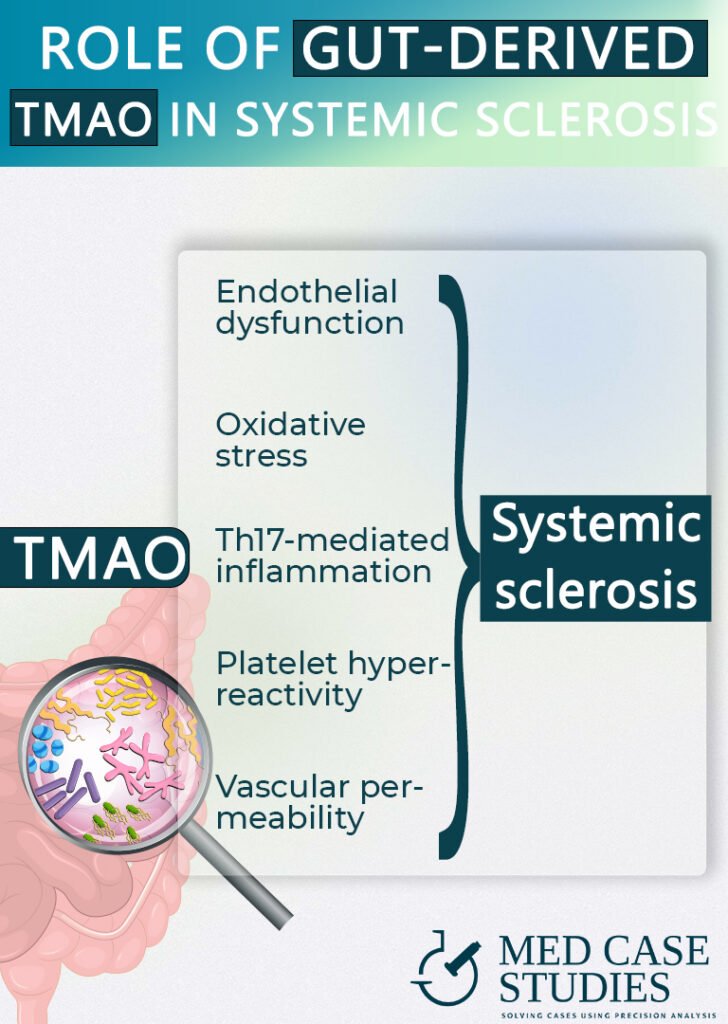
Gut-derived TMAO
TMAO from the gut is linked with systemic sclerosis through the five items below.
Endothelial dysfunction
TMAO is linked with endothelial dysfunction.
Oxidative stress
TMAO is linked with oxidative stress.
Th17-mediated inflammation
TMAO is linked with Th17-mediated inflammation.
Platelet hyperreactivity
TMAO is linked with platelet hyperreactivity.
Vascular permeability
TMAO is linked with vascular permeability.
Systemic sclerosis
All five items lead to systemic sclerosis.
- Diet and gut bacteria
Choline and carnitine from food become trimethylamine in the gut, then TMAO in the liver.8
- Oxidative stress
Damage from reactive oxygen species is one of the mechanisms of vascular injury in the disease.13
- Immune imbalance
Th17 cells, which drive inflammation, are out of balance with regulatory T cells in systemic sclerosis.14
A simplified chain of proposed mechanisms, not proven steps in every patient.
What does 2026 research show about the gut and the lungs?
Lung disease is a leading concern in systemic sclerosis, and the gut may be part of that story. A 2026 international study analyzed stool from 285 people with SSc at seven centers on five continents. Of them, 62.5% had ILD.2
People with ILD had a distinct gut bacterial signature, with more candidate pathobiont species. In addition, in 103 people with ILD, specific bacteria and bacterial pathways tracked with how much lung tissue was affected on CT scans.2
Can the gut microbiome be modified in systemic sclerosis?
It is too early for a definite answer, but the question is being tested. Studies have looked at probiotics and fecal microbiota transplantation (FMT) for the gut symptoms of SSc, with mixed results.
| Study | What was tested | Main finding |
|---|---|---|
| Low et al. 2019, 40 people | Multi-strain probiotic for 60 days, then for all | No change in overall gut symptoms at 60 days, better reflux at 120 days.16 |
| Marighela et al. 2019, 73 people | Probiotics for 8 weeks | No change in gut symptoms, but fewer Th17 inflammatory cells.17 |
| Fretheim et al. 2020, 10 people | Fecal transplant from cultured microbiota | Less bloating, diarrhea or incontinence in four of five treated patients, a small pilot.18 |
| Fretheim et al. 2025, 67 people | Same fecal transplant, phase 2 trial | Well tolerated, but no improvement in lower gut symptoms over placebo.19 |
A 2025 systematic review of four probiotic trials could not prove a benefit or harm and rated the evidence as low certainty.20 Together, these findings show that changing the gut microbiome in SSc is possible, yet the right tools are still being worked out. Considering several sources of evidence, rather than one study, gives the clearest picture of how the gut microbiota relates to systemic sclerosis.21
How common is SIBO in scleroderma?
Small intestinal bacterial overgrowth (SIBO) means too many bacteria in the small intestine. It is common in autoimmune disease, and in SSc the slow movement of the gut makes room for it. Across 28 studies, SIBO was about ten times more common in SSc than in controls (OR 9.6).6
Antibiotics such as rifaximin cleared SIBO in most treated patients in that analysis, yet relapses are common and breath tests are not very accurate in SSc.6, 22 So SIBO is worth checking, especially when diarrhea, bloating or weight loss appear.
What diet supports a healthy gut microbiota in systemic sclerosis?
In light of these findings, people with systemic sclerosis might consider changes in diet and lifestyle that support healthy gut microbiota. For example, fiber-rich foods such as fruits, vegetables and whole grains, within a fresh Mediterranean diet, can help keep the gut microbiota balanced. In addition, fermented foods such as yogurt, kefir and sauerkraut bring beneficial bacteria and may support gut health and ease some gut symptoms of SSc.
Food processing may also matter. In 65 people with SSc, eating more ultra-processed food went with more gut symptoms, even after accounting for SIBO, acid-blocking drugs and probiotics.3 As always, fiber needs care when the gut moves slowly, so changes work best step by step with the care team.
Now what?
The TMAO study links one metabolite with specific complications, and future studies could look at other bacterial metabolites in SSc. They could also test whether changing the gut microbiota through diet, probiotics or other approaches helps the disease and its complications.
The link between TMAO and SSc complications points to the role of the gut microbiome in autoimmune disease. By understanding bacterial metabolites such as TMAO, patients, clinicians and researchers can work toward new approaches. A healthy gut microbiota supported by diet and lifestyle is a sensible step in living with systemic sclerosis, especially when the gut is involved.
Actionable tips for the gut in systemic sclerosis
These tips come from practice and from the mechanisms above. They have not been tested as a package in SSc, so they work best as additions to medical care.

Early dinners and seasonal vegetables
An early dinner and plenty of seasonal vegetables may help lower TMAO and the endothelial dysfunction and fibrosis linked to it, while supporting a balanced gut microbiota.11

Herbal tea and gentle cooking
Antioxidant-rich herbal tea and gentle cooking methods may counter TMAO-driven oxidative stress, which is part of the vascular damage in SSc.13
Salad with meat and intermittent fasting
A salad with every meat meal and intermittent fasting may limit TMAO-driven activation of the blood vessel lining, vessel leakiness and release of inflammatory cytokines, while supporting gut balance.23
Frequently asked questions
Yes. People with systemic sclerosis have a distinct gut microbiome, and TMAO, a gut microbial metabolite, was significantly higher in patients, especially those with advanced organ involvement. This suggests that bacterial metabolites such as TMAO may contribute to the disease and its complications.5, 1
Almost any part of the gut can be affected, from reflux and swallowing problems to slow stomach emptying, SIBO, constipation and fecal incontinence. The esophagus is involved in about 90% of patients.4
Yes. About 40% of people with systemic sclerosis had SIBO across 28 studies, about ten times more often than controls.6
No single diet is proven. A fresh Mediterranean-style diet with vegetables, fermented foods and less ultra-processed food supports the gut microbiota, with fiber adjusted to how well the gut moves.3
References
23 studies
- Stec A, Maciejewska M, Paralusz-Stec K, et al. The gut microbial metabolite trimethylamine N-oxide is linked to specific complications of systemic sclerosis. J Inflamm Res. 2023.
- Andréasson K, Young A, Joshi S, et al. International investigation of the gut-lung axis in systemic sclerosis-interstitial lung disease. Arthritis Care Res (Hoboken). 2026.
- Lee JY, Mahurkar-Joshi S, Young A, et al. Ultra-processed food intake is associated with increased gastrointestinal tract symptoms and alterations in gut microbiota in patients with systemic sclerosis. Front Immunol. 2025.
- Quigley EMM, McMahan ZH, Kulkarni S, et al. Gastrointestinal disorders in scleroderma. Gastroenterology. 2026.
- Volkmann ER, Chang YL, Barroso N, et al. Association of systemic sclerosis with a unique colonic microbial consortium. Arthritis Rheumatol. 2016.
- Shah A, Pakeerathan V, Jones MP, et al. Small intestinal bacterial overgrowth complicating gastrointestinal manifestations of systemic sclerosis: a systematic review and meta-analysis. J Neurogastroenterol Motil. 2023.
- Yao QC, Zhang DY, Du YP, et al. Gut microbiome-metabolome dysregulation in systemic sclerosis: a multi-omics study. Rheumatology (Oxford). 2026.
- Wang Z, Bergeron N, Levison BS, et al. Impact of chronic dietary red meat, white meat, or non-meat protein on trimethylamine N-oxide metabolism and renal excretion in healthy men and women. Eur Heart J. 2019.
- Zhu W, Gregory JC, Org E, et al. Gut microbial metabolite TMAO enhances platelet hyperreactivity and thrombosis risk. Cell. 2016.
- Cannarile F, Valentini V, Mirabelli G, et al. Cardiovascular disease in systemic sclerosis. Ann Transl Med. 2015.
- Altorok N, Wang Y, Kahaleh B. Endothelial dysfunction in systemic sclerosis. Curr Opin Rheumatol. 2014.
- Manetti M, Romano E, Rosa I, et al. Endothelial-to-mesenchymal transition contributes to endothelial dysfunction and dermal fibrosis in systemic sclerosis. Ann Rheum Dis. 2017.
- Müller-Ladner U, Distler O, Ibba-Manneschi L, et al. Mechanisms of vascular damage in systemic sclerosis. Autoimmunity. 2009.
- Khoury SJ. Th17 and Treg balance in systemic sclerosis. Clin Immunol. 2011.
- Habets KL, Huizinga TW, Toes RE. Platelets and autoimmunity. Eur J Clin Invest. 2013.
- Low AHL, Teng GG, Pettersson S, et al. A double-blind randomized placebo-controlled trial of probiotics in systemic sclerosis associated gastrointestinal disease. Semin Arthritis Rheum. 2019.
- Marighela TF, Arismendi MI, Marvulle V, et al. Effect of probiotics on gastrointestinal symptoms and immune parameters in systemic sclerosis: a randomized placebo-controlled trial. Rheumatology (Oxford). 2019.
- Fretheim H, Chung BK, Didriksen H, et al. Fecal microbiota transplantation in systemic sclerosis: a double-blind, placebo-controlled randomized pilot trial. PLoS One. 2020.
- Fretheim H, Barua I, Bakland G, et al. Faecal microbiota transplantation in patients with systemic sclerosis and lower gastrointestinal tract symptoms in Norway (ReSScue): a phase 2, randomised, double-blind, placebo-controlled trial. Lancet Rheumatol. 2025.
- Wach AA, Storman D, Więckowski K, et al. The efficacy of probiotics, prebiotics or synbiotics in scleroderma: a systematic review. Clin Nutr ESPEN. 2025.
- Volkmann ER, Hoffmann-Vold AM. Gastrointestinal tract microbiota modifications in systemic sclerosis. Eur J Rheumatol. 2020.
- Radić M, Belančić A, Vučković M, et al. Eradication of small intestinal bacterial overgrowth in systemic sclerosis: current treatment and perspectives, a narrative review. Biomedicines. 2025.
- Abraham D, Distler O. How does endothelial cell injury start? The role of endothelin in systemic sclerosis. Arthritis Res Ther. 2007.
Found this useful? Share it with someone who needs it.
Cite this article
Prevedoros, T. (2023, May 10). How the gut microbiome and TMAO are linked to systemic sclerosis. Gut Pathways. https://gutpathways.com/articles/systemic-sclerosis-gut-microbiome/