Is Klebsiella linked to ankylosing spondylitis?
Ankylosing spondylitis and Klebsiella keep turning up together in the research, tied by a shared piece of biology inside the immune system. Here is what the data show, mechanism by mechanism, including the studies that disagree.

What's the real link between ankylosing spondylitis and Klebsiella?
Ankylosing spondylitis and Klebsiella are connected through a well-documented immune mechanism, built from decades of overlapping evidence. Klebsiella pneumoniae is a gut bacterium that most people carry in small numbers, usually without any trouble. In people who carry the HLA-B27 gene, an overgrowth of Klebsiella in the bowel may push the immune system into attacking the body's own spinal and joint tissue, because part of the bacterium closely resembles part of HLA-B27 itself.1 The result is the chronic pain and stiffness that mark active disease.
This process is called molecular mimicry. The HLA-B27 and Klebsiella relationship has been studied since the 1970s, with much of the work led by Alan Ebringer's group in London. The case rests on overlapping genetic, immunological and microbial findings, and anti-Klebsiella antibodies have been reported in patients from at least 10 countries.6
- 1
Klebsiella overgrows
Klebsiella overgrows in the gut, often with no obvious digestive symptoms.
- 2
A shared sequence
Some of its proteins carry a short amino acid sequence that closely resembles part of HLA-B27.
- 3
Cross-reaction
Antibodies built against Klebsiella may cross-react with the body's own HLA-B27-marked tissue.
- 4
Spine and joints
That cross-reaction is thought to settle in the spine and sacroiliac joints, driving inflammation.
In 163 people with ankylosing spondylitis seen on 433 visits, active disease was strongly linked with Klebsiella pneumoniae in the stool. In people with quiet disease, a positive Klebsiella culture was followed by a flare.7
What is Klebsiella pneumoniae, in biochemical terms?
Klebsiella pneumoniae is a gram-negative, encapsulated, rod-shaped gut bacterium, and four of its traits matter for ankylosing spondylitis. They are ranked here from the strongest driver of disease to a secondary detail. Strains vary in how strongly they carry the mimicry-linked genes, which may explain why not every carrier reacts the same way.
The thick polysaccharide capsule and the biofilm many strains build protect Klebsiella from the immune system and from antibiotics, which helps it persist in the gut.
Pullulanase lets Klebsiella digest dietary starch, so starch intake shapes how much of it grows in the bowel.4
Like other gram-negative bacteria, Klebsiella carries lipopolysaccharide on its outer membrane, a strong trigger of inflammation when it crosses the gut lining.
Which Klebsiella proteins cross-react with human tissue in ankylosing spondylitis?
Two molecules carry most of the blame: nitrogenase reductase and the pullulanase secretion system. Nitrogenase shares a six amino acid sequence, QTDRED (glutamine, threonine, aspartic acid, arginine, glutamic acid, aspartic acid), with residues 72 to 77 of HLA-B27.1 This sits in the region of HLA-B27 that presents peptides to the immune system.
Once the immune system raises antibodies against these bacterial antigens, the same antibodies may bind HLA-B27 on a person's own cells. People with ankylosing spondylitis also had higher antibody levels against pullulanase and against collagen types I, III and IV, the collagens of spine and joints.2
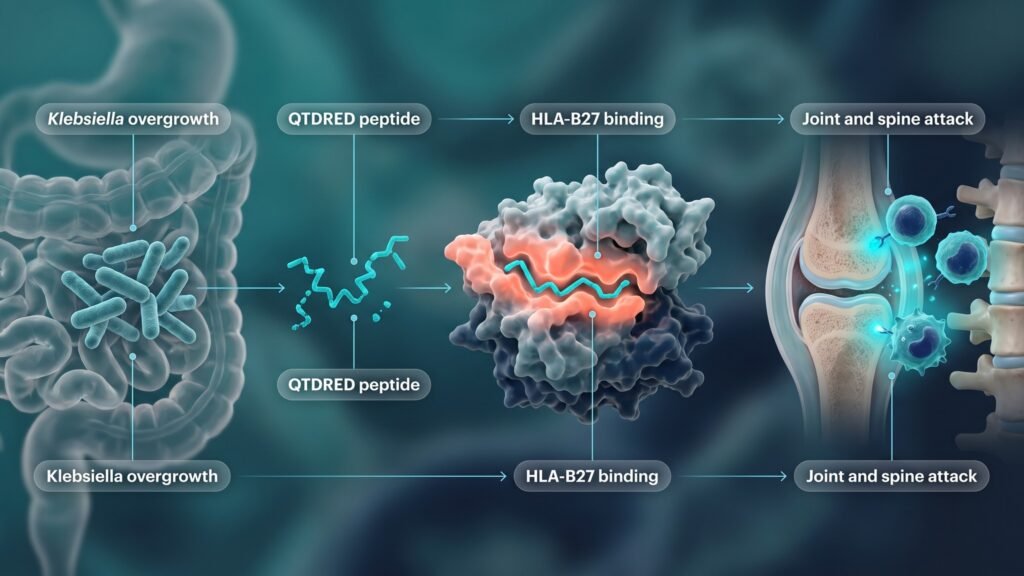
Kl. pneumoniae may be an initiating agent in ankylosing spondylitis. (Ebringer and colleagues, Annals of the Rheumatic Diseases, 1978)7
How was the pullulanase connection discovered?
A separate line of work identified the pullulanase system as a second cross-reactive target, next to nitrogenase. A secretion protein of this system shares the motif DRDE with HLA-B27, and the pullulanase enzyme shares a Gly-X-Pro motif with collagen.2 Pullulanase matters twice over here: once as an immune trigger and once as the enzyme that lets Klebsiella feed on starch, which is why diet becomes relevant later in this article. Increased gut permeability, sometimes called leaky gut, likely helps these bacterial antigens reach the immune system.
Antibodies to an HLA-B27 peptide containing the shared sequence were found in 29% of people with ankylosing spondylitis and 53% with Reiter's syndrome, against 5% of healthy HLA-B27 carriers. Over 40% of patients had antibodies to the matching Klebsiella nitrogenase sequence, while healthy carriers had none.1
None of this means every HLA-B27 carrier who meets Klebsiella develops ankylosing spondylitis, since genetics, gut permeability and how much Klebsiella overgrows shape the outcome together. Crohn's-like changes in the ileo-caecal region of the gut have also been described in ankylosing spondylitis, one more thread tying gut biology to spinal disease.6 What the shared sequence establishes is a specific, testable bridge between an ordinary gut bacterium and an autoimmune disease of the spine.
How often does Klebsiella show up in the gut in ankylosing spondylitis?
Klebsiella pneumoniae turns up in the stool more often in people with ankylosing spondylitis than in healthy people, and the link looks stronger during active disease. A 2022 meta-analysis of 25 case-control studies found Klebsiella in stool with an odds ratio of 5.65, and higher rates of IgA and IgG antibodies against it.8
Klebsiella in ankylosing spondylitis against healthy people (odds ratio)
Long 2022, meta-analysis of 25 case-control studies. An odds ratio of 1 means no difference.
Not every study agrees. In a 10-month British study, a Klebsiella exclusion diet did not change how often stool samples were positive, and carriage did not track with symptoms, ESR or IgA.5 This is why the link is best read as strong for a subgroup rather than universal.
In my own clinical stool PCR panels, Klebsiella overgrowth shows up in more than half of the people who come in with ankylosing spondylitis or a closely related autoimmune diagnosis. That is a clinical observation, and it lines up with what decades of published research keep finding. This kind of dysbiosis often carries no obvious digestive symptoms, which is part of why it goes unnoticed without targeted testing.
So i just got diagnosed with ankylosing spondylitis and im hla b27 positive, my functional med doctor ran a stool test and it came back with klebsiella overgrowth too, is that even related to my diagnosis at all
It's related more often than people expect. In my own stool panels, Klebsiella overgrowth shows up in more than half of the ankylosing spondylitis and related autoimmune cases I test. There's a real mechanism behind it too. HLA-B27 and specific Klebsiella proteins share a short stretch of amino acids, so your immune system can end up flagging your own joint tissue by mistake while it's fighting the bacterium. It's a real, testable piece of your puzzle, and worth bringing straight to whoever manages your ankylosing spondylitis care.
Do Klebsiella antibody levels differ in ankylosing spondylitis?
Yes, and the gap is large enough to be useful as a marker. Researchers tested serum IgG against a specific Klebsiella-derived peptide, and people with ankylosing spondylitis tested positive far more often than people with other forms of inflammatory arthritis, and healthy donors tested negative.3
Serum IgG against a Klebsiella-derived peptide (DPP121-145), share positive (%)
Puccetti 2017: 200 AS, 200 RA, 100 PsA and 100 healthy donors.
Do antibody levels drop with treatment?
They do, at least for the IgA class. In a 26-week double-blind trial of 84 people with ankylosing spondylitis, sulfasalazine lowered IgA antibodies against Klebsiella and E. coli, with 100 blood donors as controls.9 The fall in antibodies did not correlate with the clinical response, so the authors kept Klebsiella as a possible contributor rather than a proven cause.
IgG antibodies against the Klebsiella DPP peptide were present in 190 of 200 people with ankylosing spondylitis, 3 of 200 with rheumatoid arthritis and 1 of 100 with psoriatic arthritis, with no reactivity in healthy donors.3
Ive had ankylosing spondylitis for years and someone in a facebook group told me to cut out bread, pasta and potatoes because of some klebsiella diet thing, is that actually backed by real research, is it just another fad people push online
There's decades of research behind it, it's not a random internet trend. Klebsiella feeds on starch, and one of my favorite old findings is that Klebsiella grown on sugars reached about ten times higher counts than when it was fed amino acids instead. People on a low-starch diet for several months have shown drops in inflammation markers and IgA in published work. Some of the people I work with with ankylosing spondylitis report less stiffness within weeks of cutting starch hard, and the biology behind it holds up, although not every study agrees.
Does a low-starch diet help ankylosing spondylitis linked to Klebsiella?
A low-starch diet has measurable evidence behind it for ankylosing spondylitis. Since bowel microbes such as Klebsiella depend on dietary starch to grow, cutting starch goes straight at the bacterium's energy source.6
Klebsiella counts on sugars against amino acids (relative)
Rashid 2013, citing culture work: about ten times higher counts on glucose, sucrose or lactose than on eleven amino acids.
What does the low-starch diet restrict?
The diet cuts bread, potatoes, cakes and pasta,6 with rice, most cereals and refined sugar often added to the list. It keeps meat, fish, eggs, most vegetables, some fruit and dairy. It is a targeted starch restriction, meant to run for several months to give Klebsiella levels a real chance to fall.
What did the low-starch diet trials find?
The diet was developed and tested in London by Ebringer's group. It lowered total serum IgA in healthy people and in patients, and reduced inflammation and symptoms in people with ankylosing spondylitis.6 The authors noted that its role still needed further evaluation. A newer randomized trial at the University of Porto compared a low-starch diet with general healthy-eating advice in people with ankylosing spondylitis, with stool Klebsiella, ESR, CRP and disease activity as outcomes, but its results have not been posted.10
In 36 patients with active ankylosing spondylitis followed for nine months on a low-starch diet, most showed lower erythrocyte sedimentation rates and total IgA, and a lower need for anti-inflammatory drugs.4
What about calcium and other practical concerns on this diet?
Cutting bread and cereals removes a common fortified calcium source for many people, so dairy, leafy greens, tinned fish with bones and, where needed, a calcium supplement deserve attention on this diet. Ankylosing spondylitis itself carries some risk of osteoporosis, so tracking calcium and vitamin D belongs in the same plan.
What role do antibiotics or probiotics play against Klebsiella overgrowth?
Diet remains the best-studied approach for Klebsiella-linked ankylosing spondylitis, while antibiotic courses, sulfasalazine and probiotics play smaller, more situational roles beside it.

Antibiotic courses
Early attempts to clear Klebsiella with antibiotics showed limited benefit on their own, likely because the gut reseeds quickly once starch intake resumes.

Sulfasalazine
This disease-modifying drug lowered IgA antibodies to Klebsiella over 26 weeks in a controlled trial, alongside its known anti-inflammatory effect, although the antibody drop did not track the clinical response.9

Probiotics
Strains that compete with Klebsiella for space in the gut show early promise, and overlap with strategies used for SIBO, small intestinal bacterial overgrowth.
A comprehensive stool test that measures Klebsiella turns any of these into a targeted plan built on your own numbers, aimed at a more balanced gut microbiome over time.
What should you do next if you suspect Klebsiella is behind your symptoms?
Start with a comprehensive stool test that screens for Klebsiella overgrowth, since it looks at the mechanism directly. From there, an HLA-B27 result, a Klebsiella antibody panel and a low-starch trial of several months give you three concrete levers to discuss with your doctor.
Frequently asked questions
Klebsiella pneumoniae has the longest evidence trail.8 Gut and urinary infections with other bacteria are linked with reactive arthritis, a related condition.
The best-studied option is the low-starch diet, which limits bread, pasta, potatoes, cakes and refined sugar.6 It is meant for people with ankylosing spondylitis or related disease, not for every HLA-B27 carrier, and it works best planned with a doctor or dietitian.
Yes. Klebsiella antibodies have been studied in Reiter's syndrome, now called reactive arthritis, where antibodies to the shared HLA-B27 sequence were even more common than in ankylosing spondylitis.1
References
10 studies
- Schwimmbeck PL, Yu DT, Oldstone MB. Autoantibodies to HLA B27 in the sera of HLA B27 patients with ankylosing spondylitis and Reiter's syndrome. Molecular mimicry with Klebsiella pneumoniae as potential mechanism of autoimmune disease. J Exp Med. 1987.
- Fielder M, Pirt SJ, Tarpey I, et al. Molecular mimicry and ankylosing spondylitis: possible role of a novel sequence in pullulanase of Klebsiella pneumoniae. FEBS Lett. 1995.
- Puccetti A, Dolcino M, Tinazzi E, et al. Antibodies Directed against a Peptide Epitope of a Klebsiella pneumoniae-Derived Protein Are Present in Ankylosing Spondylitis. PLoS One. 2017.
- Rashid T, Wilson C, Ebringer A. The link between ankylosing spondylitis, Crohn's disease, Klebsiella, and starch consumption. Clin Dev Immunol. 2013.
- Shinebaum R, Neumann V, Hopkins R, et al. Attempt to modify klebsiella carriage in ankylosing spondylitic patients by diet: correlation of klebsiella carriage with disease activity. Ann Rheum Dis. 1984.
- Ebringer A, Wilson C. The use of a low starch diet in the treatment of patients suffering from ankylosing spondylitis. Clin Rheumatol. 1996.
- Ebringer RW, Cawdell DR, Cowling P, et al. Sequential studies in ankylosing spondylitis. Association of Klebsiella pneumoniae with active disease. Ann Rheum Dis. 1978.
- Long F, Wang T, Li Q, et al. Association between Klebsiella pneumoniae and ankylosing spondylitis: A systematic review and meta-analysis. Int J Rheum Dis. 2022.
- Nissilä M, Lahesmaa R, Leirisalo-Repo M, et al. Antibodies to Klebsiella pneumoniae, Escherichia coli, and Proteus mirabilis in ankylosing spondylitis: effect of sulfasalazine treatment. J Rheumatol. 1994.
- Universidade do Porto. Effect of a Low Starch Diet in Patients With Ankylosing Spondylitis. ClinicalTrials.gov NCT04386538.
Found this useful? Share it with someone who needs it.
Cite this article
Prevedoros, T. (2026, August 10). Is Klebsiella linked to ankylosing spondylitis?. Gut Pathways. https://gutpathways.com/articles/ankylosing-spondylitis-and-klebsiella/